South Korean lawmaker Park Jie-won of the Democratic Party has proposed recognizing North Korea as a ‘nuclear state’ as part of a three-step denuclearization process. His remarks have sparked fierce backlash from the conservative People Power Party (PPP), which condemned them as “anti-state rhetoric.”
Meanwhile, the Democratic Party distanced itself from Park’s comments, stating that they do not represent the party’s official stance.
During a speech at the National Assembly’s Korea Peninsula Peace Forum on February 20, Park said, “As North Korea’s nuclear capabilities continue to advance, neither irresponsible nor unrealistic calls for nuclear armament will ensure South Korea’s security or gain international support.”
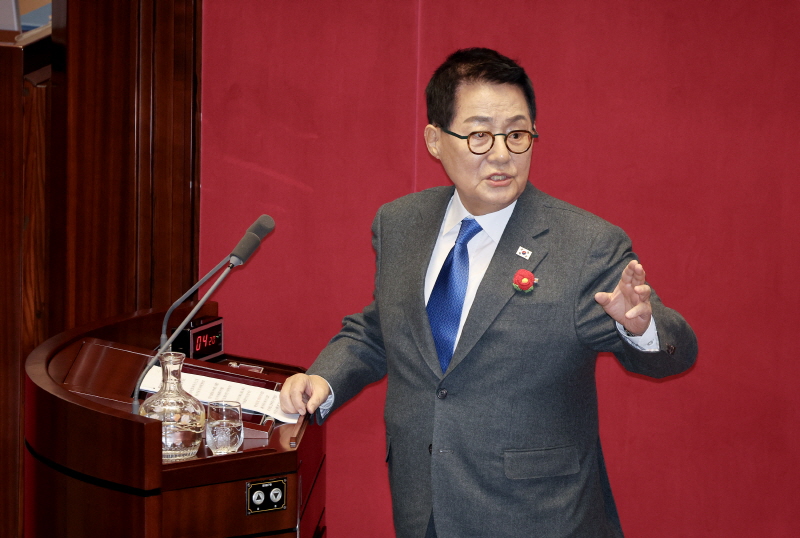
Park proposed a three-step approach to denuclearization, beginning with the formal recognition of North Korea as a nuclear state. In the second step, he suggested encouraging Pyongyang to rejoin the Nuclear Non-Proliferation Treaty (NPT) and agree to freeze its nuclear program under inspections by the International Atomic Energy Agency (IAEA). As the final step, he advocated guaranteeing the security of the North Korean regime and lifting economic sanctions in exchange for normalized diplomatic relations between Pyongyang and Washington.
Park also criticized the Yoon Suk Yeol administration for failing to respond to shifts in U.S. policy. He noted that both the Republican and Democratic parties in the U.S. removed the term “North Korean denuclearization” from their official platforms during the last presidential campaign.
“As expected, President Trump referred to North Korea as a ‘nuclear power’ shortly after taking office on January 20,” Park said. “The likelihood of a major shift in U.S. policy toward North Korea is higher than ever.”
Conservative Party Condemns Proposal as “Anti-State”
The PPP strongly denounced Park’s proposal. The party’s chief spokesman, Shin Dong-wook, issued a statement calling Park’s proposal “an anti-state argument that abandons national security and advocates for North Korea’s position.”
“It is utterly unacceptable for a South Korean lawmaker—who should be prioritizing national security—to legitimize North Korea’s nuclear weapons program,” Shin said.
He warned that recognizing North Korea as a nuclear state would set off a nuclear domino effect in Northeast Asia and permanently leave South Korea hostage to North Korea’s nuclear threats.
Democratic Party Distances Itself
The Democratic Party sought to clarify that Park’s views were not coordinated with party leadership.
When asked whether Park had consulted with party leaders before making his remarks, Chief Spokesperson Cho Seung-rae responded, “No, he did not. It appears to be his personal opinion.”
Cho also suggested that Trump’s reference to North Korea as a “nuclear power” did not necessarily indicate that the U.S. was granting official recognition of its nuclear status but rather acknowledging the reality of its nuclear capabilities.
“It is unclear whether Park was advocating for the formal recognition of North Korea as a nuclear state or simply acknowledging its nuclear reality,” Cho added. “We need to examine his remarks more closely before making an assessment.”
However, Cho reaffirmed South Korea’s commitment to denuclearization, stating, “Our ultimate goal remains the denuclearization of the Korean Peninsula. Some argue that we should pursue nuclear armament in response to North Korea’s nuclear capabilities, but that is a dangerous idea.”
BY JAESUNG BAE, YOUNGNAM KIM [kim.youngnam@koreadaily.com]