Many K-pop groups have been making the effort to fuse Korean culture, both traditional and modern, into their artistry, with efforts ranging from costumes and props to their musical sound and lyrics.
From outfits inspired by Korea’s traditional hanbok dress, as worn by NewJeans and Blackpink, to melodies using Korean traditional instruments, like in the music of Agust D, and lyrics using Korean folklore, in the case of IVE, the effort to instill Korean culture in the homegrown genre continues to be a successful endeavor — one that brings the world closer to Korea through the power of music.
History, heritage and hanbok
In the highly visual and performance-oriented art form that is K-pop, clothing is an element that stands out to most fans. In line with this, hanbok is a significant way of spreading Korean culture through clothing. This was evident when NewJeans performed at Gyeongbok Palace in central Seoul as a part of the “2024 Korea On Stage – New Generation” concert.
The concert celebrated the former Cultural Heritage Administration rebranding itself as the Korea Heritage Service (KHS). To go along with the occasion, NewJeans was clad in stylish hanbok, modified to fit modern sensibilities.
Danielle said she wants to do her “small part in promoting and protecting” her Korean heritage during the event. The singer was born in Australia and raised in Korea, which allowed her to experience “both the cultures of the East and the West,” a sentiment well-reflected in her clothing.
![Danielle of NewJeans takes to the stage. [TREVOR TREHARNE]](https://koreajoongangdaily.joins.com/data/photo/2024/06/02/bfd34f55-dfa4-451d-a5f7-874999abed58.jpg)
Danielle, who hosted the show, was seen in a high-waisted, bright pink skirt and a purple Korean jacket, known as jeogori, weaved with organza. Minji, Haerin and Hani wore lighter tops with frilled hanbok skirts. The uniquely Korean vibe fused with Western sensibilities could be seen through the composition of their hanbok outits.
Happly, the Korean clothing company that designed Danielle’s attire, took to Instagram to explain the philosophy behind the design. The idea was to “reinterpret hanbok in balletcore, giving the dress a tutu-like flair,” according to the company.
Girl group Blackpink has also flaunted the hanbok look in the past.
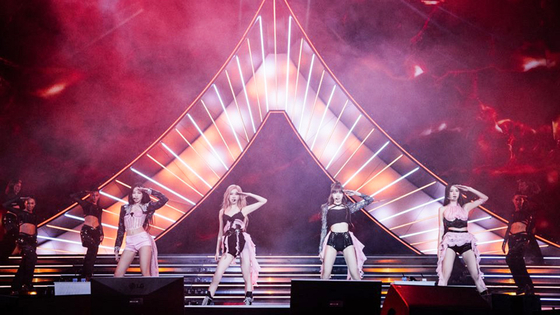
When girl group Blackpink headlined the Coachella Valley Music and Arts Festival Music festival in 2023, CNN stated that the girl group’s performance will “go down in history.” It also highlighted Blackpink’s hanbok outfits at Coachella in the online edition of its fashion-oriented segment, “Look of the Week.”
The four modern hanbok outfits that Blackpink wore on stage at the time were customized by Korean pattern design brand OUWR and traditional hanbok brand Kumdanje. Inspired by cheollik, uniforms for military officers of the Joseon Dynasty, the outfits embroidered with traditional Korean patterns were designed with both aesthetics and utility in mind.
The design symbolized “harmony between the modern and traditional,” according to designer and CEO Chang Ha-eun of OUWR.
The stage costumes displayed patterns inspired by dancheong and peony flowers. Dancheong is a pattern unique to Korea and is often used in traditional architecture, with its prominent assortment of colors. Both dancheong and peony flowers were loved by the Korean royal family in ancient times.
Ten symbols of longevity in Korean folklore — rocks, water, clouds, the sun, pine trees, turtles, deer, cranes, bamboo and fungus — were also incorporated into Blackpink’s costumes. Blackpink also wore traditional jewelry and mother-of-pearl brooch accessories.
![Scene from Agust D's music video of ″Daechwita.″ [SCREEN CAPTURE]](https://koreajoongangdaily.joins.com/data/photo/2024/06/02/ad8da2fd-3660-46a4-8050-5a5ab715c65d.jpg)
The sound of gugak
The traditional Korean aesthetic can also go deeper than the live stage, often being found in the music itself. One of the most well-known examples of this is Agust D’s single “Daechwita” (2020) from his second solo mixtape “D-2” (2020). The track is built around gugak motifs, a type of traditional Korean music.
“Daechwita” takes its title from a traditional Korean military march. The track incorporates an actual traditional performance in its intro, which was performed by the National Gugak Center. The song begins with the sounding of traditional Korean percussion and transitions to a modern hip-hop beat with bass-oriented trap drums.
The Korean horns complement the hook, which repeats the title in an addictive manner. The traditional Korean sonic backdrop creates a laid-back aggression that complements Agust D’s grounded rap performance perfectly.
![BTS's Suga, under his other stage name Agust D, released his song ″Daechwita,″ which has strong gugak (traditional Korean music), in May 2020. [BIG HIT MUSIC]](https://koreajoongangdaily.joins.com/data/photo/2024/06/02/8a8b86b5-42bd-4074-b130-d6716a3511f6.jpg)
The mixtape, “D-2,” topped the iTunes albums chart in 66 countries, with “Daechwita” ranking No. 1 on the singles charts of 19 countries upon its release. The album was ranked 76 on the Billboard 200 album chart, with “Daechwita” reaching the 11th spot of the Billboard 200 singles chart.
“D-2” was described by Billboard as a “sonic reliquary,” a fitting statement for the way that it captures not only Korean sounds, but also Korean lyrics.
Aside from “Daechwita,” the song “That Moon,” which serves as the intro to the whole project, is an album opener outlining the artist’s thoughts and emotions. The song is a reflection of the path that Agust D has taken. The first verse opens with the lyrics, “My beginning was humble, Daegu, Namsan-dong basement,” followed by, “Now I’m in a penthouse, Hannam The Hill.”
The lyrics show the artist’s class struggle by explicitly mentioning Korean locations. This type of expression will have many fans curious about the lyrics, their meaning and their inspiration.
Agust D’s fusion of gugak with modern hip-hop was well-made and globally well-received, but not entirely new. There have been many but, at the same time, underappreciated attempts in the K-pop industry to fuse gugak with contemporary music.
![G-Dragon performing ″Niliria″ with Missy Elliott at KCON 2013 [CJ ENM]](https://koreajoongangdaily.joins.com/data/photo/2024/06/02/607da12f-0495-4755-9525-4b9b32a88778.jpg)
Then, there was G-Dragon, who began his career in the mid-2000s.
The Big Bang member released his second full-length studio album, “Coup D’etat” (2023), which featured the song “Niliria,” a collaboration with U.S. rapper Missy Elliott. The beat samples the traditional Korean folk song “Niliria,” which was composed in the late Joseon period.
The song starts off with hip-hop horns juxtaposed by the traditional Korean sample. It then opens up with an energetic verse by Elliott. The storm of rattling hi-hats and cracking snare bursts amplify the chaotic and exuberant nature of the original sample, showcasing producer Teddy Park’s witty understanding of the source material at hand.
G-Dragon’s lyrics are also delivered with a relaxed flow that makes the verses stand out in contrast to the beat. The short phrase, “Proud of Korea,” kicks down the door, followed by, “This is international diplomacy,” referencing the multicultural nature of the song.
Once upon a time in K-pop
Agust D and G-Dragon’s lyrics tend to use the Korean language to flex achievements, including international recognition and success. However, other groups have taken a different approach, using the storytelling aspects of the Korean language to tell folk stories.
![Scene from a music video of IVE's ″HEYA.″ [SCREEN CAPTURE]](https://koreajoongangdaily.joins.com/data/photo/2024/06/02/532bfdae-ec4b-45b4-8d4e-7934b9ff0bb5.jpg)
One example is IVE’s new song “HEYA,” released on April 29 this year. It is the lead track for its new EP, “Ive Switch.” The groovy song, with driving drums and flourishes of piano arpeggios, is a reimagining of the tragic Korean folk tale, “The Tiger Who Loved a Human.”
The original story is about a man named Kim Hyun and a woman disguised as a tiger who fall in love with each other. “HEYA” reimagines the story in the perspective of the woman. Its lyrics allude to a tiger enticing its prospective partner, with phrases like “eat you up in one bite.”
The music video reflects the lyrical theme as well. It follows the story of a tiger trapped in an ice prison, teaming up with the sun to escape. The tiger later performs jwibulnori, a Korean ritual involving swinging a flaming can filled with hay that is connected to a string. The ritual was traditionally done to burn the harvest fields and renew the soil.
![A scene from IVE's music video "HEYA." [SCREEN CAPTURE]](https://koreajoongangdaily.joins.com/data/photo/2024/06/02/50a58656-410f-4d4b-9c59-37001c2bdf19.jpg)
Other subtle details in the song and music video show a deep appreciation for Korean culture. The chorus lyric, “Heya,” is lifted from a Korean folk song calling for the sun to come up. Ahn Yu-jin is smoking a Korean pipe in the video, an allusion to a trope in Korean folklore where stories started with the phrase, “When tigers used to smoke pipes.” This is the Korean equivalent to the phrase, “A long, long time ago.” The subtle details make the story even more convincing.
“Ive Switch” ranked No. 2 on the Melon Top 100 album chart, and the song “HEYA” reached No. 13 on the Melon Top 100 singles chart. Over 1.3 million copies of “Ive Switch” were sold in the first week of release.
“There is a demand not just for K-pop but the charms of Korea as a country,” said pop music critic Lim Jin-mo. “More deliberate musical experiments in K-pop will push the genre forward and fuse it better with traditional Korean culture.”