Rental Scams in California are becoming increasingly sophisticated, with fraudsters advertising homes below market rates and collecting application fees or security deposits before prospective tenants ever see the property. Scammers are copying photos and descriptions from legitimate listings, posing as landlords and, increasingly, using artificial intelligence to make their impersonations more convincing.
According to the Federal Trade Commission (FTC), about 65,000 rental scams were reported from 2020 through the first half of 2025, resulting in approximately $65 million in reported losses. The median reported loss was $1,000.
Social media has emerged as a major gateway for these schemes. An FTC analysis of rental scam reports filed between July 2024 and June 2025 found that, among cases where the platform could be identified, nearly half began with fraudulent rental advertisements on Facebook. Craigslist accounted for another 16%.
Rental Scams in California Target Real Homes
A common tactic involves stealing photos and information from legitimate property listings — or even homes that are currently occupied — and using them to create fake rental advertisements. Scammers then pose as landlords or real estate agents to collect money from prospective tenants.
Ethan Baik, president of the Korean Real Estate Brokers Association of Southern California (KREBASC), said scammers sometimes use legitimate listings or occupied homes to pose as property owners. In other cases, they may enter vacant properties and pretend to be the owner while collecting security deposits or other upfront payments.
Baik said fraudulent listings can appear not only on real estate platforms such as Zillow but also on community websites and social media.
“Some platforms allow listings to be posted without extensive verification, so renters need to be especially cautious,” he said.
The Los Angeles Times also reported on Aug. 10 that rental scams involving stolen photos and descriptions from legitimate listings are becoming more common across California. Fraudsters often change only the contact information before posing as landlords or real estate representatives.
Fullerton Renter Loses $2,575
In a recent case in Fullerton, Orange County, 53-year-old Pam Yeager lost $2,575 after responding to a fraudulent rental listing.
Yeager found a two-bedroom rental on Zillow last month that was priced somewhat below the local market rate. The property, however, was not actually available for rent — the owner was living there.
The scammer had taken photos and videos from an earlier listing for the property and claimed that a current tenant was still living inside, using that explanation to avoid showing Yeager the home.
Without seeing the property in person, Yeager sent a $75 application fee and a $2,500 security deposit through Zelle. When the scammer later demanded the first month’s rent, she became suspicious and asked for her money back. The scammer then stopped responding.
Similar fake listings have surfaced elsewhere in California.
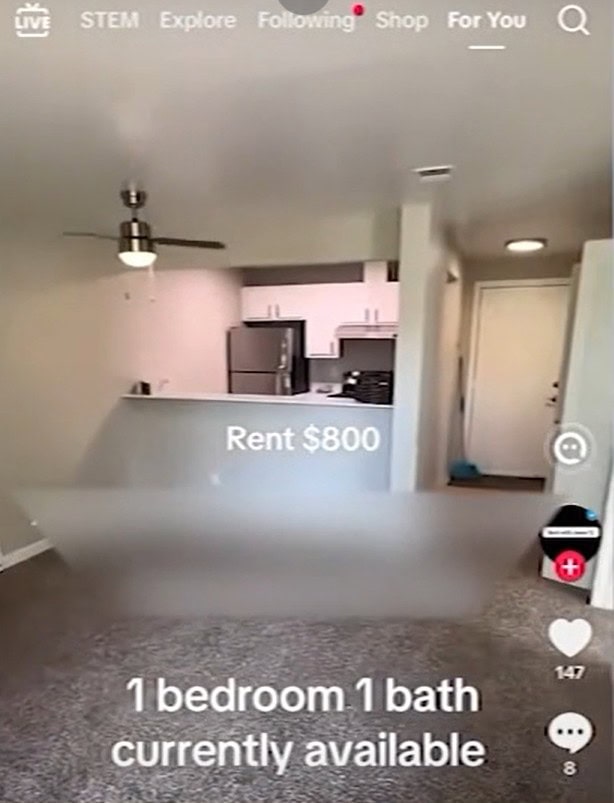
In San Leandro, a homeowner discovered that his occupied home had been advertised on TikTok in June as a rental for $800 per month, according to ABC7 News. About eight similar fraudulent listings were found in the same neighborhood.
In San Diego’s Mira Mesa neighborhood, a fake Facebook rental advertisement surfaced in April using photos and descriptions copied from a legitimate Zillow listing. The scammer demanded $75 to $80 before allowing prospective renters to see the property.
AI Makes Rental Fraud More Convincing
Artificial intelligence is adding another layer of sophistication to real estate fraud.
The National Association of Realtors (NAR) warned on Aug. 3 that criminals are increasingly using AI to fabricate videos, voices, identification documents, income records and property ownership documents.
Scammers can clone the voice of a landlord or real estate agent and even use deepfake video during virtual meetings, making it increasingly difficult for renters to determine whether the person they are dealing with is legitimate.
How Renters Can Avoid Fake Listings
Experts say renters should never send money before verifying both the property and the identity of the person offering it.
Prospective tenants should compare the address, rental price, photos and contact information across multiple real estate websites. They should also independently verify the identity of the property owner or real estate agent rather than relying solely on information provided in an online advertisement.
Requests for application fees or security deposits before a property can be viewed should be treated as a major warning sign. Renters should also be cautious when someone pressures them to transfer money quickly, particularly through payment services that may make funds difficult to recover.
Personal information should not be provided until the identity of the landlord or agent has been independently verified.
As Rental Scams in California grow more sophisticated through social media and AI, experts say one of the most effective defenses remains simple: verify the property, verify the person and see the home before sending money.