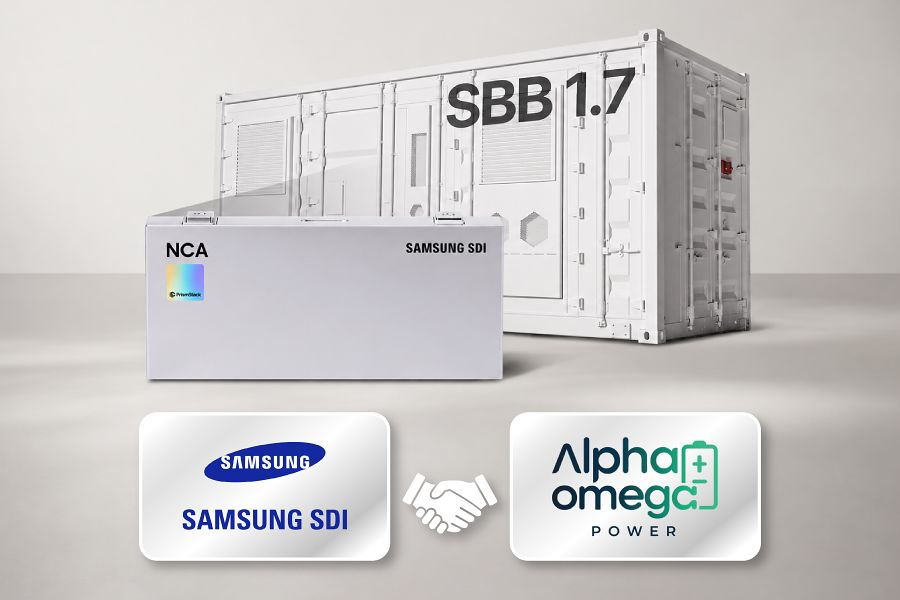
In the U.S. energy storage system (ESS) market, traditionally dominated by lithium-iron-phosphate (LFP) batteries, Samsung SDI has successfully secured a large-scale supply contract utilizing ternary batteries.
Samsung SDI announced on October 26 that its Americas subsidiary (SDIA) has signed an ESS solution supply contract with the U.S. energy firm Alpha Omega Power (AOP) for a capacity of 1 gigawatt-hour (GWh). Combined with a previous phase-one contract late last year, the total volume reaches 1.5 GWh. The supply will be delivered within the year, and AOP plans to deploy it in a large-scale power project breaking ground in Texas next year.
While the contract amount is private, industry observers estimate the price of ESS solutions at roughly $160 to $200 per kilowatt-hour (kWh). For 1 GWh, this translates to $160 million to $200 million, or approximately 210 billion to 260 billion Korean won.
Batteries are classified into types like prismatic and pouch depending on how the cell is encased. The batteries supplied by Samsung SDI this time are prismatic batteries. Prismatic cells are enclosed in a hard metal can, offering greater impact resistance and higher fire safety compared to pouch types housed in thin film pouches. Among non-Chinese battery manufacturers with North American production facilities, Samsung SDI is the only one producing prismatic batteries for ESS applications.
The product being supplied is not just a standalone cell, but a solution called ‘SBB (Samsung Battery Box) 1.7’. It packs not only prismatic battery cells but also cooling and fire-suppression systems, along with battery management software, into a container approximately 6 meters long. Unlike the method of delivering only battery cells, this integrated approach minimizes the need for clients to assemble multiple devices separately, making installation much simpler.
The battery chemistry relies on nickel-cobalt-aluminum (NCA) ternary cells. ESS applications with fewer spatial constraints typically utilize LFP batteries, which are cheaper and have longer lifespans. However, although ternary batteries are more expensive, they pack more electricity into the same space and deliver instant high power. Power grids must maintain a stable frequency (60Hz) by balancing supply and demand; when imbalances occur due to power plant failures, ESS systems instantly discharge or absorb electricity to correct it. Company officials explain that ternary batteries are advantageous for projects requiring massive power output in short bursts.
Production will be handled by StarPlus Energy (SPE), an Indiana-based joint venture factory between Samsung SDI and Stellantis. Although originally an electric vehicle battery plant, some lines have been repurposed for ESS production since October of last year to navigate a temporary slowdown in U.S. EV demand. Fabrice Hudry, head of the SDIA ESS team and vice president, stated, “We will continue to expand our business foundation in the North American ESS market through differentiated technological competitiveness and local production.”