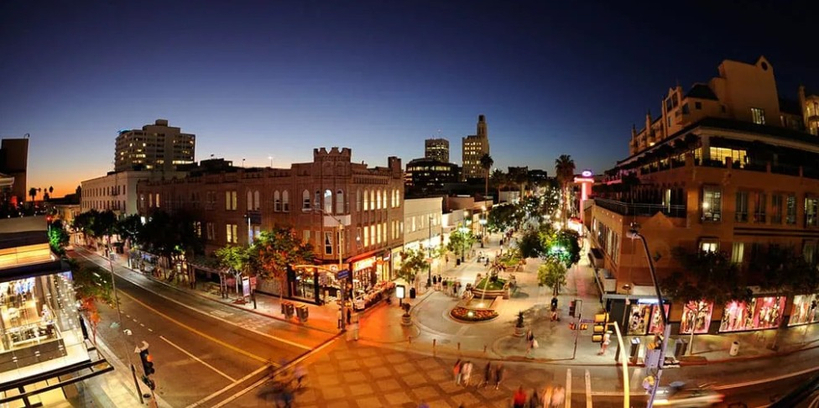
Korean tourists visiting Los Angeles never missed checking off the essential pilgrimage site of the Santa Monica 3rd Street Promenade, which has now fallen into the swamp of an unprecedented economic slump.
The vitality of enjoying shopping and busking while feeling the ocean breeze has disappeared, and only desolate empty businesses are increasing in corners of the commercial district.
On the 6th, the Los Angeles Times cited a recent report by the RAND Corporation, a think tank, reporting that currently more than 11% of all commercial spaces in Santa Monica are in a vacant state. As much as 45% of all vacant commercial spaces were concentrated in the 3rd Street Promenade and Santa Monica Place shopping mall, where tourists used to flock.
Compared to neighboring wealthy commercial districts, Santa Monica’s shadow grows even darker. West Hollywood’s commercial vacancy rate stood at 9.2%, Beverly Hills at 6%, and Culver City at only 5.2%, all receiving much more favorable report cards than Santa Monica.
The two pillars supporting the Santa Monica economy—retail and food service—suffered direct hits.
According to the report, last year’s apparel and accessory sales in Santa Monica plummeted by a staggering 75% compared to 2015. Over the same period, food service sales, including restaurants, also dropped by 24%. In other words, the city’s overall sales revenue itself has been shaved down to about one-third of what it was before the pandemic.
The local government’s coffers are also running empty. Santa Monica’s tax revenue staged a surprising recovery to 89% of 2015 levels back in 2021, but it subsequently slumped again, plunging to the 60% level early this year. The report cited the consecutive departure of large anchor retail stores like Nordstrom, which sustained downtown commercial districts, as the direct cause of the blow.
In contrast, competing commercial districts like Beverly Hills, West Hollywood, and Culver City saw sales plummet immediately after the pandemic, but completely recovered to pre-pandemic levels as early as 2021, showing a stark contrast.
Experts analyze that this current saga of Santa Monica is not merely due to an economic recession, but the result of a combination of factors including an economic structure overly dependent on tourists, changing consumer shopping patterns, and worsening safety and homeless issues.
Originally, Santa Monica grew rapidly by opening the wallets of overseas tourists using its beautiful beach, pier, and 3rd Street Promenade as weapons. However, with the unfavorable factor of the pandemic cutting off tourist footsteps and online-centered shopping habit shifts sweeping through, its existing economic model began to shake to its roots.
According to Santa Monica Tourism Board tallies, annual visitors, which reached 8.41 million in 2019 right before the pandemic, shriveled to 3.9 million last year. That is less than half. Accordingly, spending left behind by tourists also plummeted from $1.89 billion to $996.6 million over the same period.
Complaints about homeless people spilling onto the streets and deteriorated safety are also acting as stumbling blocks to commercial district recovery. According to the report, although the total number of homeless people in Santa Monica decreased slightly this year, crime and homelessness problems concentrated precisely on beaches and downtown commercial districts crowded with tourists, causing the anxiety felt by visitors to grow much greater.
In fact, it was found that as much as 70% of all assault and robbery incidents occurred concentrated in some hotspot areas accounting for a mere 5% of the city’s total area.
The city of Santa Monica, facing an emergency, decided to urgently inject a budget of $3.0 million to revive the 3rd Street Promenade. The plan is to consecutively hold large-scale public events such as outdoor concerts and sports viewing events to draw people back in.
Mayor Caroline Torosi emphasized that to ease the burden on small business owners, water and parking costs have been lowered, business permit procedures have been drastically simplified, and police foot and bicycle patrol deployments in the downtown area have been significantly expanded.
Mayor Torosi expressed her determination to revive the commercial district, stating that Santa Monica is still operating normally and better times lie ahead.