Stripped to the Studs: First Impressions of the Anti-Tech Cockpit
Experiencing an electric vehicle that proudly boasts a sub-$25,000 price tag is one thing on paper; riding shotgun in it on public streets is another entirely. Following Slate Auto’s major vehicle rollout at its Gardena design studio, we secured an exclusive first ride alongside a company engineer to see if this ultra-budget EV lives up to its immense pre-order hype.
Up close, the truck looks remarkably distinct. While it features compact dimensions, the hood stretches forward aggressively, capturing a classic, retro-American pickup silhouette. The heavy use of straight geometric lines makes it look like a sharp, modern reinterpretation of an 80s compact truck.
The first hint of its build quality comes before even turning the key. Closing the heavy driver-side door doesn’t produce the hollow, tinny sound typical of cheap economy cars. Instead, it hits with a solid, mechanical thud—a deliberate structural choice by the engineering team.

The Screenless Dashboard and the Return of the Window Crank
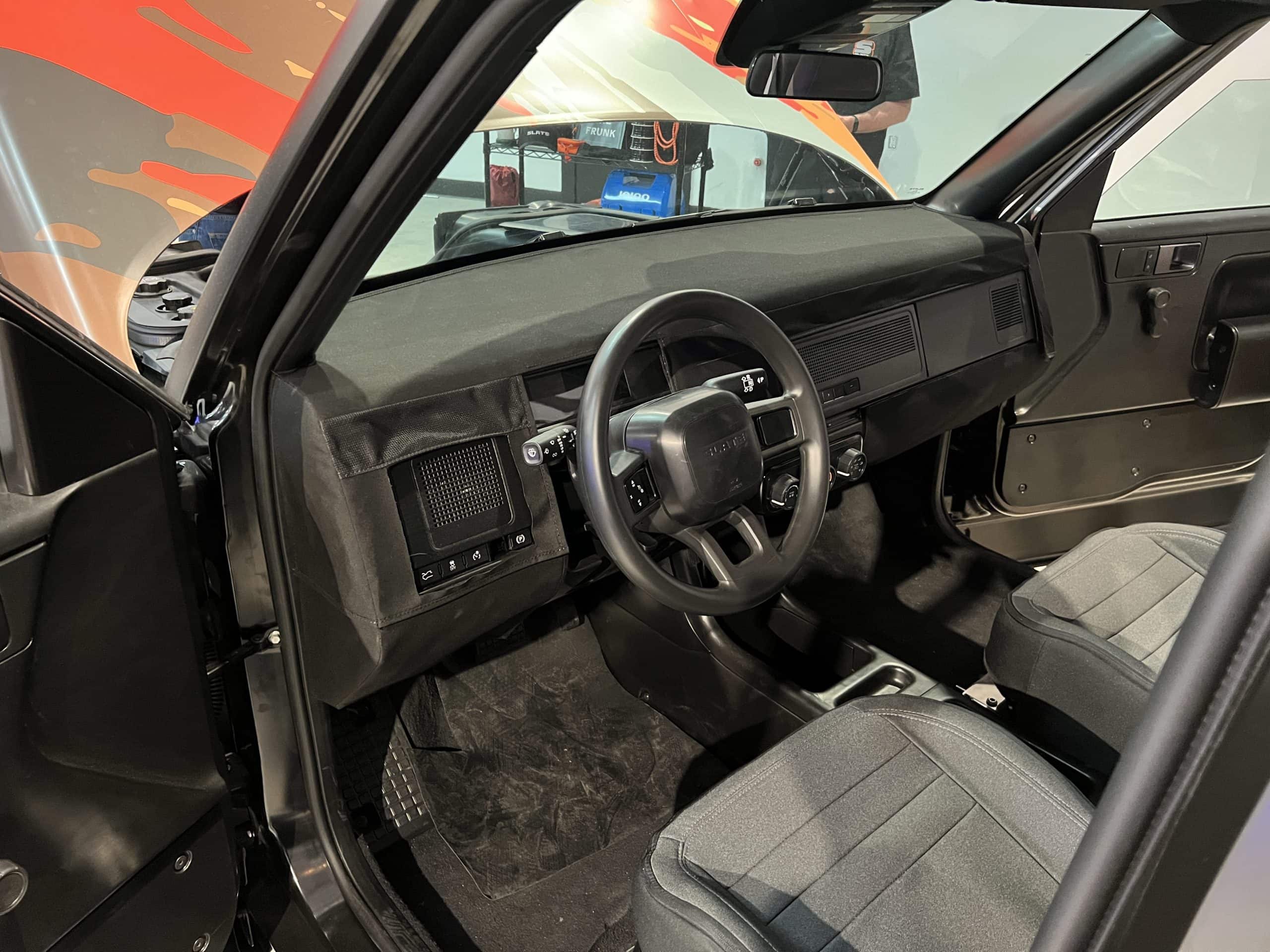
Step inside, and the interior immediately exposes exactly how Slate achieved its impossible $24,950 base price. The cabin is a masterclass in minimalism, leaving behind only the absolute bare essentials.
The most jarring omission is the complete absence of a central infotainment screen. In its place sits a rugged, universal smartphone mount. If an owner wants a permanent digital tablet interface, they have to purchase it as a separate hardware module.
The forward dashboard area consists of just three tactile analog dials for climate control and a deep storage cubby. Perhaps the most symbolic nod to the “anti-technology” ethos is the window mechanism: manual hand-crank windows. While rotating a mechanical lever to lower a window feels bizarre in a modern EV, it perfectly embodies Slate’s philosophy of eliminating electronic complexity to drive down consumer costs.
The Material Trade-off: While the cabin feels spacious, the heavy cost-cutting is noticeable. The high-frequency touchpoints, such as the climate dials and turn signal stalks, are finished in a rigid, lightweight plastic that feels encoding cheap. Because our test vehicle was a pre-production prototype, we will have to wait and see if final production line quality improves.
On the Road: Lightweight Agility and Real-World Physics
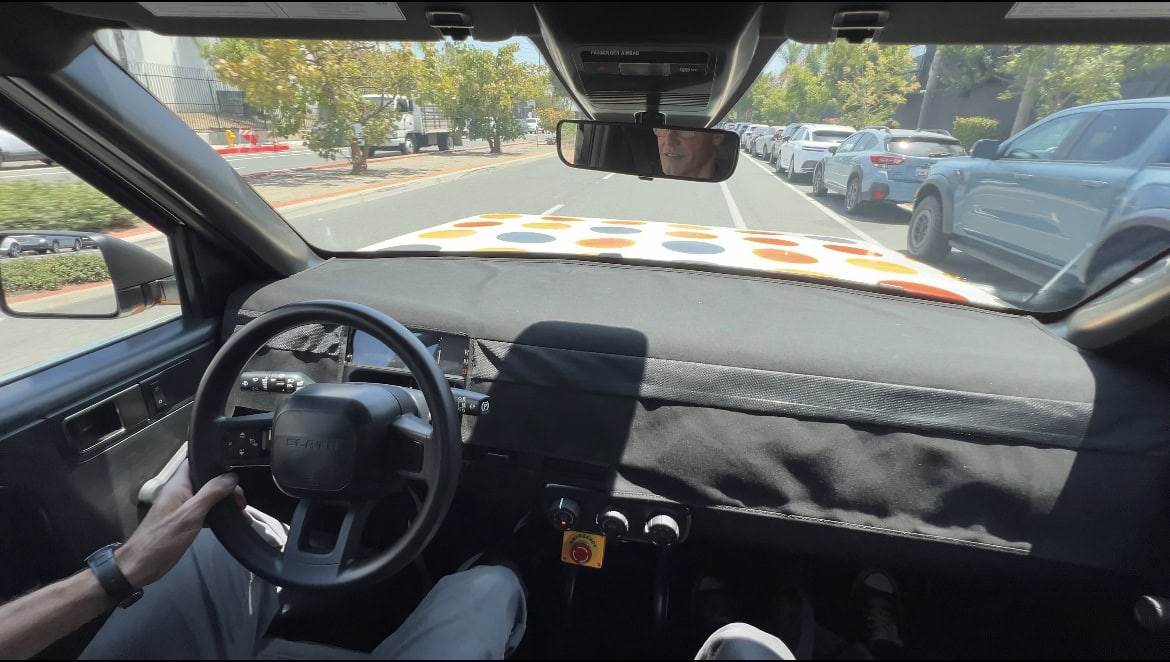
When the engineer cracked the throttle on the city streets surrounding the Gardena studio, the truck moved with surprising urgency. Power is sent exclusively to the rear axle via a single electric motor generating 181 horsepower and 195 lb-ft of torque. Thanks to the instant torque delivery native to electric powertrains, the truck pulled cleanly away from stops, scaling up to 50 mph without any noticeable hesitation. The factory-claimed 0-to-60 mph time of 8.0 seconds feels completely accurate and is more than adequate for everyday urban commuting.
The braking system behaves predictably, offering linear, progressive stopping power that avoids the jerky regenerative braking sensations common in first-generation EVs.
The suspension layout also delivered a surprisingly refined ride. The truck absorbed minor potholes and uneven pavement ripples smoothly, keeping the chassis well-planted. However, because it is fundamentally a lightweight truck chassis, a true test of its suspension tuning will require driving it under a full 1,550-pound payload or evaluating it after installing the heavy SUV conversion kit. At low speeds, cabin isolation was excellent, though noticeable wind noise began creeping past the A-pillars once we pushed past 45 mph.
The Modular Catch: When the Base Price Skyrockets
The most brilliant design choice behind Slate is that it isn’t sold as a finished car, but rather as a highly adaptable platform. However, this business model introduces a massive financial caveat for the consumer.
While the $24,950 starting sticker is incredibly compelling, the total transactional price escalates quickly as you piece the truck together. Converting the 2-seat bed into a 4-passenger Squareback SUV costs an extra $5,000 right out of the gate. Factoring in basic interior speakers (which are not standard), a locking center console, a lift kit, and upgraded all-terrain tires quickly burns through your savings. In fact, the fully optioned model displayed on the Gardena stage carried a final price tag of $35,000—a massive $10,000 premium over the advertised base price.
Additionally, the final battery specification was capped at a single 63 kWh usable LFP pack yielding 205 miles of range, officially replacing earlier internal hopes of an optional 240-mile NMC battery upgrade. Its 120 kW DC fast-charging speed, which replenishes the pack from 20% to 80% in roughly 30 minutes, is perfectly average by modern standards.
Ultimately, if you approach Slate Auto looking for a basic, zero-frills electric work vehicle to handle light utilities, it represents an unbeatable value proposition. It is explicitly not trying to be the fastest or most high-tech vehicle on the block. Instead, by giving consumers a blank canvas to build upon as their budget grows, Slate has carved out an ingenious survival strategy in an increasingly cutthroat automotive landscape.