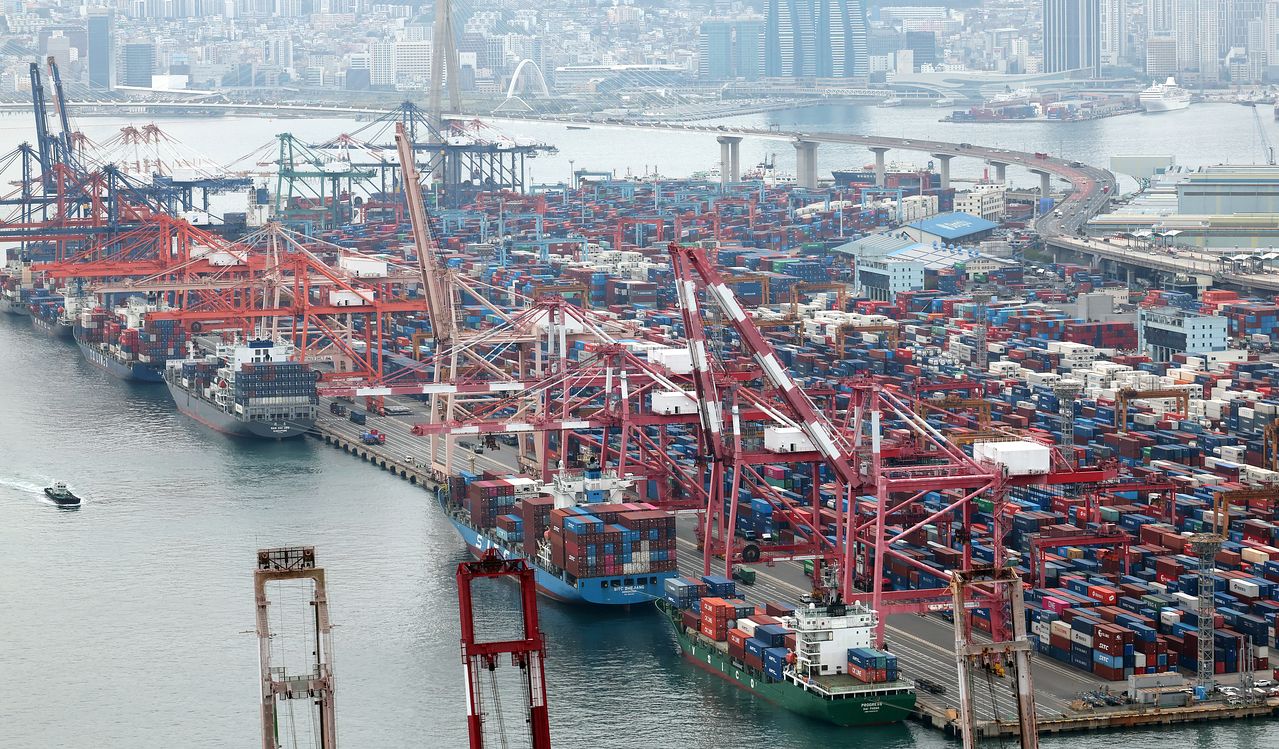
South Korea’s South Korea current account surplus in the second quarter of this year exceeded the combined surpluses of manufacturing powerhouses Germany and Japan, marking a historic first since related statistics began being compiled. This milestone was driven by a semiconductor-led export boom. While projections suggest the record surplus streak will continue for the time being, experts point out that the country must accelerate industrial diversification amid intensifying competition from China.
According to the International Monetary Fund (IMF) major economies’ current account statistics via the Bank of Korea’s Economic Statistics System on the 25th, South Korea’s Q2 current account surplus was tallied at $116.63 billion. Among 36 major countries with confirmed Q2 figures, this was the second-largest scale following China ($193.724 billion). Germany ($52.28 billion) and Japan ($50.62 billion) followed. The combined total of the two nations stood at $102.892 billion, which was $13.737 billion lower than South Korea’s.
This is the first time since the first quarter of 1996—when statistics for all three nations became simultaneously available—that South Korea’s current account surplus has surpassed the combined total of Germany and Japan. The gap with Germany widened to $64.354 billion, the largest since records began in 1976. The gap with Japan also reached $66.015 billion, the widest since 1996. South Korea’s Q2 surplus swelled 4.1-fold compared to the same period last year ($28.386 billion), whereas Germany and Japan only saw modest increases of 11.9% and 5.0%, respectively.
Semiconductor Export Boom Fuels Historic Surplus
The record-breaking expansion of the current account surplus was spearheaded by rising semiconductor prices and the resulting export boom. According to the National Data Agency, semiconductor exports in the second quarter surged 181.6% year-on-year to $113.89 billion. In the third quarter, they skyrocketed by 218.7% to $148.02 billion. Higher semiconductor prices created an effect where the same volume of goods generated significantly larger export revenues. Through September, $340.3 billion came from semiconductors, accounting for 41.8% of South Korea’s cumulative total exports ($814.5 billion).
This positive trajectory is expected to continue. The IMF’s projection for South Korea’s annual current account surplus this year stands at $421.946 billion, the second highest among 190 countries and regions behind China ($863.205 billion). In terms of growth magnitude, South Korea’s $298.892 billion increase outpaces China ($138.803 billion), ranking it first globally. Consequently, the surplus-to-GDP ratio is projected to hit a record 18.8%—the highest since IMF statistics began in 1980—far outperforming major economies like China (4.0%), Germany (4.5%), and Japan (4.6%). Some projections even suggest the annual surplus could approach $500 billion, roughly four times last year’s historic record of $123.1 billion.
Challenges Ahead: Industrial Polarization and Over-Reliance
While this is a historic achievement, experts warn against complacency. Beyond concerns over a potential semiconductor bubble, the widening polarization between semiconductors and other industries poses a serious challenge. Automobiles and batteries face mounting uncertainties due to slowing electric vehicle demand, aggressive Chinese market penetration, and tariff barriers. Shipbuilding and defense industries are also squeezed between China’s aggressive pricing and regulatory pressures from the US and Europe, raising worries over slowing order intakes. Meanwhile, the petrochemical sector is enduring a harsh period as the global oversupply glut prolongs.
The IMF projected that South Korea’s current account surplus will remain above $400 billion through next year, but expects it to decline to $295.656 billion by 2029 and $177.491 billion by 2031. Experts have also echoed the need to guard against excessive optimism. Yang Jun-seok, a professor of economics at Catholic University of Korea, noted, “The recent surplus is thanks to semiconductor pricing rather than volume. If price competition intensifies, the economy will inevitably take a hit.” Kim Kwang-seok, head of the economic research division at the Korea Economic Industry Research Institute, added, “As various countries pursue self-sufficiency in semiconductors, our market share could face downward pressure.”
Suggestions have also emerged that the windfall from the surplus should be utilized to improve economic fundamentals. Professor Yang emphasized, “If the AI boom—which underpins the semiconductor supercycle—ends unexpectedly soon, the shock will be severe. This year and the next, when large amounts of capital are flowing in, represent the optimal window to push forward long-delayed corporate restructuring, including trimming marginal enterprises.”/>