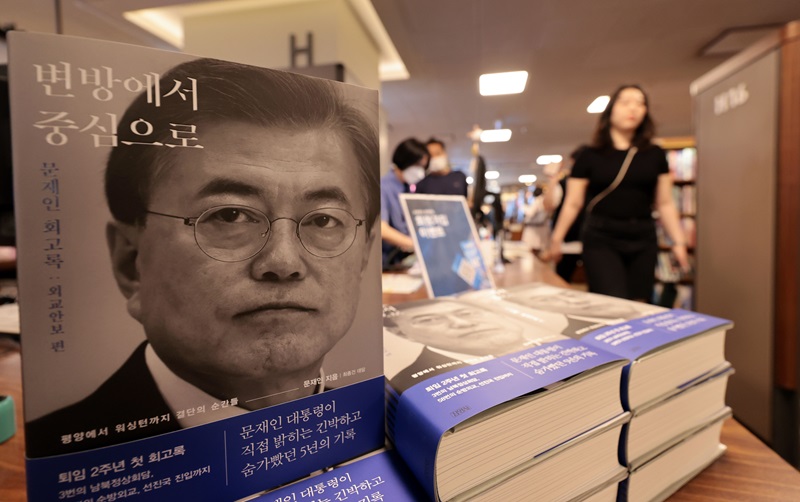
Former President Moon Jae-in stirred controversy on Friday when he released his memoir, breaking his longtime silence regarding his administration’s foreign and defense policy.
In the book, which is his first to be published since he left office two years ago, Moon recounts major encounters he had with foreign leaders, including former U.S. President Donald Trump, late Japanese Prime Minister Shinzo Abe and North Korean leader Kim Jong-un, as well as international and domestic circumstances that shaped global events from 2017 to 2022, when he was in office.
The memoir is structured around the former president’s responses to questions asked by Choi Jong-kun, an international relations professor at Yonsei University who served as first deputy foreign minister under Moon.
According to Moon, Kim argued that his regime “would not have endured sanctions to develop nuclear weapons if he thought it could survive without them,” adding that he “as a father to a young daughter” did not want to see her “carrying a nuclear arsenal upon her shoulders.”
But Moon said Kim also told him “time and again” that he was “frustrated that the United States and the international community did not believe he was serious about denuclearization.”
While Moon supported direct talks between the United States and North Korea to ease tensions on the Korean Peninsula over Pyongyang’s nuclear weapons and missile programs, two summits between Trump and Kim in 2018 and 2019 ended without an agreement, after which the North ramped up missile testing, eventually launching its first solid-fuel intercontinental ballistic missile last year.
While Moon said that Trump “could be rude and rough around the edges in the eyes of some observers,” he also recounted that the U.S. president was “honest” in his dealings with South Korea.
“Even Trump said himself on multiple occasions that he had ‘good chemistry’ with me,” Moon said, noting that the U.S. president made for a “good partner in diplomacy” during the three years that both men were in office.
But Moon was significantly less rosy in his recollections of Abe, who was assassinated three months after the South Korean president’s term ended.
Calling him “headstrong,” Moon said that Abe’s approach to Pyongyang only served to fan anxiety on the peninsula in 2017, when the North launched a flurry of missiles.
According to Moon, Abe proposed a joint military exercise between South Korea, the United States and Japan to counter the North, as well as a drill to evacuate Japanese nationals from South Korea to prepare for a contingency.
Moon claimed that he pursued “future-oriented cooperation” with Tokyo despite multiple disputes stemming from Japan’s 1910-45 colonial occupation of Korea, but that Abe’s government chose to damage relations with Seoul by imposing export controls on key technologies in 2019.
While Moon wrote that his memoir was “not intended to boast about [his] administration’s foreign policy and security accomplishments, but rather to diligently document the reasons for and consequences of [his] successes and failures,” members of the conservative People Power Party (PPP) criticized the former president for taking the North Korean leader at his word.
On Saturday, PPP Rep. Na Kyung-won said the memoir showed that Moon “is still serving as Kim Jong-un’s spokesman” by “failing to escape the narrative promoted by the North to justify its development of nuclear weapons.”
Calling Moon’s “naiveté” a mark of “grave incompetence,” Na argued that Moon’s willingness to believe Kim “a great risk to the country.”
Na further called on the former president’s liberal Democratic Party to “escape Moon’s ideological framework for approaching North Korea” through conciliation.
BY MICHAEL LEE [lee.junhyuk@joongang.co.kr]