Recent surveys reveal growing support among South Koreans for developing their own nuclear weapons, driven by declining confidence in the U.S. nuclear umbrella, with many even willing to accept the risk of international sanctions.
A poll, conducted between August 26 to 28 among 1,006 adults jointly by the JoongAng Ilbo, an affiliate of the Korea Daily, and the East Asia Institute (EAI), found that 47.4 percent of respondents disagreed with the notion that the U.S.-provided nuclear umbrella is sufficient to counter North Korea’s nuclear threat. In contrast, 41.2 percent of the respondents expressed trust in U.S. nuclear deterrence.
The results show a marked shift from a year earlier when 57.6 percent of respondents supported the South Korea-U.S. alliance’s strategy, including the Washington Declaration of April 2023, which aimed to enhance extended deterrence measures against North Korea.
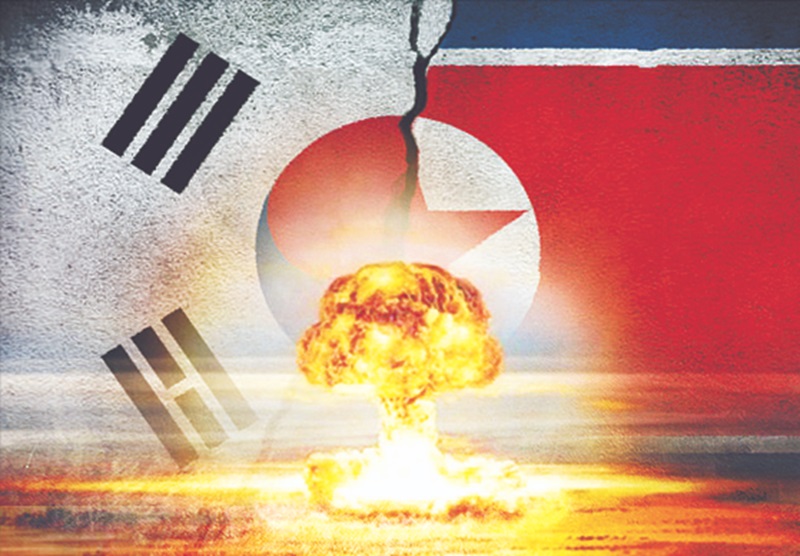
According to a public opinion survey conducted by Seoul National University’s Institute for Peace and Unification Studies involving 1,785 respondents, 37% of participants supported South Korea developing its own nuclear weapons, even if it meant facing “permanent” economic sanctions from the international community.
Researchers examined the impact of personal income reduction due to economic sanctions on public support for nuclear armament. The survey presented scenarios where personal income decreased by 25%, based on Pakistan’s case, and asked respondents whether they would support nuclear armament if the economic impact lasted between six months to six years, or became permanent.
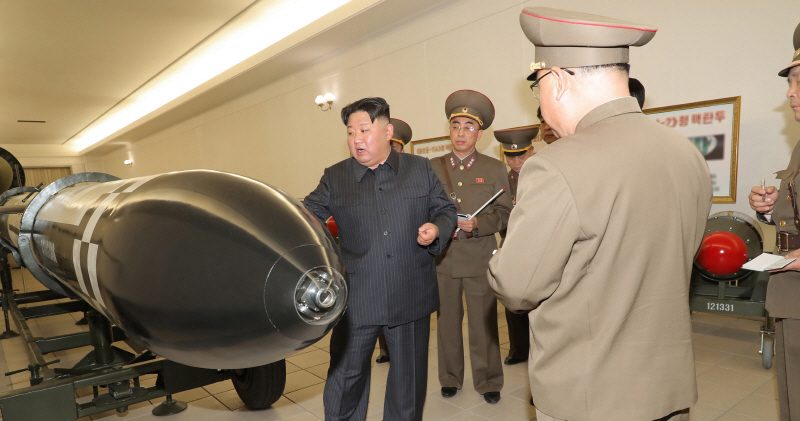
If the sanctions lasted up to four years and then eased due to changing internal and external circumstances, 53.3% supported nuclear development. Support rose to 57.8% if the sanctions lasted only six months.
However, support dropped sharply if income reduction persisted for more than six years (47.7%) or became permanent (37.0%). The research indicated that when support falls below 50%, it suggests significant opposition to nuclear development.
Professor Lee Kyung-seok, who led the study, noted that “even with these negative outcomes, 37% of respondents form a ‘hardcore support base’ that backs nuclear armament regardless of the consequences.”
Certain factors also boosted support for nuclear development. Among diplomatic and security considerations, the scenario that South Korea could join the “nuclear club”—an elite group of nuclear-armed states—elicited the highest level of support at 61.8%.
This surpassed the 52.6% support for the idea that South Korea could independently counter North Korea’s nuclear threat. The prestige associated with being on par with the United States, United Kingdom, France, China, and Russia, all of which are permanent members of the UN Security Council and recognized nuclear powers, was the most preferred rationale for supporting nuclear development.
BY YUJUNG LEE, YOUNGNAM KIM [kim.youngnam@koreadaily.com]