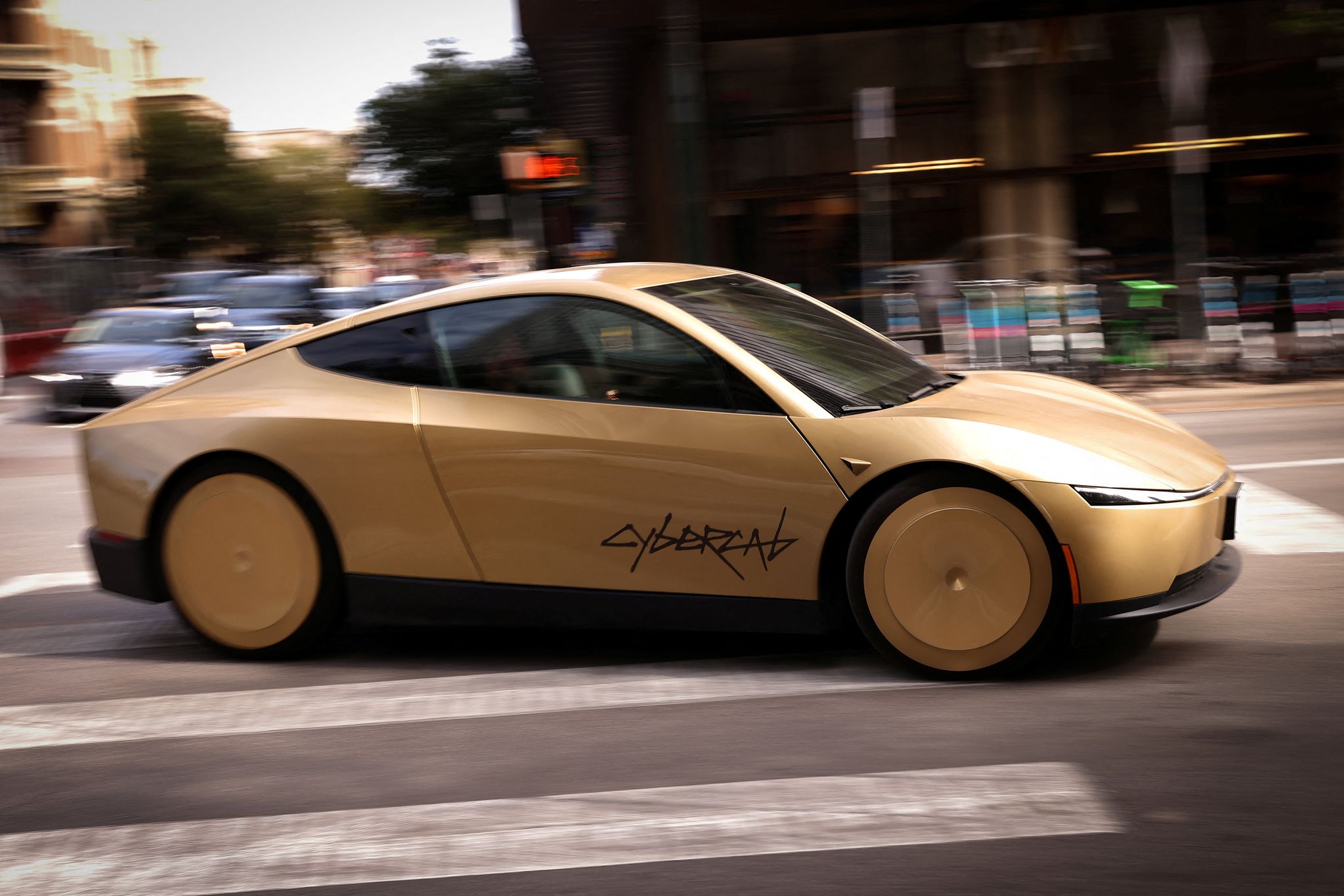
Tesla has begun selling its fully autonomous vehicle, the Tesla Cybercab, which lacks a steering wheel and acceleration/brake pedals, to general consumers. This marks a shift from solely utilizing the self-driving vehicles for its proprietary robotaxi service to allowing individuals to own them. The vehicle is priced at $29,990 (approx. 40.18 million KRW). However, a separate autonomous software subscription fee of $299 (approx. 400,000 KRW) per month is required for actual operation.
Tesla announced via social media platform X on the 14th (local time) that it has started sending out personal Cybercab purchase invitations to select customers. Customers wishing to purchase must pay a non-refundable deposit of $1,000 (approx. 1.34 million KRW), with vehicle delivery expected in December. Initial sales target a select group chosen by Tesla, and personal Cybercabs can only be operated within service areas supported by Tesla.
Design and Autonomous Technology Features
Unveiled by Tesla in 2024, the Cybercab is a two-seat autonomous electric vehicle featuring a gold exterior and gull-wing doors. Its most defining characteristic is the complete absence of a steering wheel and pedals. Unlike conventional automobiles operated manually by drivers, it is engineered exclusively for autonomous driving, with artificial intelligence handling all navigation.
This commercial release reflects the realization of autonomous vehicle mass-market strategies long pursued by Tesla CEO Elon Musk. Although past ambitious timelines for a fleet of million-plus robotaxis fell short, Tesla has rapidly accelerated its autonomous business recently. Following the launch of the Model Y-based robotaxi service in Austin, Texas, in June 2025, the company expanded operations to other cities and introduced the Cybercab into the Austin fleet in September.
Regulatory Hurdles and Operational Restrictions
Despite the commercial rollout, regulatory hurdles remain a significant obstacle. The National Highway Traffic Safety Administration (NHTSA) is currently investigating whether the steering-wheel-free and pedal-free Cybercab complies with federal motor vehicle safety standards, which traditionally mandate manual driver controls.
Personal vehicle owners also face strict operational limitations. According to Ashok Elluswamy, Tesla’s head of AI, privately owned Cybercabs must operate within the same designated geographic boundaries as the existing robotaxi service without driver supervision. Owners cannot immediately utilize the vehicles for independent commercial ride-hailing to generate direct profits outside of Tesla’s approved zones.