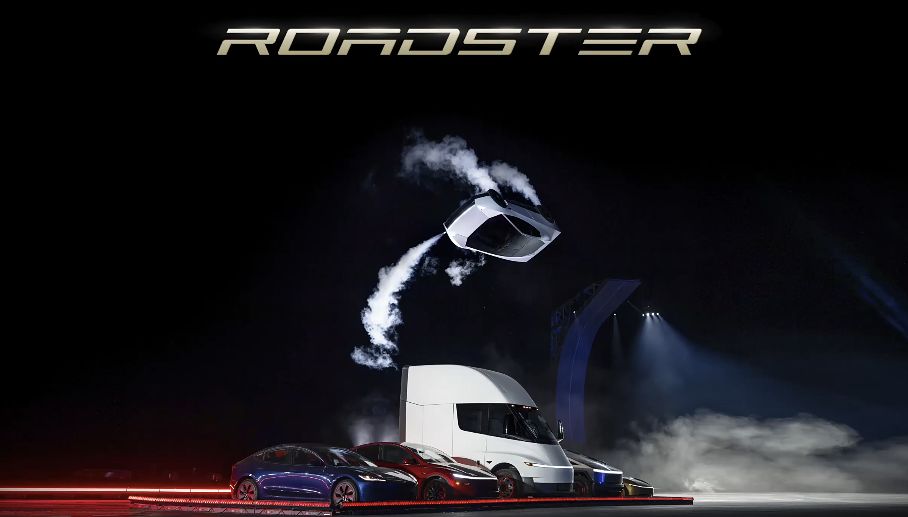
A white sports car raced along a roller coaster-like curved track, soaring into the sky. Reaching the peak, the vehicle began to fall upside down before deploying white compressed gas to correct its posture and land stably on the ground.
This was the demonstration scene of Tesla’s next-generation electric sports car, the Tesla Roadster, unveiled on the afternoon of the 15th (local time) in Texas. The Roadster is a new model returning nine years after its initial prototype was announced in 2017. Tesla CEO Elon Musk had teased ahead of the event that it would be "the most mind-blowing product demo of all time."
The centerpiece of interest was the ‘levitation’ technology. Musk had previously claimed in 2018 that he would incorporate SpaceX rocket technology into the new Roadster, stating that "Tesla cars will be able to fly."
True to his word, the Roadster utilized thrusters ejecting compressed gas to leap into the air and control its posture. Attendees erupted in cheers as the Roadster sprayed gas to jump over five parked vehicles, including Tesla’s flagship models Model 3, Model Y, and the Cybertruck. Like a gymnast, the Roadster rotated its body 360 degrees while clearing the five cars before landing.
The vehicle also showcased explosive acceleration powered by compressed gas. Musk previously set a target of reaching 0 to 60 mph (97 km/h) in under one second using rocket thrusters. In the test demonstrated by Tesla, the Roadster accelerated to 97 km/h in just 0.81 seconds. Musk remarked, "We can achieve even better times in the future. Increase the power, reduce the mass, and acceleration gets even bigger. The actual production car will be even faster."
Pricing details were not disclosed at the event. While the base model was priced at $200,000 (approx. 280 million KRW) in 2017, the actual price remains a mystery. The production timeline is also uncertain. During the event, Musk stated plans to begin manufacturing in 2028. However, the Roadster has faced repeated delays since taking reservations starting in 2017 with a promised 2020 production target. Critics have pointed out that Tesla has held onto customer deposits for years without delivering vehicles. OpenAI co-founder Sam Altman, an early Roadster reservation holder, canceled his reservation last year and expressed frustration, stating that "seven and a half years is too long to wait."
The Roadster is currently accepting pre-orders in South Korea as well, requiring a non-refundable credit card deposit followed by a bank transfer within ten days.
Whether the rocket thrusters used in the aerial acrobatics will be permitted for public road use remains unclear. Tesla noted on its website that the rocket technology applied to the Roadster is not approved for public road driving and will not be available in all regions. Musk stated during the demonstration, "This car can do stunts in the air, but it is not designed with safety as its top priority. However, the fun factor is absolute. On a scale of 1 to 10, the fun level is an 11."
Industry experts believe the Roadster is not intended to boost Tesla’s profitability. Rather, as Tesla shifts its core focus from automotive manufacturing toward robotaxis, humanoids, artificial intelligence (AI), and space exploration, the Roadster serves primarily as a showcase of technological prowess. Musk stated during the event, "Long-term, the only Tesla car that humans will drive themselves will be the Roadster."