Younger generations prioritize personal freedom and quality of life over traditional milestones
The definition of the American Dream is evolving as younger generations place greater value on personal freedom, life satisfaction, and flexibility rather than solely pursuing traditional markers of success such as homeownership and wealth accumulation.
For decades, the American Dream was widely understood as a straightforward formula: earn a college degree, work hard, buy a home, raise a family, and retire comfortably. While many Americans still aspire to those goals, new research suggests the concept is becoming increasingly personal and less tied to a single vision of success.
According to a recent survey conducted by consulting firm Simon-Kucher, Americans continue to believe in the American Dream, but their definition of it is changing. The study surveyed 5,000 adults across different generations and income levels throughout the United States.
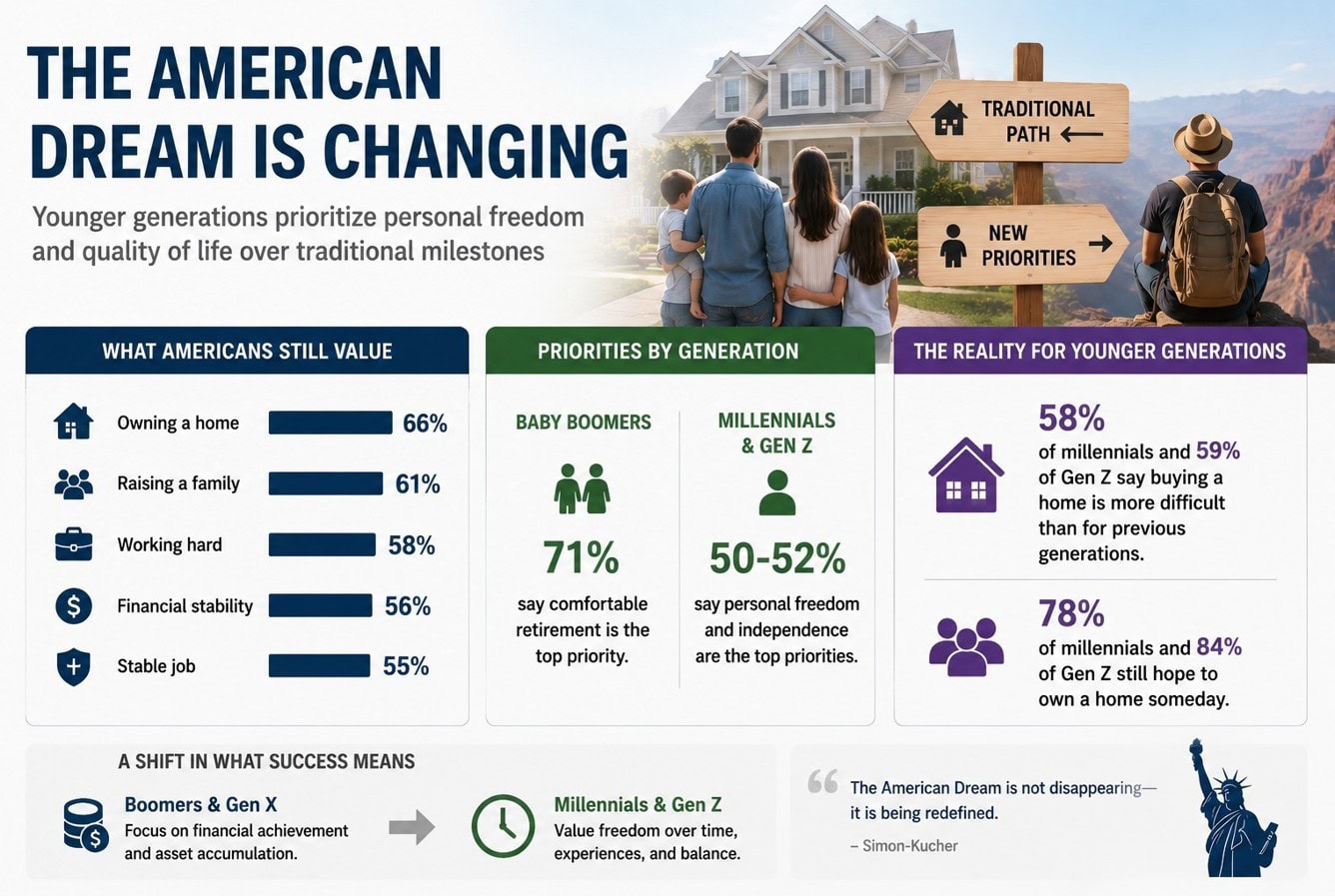
The findings show that traditional aspirations remain important. Sixty-six percent of respondents said homeownership is a key component of the American Dream, while 61% cited raising a family and 58% pointed to achieving success through hard work. Financial stability (56%) and stable employment (55%) also ranked among the top priorities.
However, significant generational differences emerged.
For baby boomers, the most important goal was a comfortable retirement, with 71% identifying it as a primary measure of success. Millennials and Generation Z, on the other hand, placed the highest value on personal freedom and independence. Fifty percent of millennials and 52% of Gen Z respondents said freedom and autonomy were their top priorities.
Experts say the shift reflects not only changing values but also changing economic realities.
When many baby boomers entered adulthood, home prices were relatively affordable and student debt burdens were far lower than they are today. Younger generations face a much different environment, marked by high housing costs, rising rents, student loan debt, inflation, and ongoing economic uncertainty.
As a result, many younger Americans view traditional milestones as increasingly difficult to achieve.
The survey found that 58% of millennials and 59% of Gen Z respondents believe purchasing a home is more difficult today than it was for previous generations. Yet younger Americans have not abandoned the dream of homeownership altogether. Seventy-eight percent of millennials and 84% of Gen Z respondents said they still hope to own a home someday.
The difference is that many are less willing to sacrifice their personal well-being, flexibility, and quality of life in pursuit of those goals.
The changing definition of success is also reflected in attitudes toward wealth.
While baby boomers and Generation X continue to place a strong emphasis on financial achievement and asset accumulation, millennials and Gen Z rank “freedom over their time” as one of the most important measures of success. For many younger Americans, having control over how they spend their time is becoming just as important as earning more money.
The rise of remote work, flexible schedules, and greater emphasis on work-life balance has accelerated this trend. Younger workers are increasingly prioritizing experiences, travel, personal fulfillment, and time with family over promotions, larger salaries, or traditional status symbols.
“The American Dream is not disappearing—it is being redefined,” Simon-Kucher researchers concluded. “While previous generations often focused on what they could own, younger generations are increasingly focused on how they want to live.”
Analysts say the shift is likely to continue as economic pressures reshape personal priorities. In an era of high living costs and changing workplace expectations, the new American Dream may be less about accumulating possessions and more about creating a life that reflects individual values, freedom, and fulfillment.