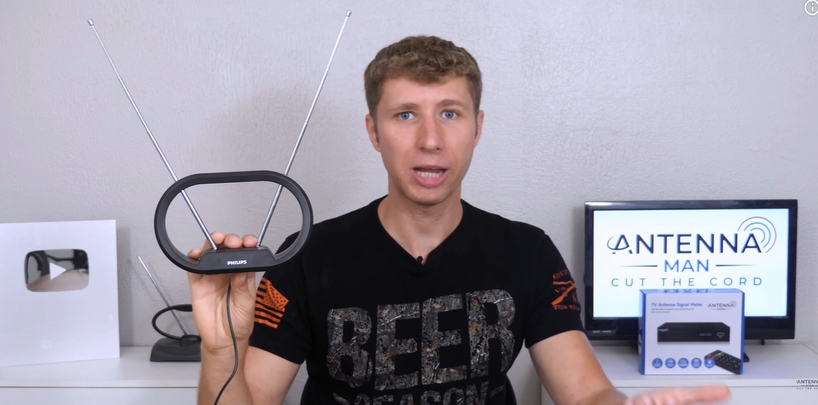
Tyler Kleinert, who operates the YouTube channel ‘Antenna Man,’ is showcasing affordable TV antenna options. [Antenna Man YouTube Capture]
If monthly cable TV and streaming subscription fees feel overwhelming, a $15 antenna is worth considering. Without any monthly subscription fees, viewers can enjoy dozens of TV channels and even popular sports events like the NFL for free.
KTLA recently introduced product purchasing and installation methods, explaining that setting up an inexpensive indoor TV antenna allows users to watch local broadcasts for free.
The method is simple. Just connect the antenna to the TV and scan for channels. The antenna directly receives signals broadcasted by TV stations, eliminating the need for internet or cable TV subscriptions. Once you buy the antenna, you can keep watching without any extra charges.
This is especially good news for sports fans. With the NFL season underway, games broadcasted by local free-to-air networks like ABC, CBS, FOX, and NBC can be watched for free. However, not all games are available, and viewable games vary depending on regional broadcasting schedules.
Prices are also affordable. Philips’ ‘Rabbit Ears’ antenna tested directly by KTLA costs about $15, while Channel Master’s ‘FLATenna’ costs around $35. Both products successfully received dozens of channels. Interestingly, the cheaper $15 product showed more stable reception performance, proving that expensive products are not necessarily better.
Tyler Kleinert, an expert known on YouTube as ‘Antenna Man,’ advised against blindly purchasing popular online products when choosing an antenna.
First, you need to check the distance from your home to the broadcast transmitter tower. By entering your address on the free website ‘RabbitEars.info,’ you can check available broadcasting stations, signal strength, and transmitter directions.
Generally, if you are within 30 miles of the transmission tower, an indoor antenna is sufficient. If the distance is greater, an outdoor antenna is more advantageous. If installing on a roof is difficult, an attic can also be an alternative.
The installation location is also crucial. Moving the antenna by just 1 to 2 feet can change the reception status. If the screen cuts out, it is best to try changing its location before buying a new product.
A signal amplifier is not strictly necessary. In fact, it can generate unnecessary noise and worsen reception quality.
Kleinert recommended trusted brands such as RCA, Antennas Direct, Channel Master, and Winegard. If your reception environment is poor, ClearStream products sold at Best Buy are also worth considering. He emphasized, “Once you buy one, you can watch free channels for life,” noting that there is no need to worry about internet video buffering, poor picture quality, or broadcast interruptions.
However, what you can watch with an antenna is free terrestrial broadcasting. Paid cable channels like ESPN or streaming services like Netflix cannot be watched for free.