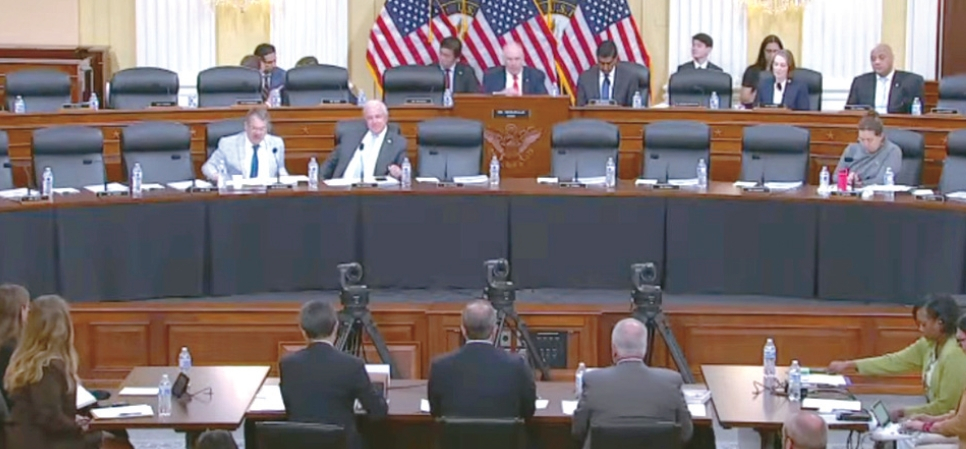
The US-China Select Committee, which primarily deals with trade issues between the United States and China, is shown during a meeting procedure in June. [Provided by the House Subcommittee]
A recent opinion column in a major US publication argued that the South Korean government imposes excessive regulations on American companies while showing a relatively lenient attitude toward Chinese businesses, necessitating an official investigation.
The Los Angeles Times published a column on the 16th by external contributor Kurt Bardella, pointing out the need for efforts to resolve this regulatory contradiction. Bardella previously worked as a Democratic strategist and served as an advisor to the House Oversight Committee under Republicans.
Following the midterm elections in November that secured a Democratic majority in the House, the column argued that the scope of the House Select Committee on the Chinese Communist Party—chaired by Representative Ro Khanna (D-CA)—should be expanded beyond US-China relations to include South Korea’s regulations on American companies.
It emphasized that Representative Khanna, whose constituency includes Silicon Valley, should take a leading role in addressing these issues. Given that the interests of US tech companies are at stake, there is a clear need to jointly investigate economic and trade issues in East Asia, including both China and South Korea.
The column highlighted the fact that the United States has provided active support and investment incentives for South Korean corporate projects.
For instance, Samsung Electronics is set to receive up to $4.745 billion in federal subsidies for constructing a semiconductor plant in Taylor, Texas, while the Hyundai Motor Group built a $7.6 billion production facility in Georgia. Furthermore, the South Korean government pledged an additional $350 billion in investments to the US last year.
In contrast, American companies operating in South Korea face an unbalanced regulatory environment, Bardella argued.
He cited Google and Coupang as prime examples. South Korea’s Fair Trade Commission (FTC) imposed a fine of approximately $170 million on Google for competition-limiting practices related to its mobile operating system. US-headquartered Coupang was also hit with a penalty of about $409 million regarding a personal data leak incident.
Research findings from the Computer & Communications Industry Association (CCIA) and the Information Technology and Innovation Foundation (ITIF) were also presented as supporting evidence.
According to analysis from both organizations, the fines levied by South Korea’s FTC against American firms were 4 to 7 times higher than those imposed on domestic South Korean companies when adjusted for business scale.
The ITIF survey revealed that the average fine for US companies was approximately $29 million, more than 20 times higher than the $1.4 million average for South Korean firms. While American companies accounted for over 81% of total penalties levied against foreign firms, Chinese companies made up less than 1%.
The column argued that these statistics point to potential regulatory discrimination based on nationality, necessitating an active investigation by the US government. However, it added that if the fine gap alone cannot definitively prove discrimination, further reviews into the nature of the violations and company sizes would also be necessary.
It also pointed out that although South Korea pledged last year to uphold digital regulation non-discrimination principles and fair competition law enforcement for US companies, it is currently pushing forward with new online platform regulations.
Consequently, the column urged the US government to investigate whether the South Korean FTC’s sanctions violate the fair treatment principles of the Korea-US Free Trade Agreement (FTA) and to elevate bilateral non-discrimination promises into a binding agreement.
Bardella concluded with the argument that just as South Korean companies have long demanded a fair and predictable investment environment in the United States, American businesses must receive equal treatment in South Korea.