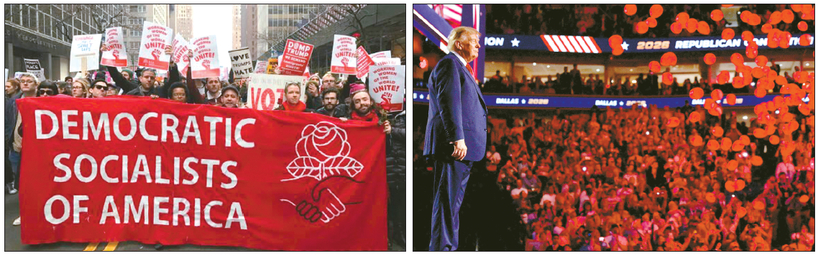
Platforms, platforms, and personalities are the three main elements driving elections. Even in the US Midterm Elections where localized battles are fought nationwide, a platform targeting all citizens is necessary. In this regard, the ruling party holding policy levers naturally has the upper hand.
President Donald Trump is rolling out populist pledges. The most radical card is the so-called ‘Trump Dividend’ revealed at the Dallas convention last month. If the Republican Party retains both the House and the Senate, it promises to pay $5,000 per adult US citizen. The idea is to solve the surging living costs—such as gas, groceries, and rent—in cash with a hefty payout. This is a direct counter to the ‘affordability’ agenda previously claimed by the Democrats.
According to the Committee for a Responsible Federal Budget (CRFB), a nonpartisan fiscal policy group in Washington, D.C., this pledge requires $1.2 trillion. Measured by Gross Domestic Product (GDP), the total value added by economic operations, it is equivalent to pumping Switzerland’s entire annual economic activity into the system at once. It amounts to little more than cash spraying, which directly contradicts the fiscal conservatism emphasizing rules that the Republican Party traditionally upholds. This is why criticism labeling it a ‘vote-buying pledge’ persists.
Even so, public opinion has been favorable. According to pollster Verasite, when the ‘$5,000 payout’ was presented purely as a policy without conditions, 53% approved and 35% opposed. Approval still outweighed opposition even when it was attributed directly to President Trump. Pumping astronomical amounts of cash all at once risks further stimulating already severe inflation and additionally driving up interest rates. However, parties and candidates facing an election rarely worry about economic logic, and judging by the favorable public opinion, voters seem to share that sentiment.
‘Courtship administration’ targeting voters has also begun. The federal government has started refunding about $500 to roughly 1 million Obamacare enrollees, and this month it will disburse $90 or more to over 20 million Medicare Part B enrollees. The administration explains these as refunds for overcharged costs and relief for premium burdens, but political effects are also anticipated given that these are tangible supports delivered right before the election.
The Democratic Party is focusing on turning dissatisfaction with Trump and financial hardships into policy agendas, prominently promoting the affordability agenda. However, unlike the Republicans who lead with cash payouts, the Democrats focus on directly lowering household fixed expenses such as healthcare, energy, and housing costs.
In healthcare, they advocate for expanding Obamacare (ACA) premium subsidies and protecting Medicaid. Furthermore, they are tying the electricity and water consumption issues stemming from the construction of Artificial Intelligence (AI) data centers into the cost-of-living issue, emphasizing the message that ‘easing residents’ burdens comes before Big Tech.’ In housing, they have made expanding housing supply and easing rental burdens core agendas.
Tariffs are also being linked to the cost of living. Tariffs are ostensibly meant to protect domestic industries. However, imposing double-digit tariffs on goods like coffee, when domestic production covers only half a day’s consumption for Americans, inevitably translates directly into a higher cost of living. The Democrats are zeroing in on this very vulnerability. While the Republicans’ approach is to immediately fill wallets with cash and refunds, the Democrats’ approach is to reduce recurring monthly expenses like medical bills, electricity, and housing.
The worsening of people’s living standards is ample fuel to stimulate sentiment against the ruling administration. For Americans, the symbolic indicator is gas prices. The Democrats attribute the cause of high oil prices to the Iran war instigated by Trump—a regular staple in their campaign speeches, which many voters believe.
However, according to the US Energy Information Administration (EIA), average gasoline prices under Trump’s second term are nominally 9 cents lower per gallon compared to the Biden administration. Adjusted for inflation, real gas prices per gallon were $4.33 under Obama, $3.29 under Trump’s first term, $3.91 under the Biden administration, and $3.45 under Trump’s second term. Getting into the details doesn’t particularly favor the Democrats. The Democrats ask about ‘gas prices that have risen now,’ while the Republicans present ‘average gas prices across the term.’ Depending on what is chosen as the baseline, the exact same numbers tell completely different stories.
Ultimately, the pledges of both parties point to one destination: the wallets of voters exhausted by high inflation and the cost of living. The Republicans put forward direct support through cash payouts and refunds, while the Democrats advance prescriptions to lower fixed costs like medical, energy, and housing expenses. Which approach resonates more deeply with voters’ lived experiences will be the ultimate battleground of this policy showdown.