On the first trading day of November, the Kospi fluctuated sharply, swinging between the 5600 and 5900 ranges. As doubts persist over the artificial intelligence (AI) investment profitability of U.S. big tech companies, market attention is converging on the upcoming US midterm elections just a day away.
The Kospi closed up 2.24% at 5,859.08. After dropping to 5,616.50 early in the session, it surged up to 5,910.83 during the day, marking a daily fluctuation range of nearly 300 points. Buying momentum from institutional investors, including the National Pension Service, and treasury stock purchases by corporations classified as other legal entities supported the rebound.
Market Reactions to Midterm Election Outcomes
Market focus is directed toward the U.S. midterm elections held on November 3 (local time). Determining the balance of power in the Senate and House, this election serves as a testing ground that will shape the policy momentum for the latter half of the Trump administration. Because domestic stock market trading hours overlap with vote counting on the morning of November 4 (Korean time), the domestic stock market could experience fluctuations as election results unfold.
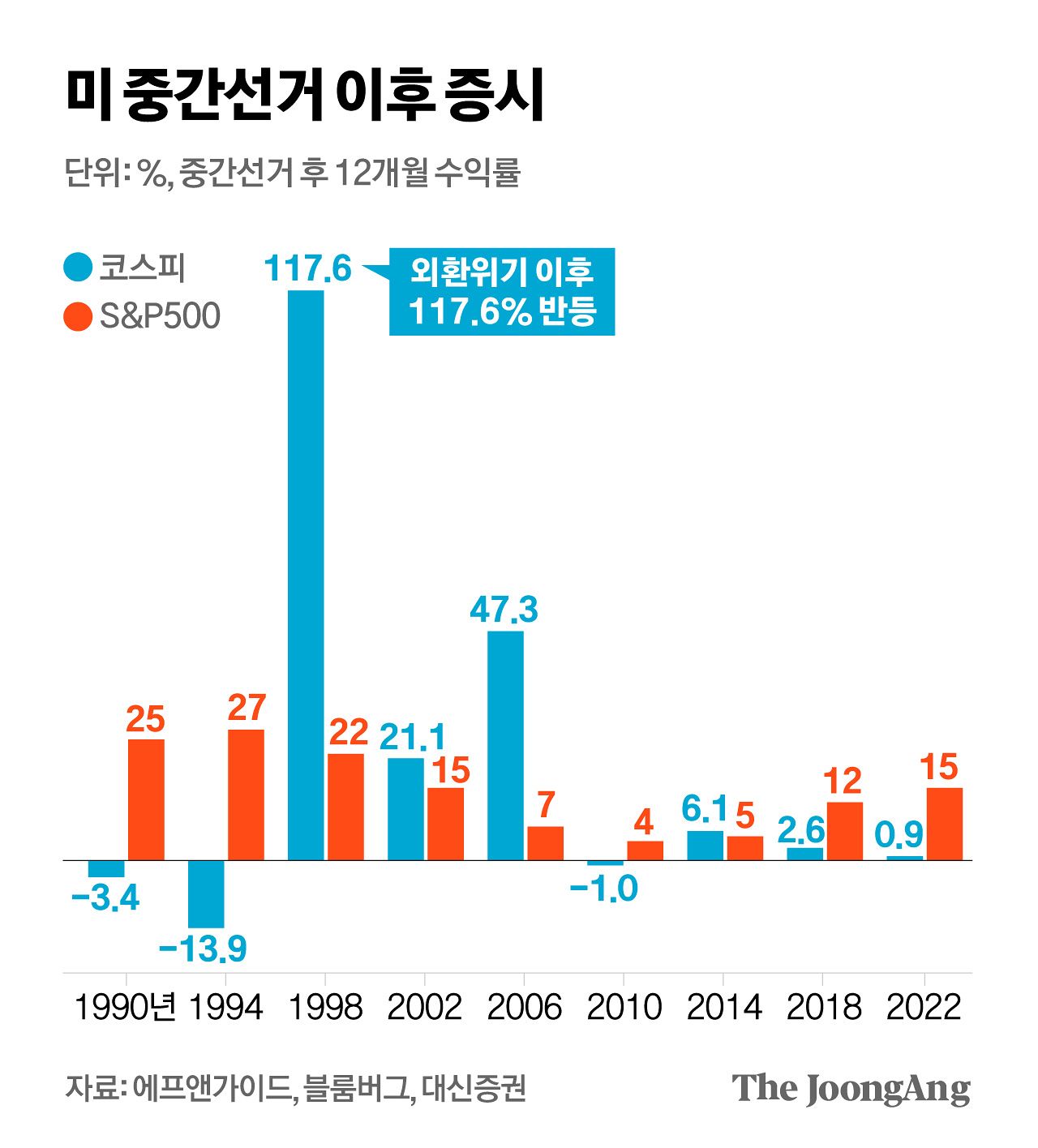
Historically, the U.S. stock market has always rallied following midterm elections. Reduced political uncertainty after the elections has typically worked in favor of the stock market. According to Daishin Securities, across 19 U.S. midterm elections from 1950 to 2022, there was not a single instance where the S&P 500 index declined in the 12 months following the election, with an average increase of 15.1%. In contrast, the Kospi has risen or fallen depending on the election year.
Interest Rates Outweigh Election Results
Securities firms generally agree that interest rates matter more than election outcomes. According to Kiwoom Securities, following the midterm elections in 2018 and 2022—periods of U.S. benchmark interest rate hikes—the Kospi gave back its rebound gains, returning to election-day levels by the 12-month mark. Han Ji-young, a researcher at Kiwoom Securities, noted that rather than expecting a trend-driven rally simply from passing the election event, investors need to check how much interest rate pressures ease.
However, some projections suggest that if Democrats maintain their current advantage, it could curb fiscal expansion by Republicans, leading to stabilized interest rates. Lee Kyung-min, a researcher at Daishin Securities, forecasted that whether Democrats sweep both houses or secure the House while Republicans hold the Senate resulting in a divided government, blocked fiscal expansion will stabilize interest rates.
Daishin Securities estimates that if Democrats sweep both chambers or the parties divide Congress, the Kospi could reach its existing fourth-quarter target of 6700. Conversely, if Republicans secure both chambers, expanded fiscal spending could drive up interest rates and the dollar’s value, potentially lowering the Kospi’s floor to 4950.
Sector-Specific Impacts and Outlook
Sector impacts may also diverge. If a “blue wave” materializes with Democrats seizing both the House and Senate, policy support expectations could grow for eco-friendly energy sectors such as solar and batteries. Meanwhile, shipbuilding sectors might see diminished policy expectations as the momentum for the MASGA (Make American Shipbuilding Great Again) project weakens.
For the semiconductor sector, the pace of data center investments remains a variable. Securities firms are closely watching the Texas gubernatorial election, where data center construction is heavily concentrated. Kim Doo-언, a researcher at Hana Securities, pointed out that since even Republican Governor Abbott ordered environmental permit suspensions citing grid and water audits, a Republican victory alone cannot be expected to resolve delay concerns. He emphasized checking audit completions, permit resumptions, power connections, and big tech investment execution together.
Nevertheless, policies pursued through executive authority are likely to continue even if the congressional alignment shifts. U.S. presidential powers regarding tariffs, commerce, and diplomacy rely heavily on executive orders. Kim Sung-keun, a researcher at Mirae Asset Securities, stated that the Trump administration will not remain idle over the remaining two years, predicting that current deregulation policies in AI, nuclear energy, and digital assets will persist for at least another two years.