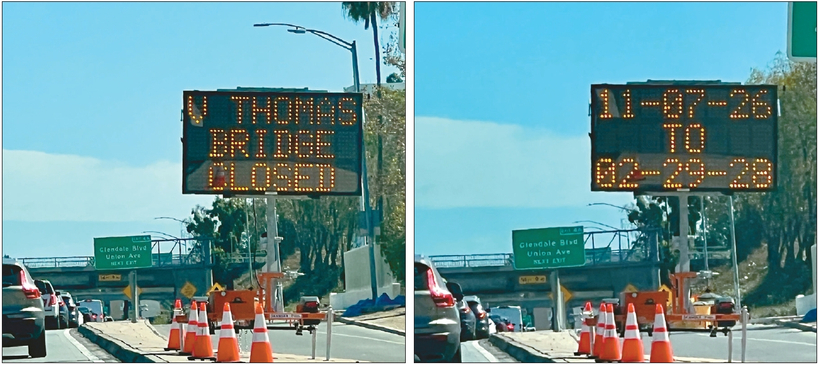
Starting this November, a severe commute traffic gridlock is expected across the greater LA-Long Beach-Anaheim metropolitan area, a core metro region in Southern California.
This is because the Vincent Thomas Bridge, a key entry and exit point for the Port of LA, will be completely closed for 16 months starting on the 7th of next month due to a bridge deck replacement project. As a result, passenger cars, large trucks, and other logistics vehicles will simultaneously detour to surrounding roads, causing traffic congestion on major freeways connecting LA and Orange County, centered around the 110 and 710 freeways, to reach extreme levels.
Caltrans is already intensively announcing the complete closure of the Vincent Thomas Bridge through electronic boards on major sections of the 110 and 710 freeways, as well as connecting 5, 101, and 405 freeways.
The problem is that despite the anticipated massive traffic congestion due to the bridge closure, there are no viable alternatives other than detour route guidance. Caltrans has already held over 100 resident information sessions targeting residents and related organizations. While presenting measures such as detour guidance, deploying intermittent traffic control personnel at 18 major intersections, or installing temporary traffic lights, critics point out that these fall far short of resolving residents’ anxiety and concerns.
Jeon Young-cheol (44), a resident of Torrance, expressed concern, saying, “Even normally, during commute hours, large freight trucks flock to the 110, 405, and 710 freeways, causing severe congestion,” adding, “If long, slow-accelerating and turning large trucks crowd even more, traffic congestion throughout the neighboring areas will reach paralyzing levels.”
Previously, when protests from local residents and related organizations regarding aggravated traffic congestion intensified, authorities reportedly considered alternative measures such as partial lane closures or nighttime construction. However, after comprehensively considering factors such as shortening the construction period and securing bridge safety, they ultimately and inevitably chose the complete closure method. The decision stems from the judgment that completing the construction early is the best choice, even if it means enduring traffic inconvenience for over a year.
According to Caltrans, the Vincent Thomas Bridge is scheduled to reopen to partial traffic around February 2028. Final finishing work, such as the removal of temporary facilities, will continue until early 2029.
According to a recently released Environmental Impact Report (EIR) by the California government, the average daily traffic volume of the bridge exceeds 53,000 vehicles.
Among them, heavy freight trucks alone account for about 4,700 vehicles. During the closure period, if these vehicles are dispersed and detoured to surrounding local roads and freeways, significant disruptions to the commuting network throughout the LA-Long Beach-Anaheim metropolitan area, as well as during peak commute hours, will be inevitable.
In particular, the Environmental Impact Report simulation analysis predicted that hourly traffic volumes on major roads during peak commute hours will increase by ▶1,074 vehicles on Alameda Street ▶762 vehicles on Harry Bridges Boulevard ▶414 vehicles on Pacific Coast Highway (PCH) and ▶392 vehicles on Gaffey Street.
Meanwhile, opened in 1963, the Vincent Thomas Bridge is a core section of Highway 47 and a vital axis of Southern California logistics directly connecting the 110 Freeway and the dual ports of LA and Long Beach. This large-scale project, backed by a budget of $750 million, is being pursued to completely replace the aging bridge deck that has been exposed to heavy cargo loads and sea breezes over the past 60 years.