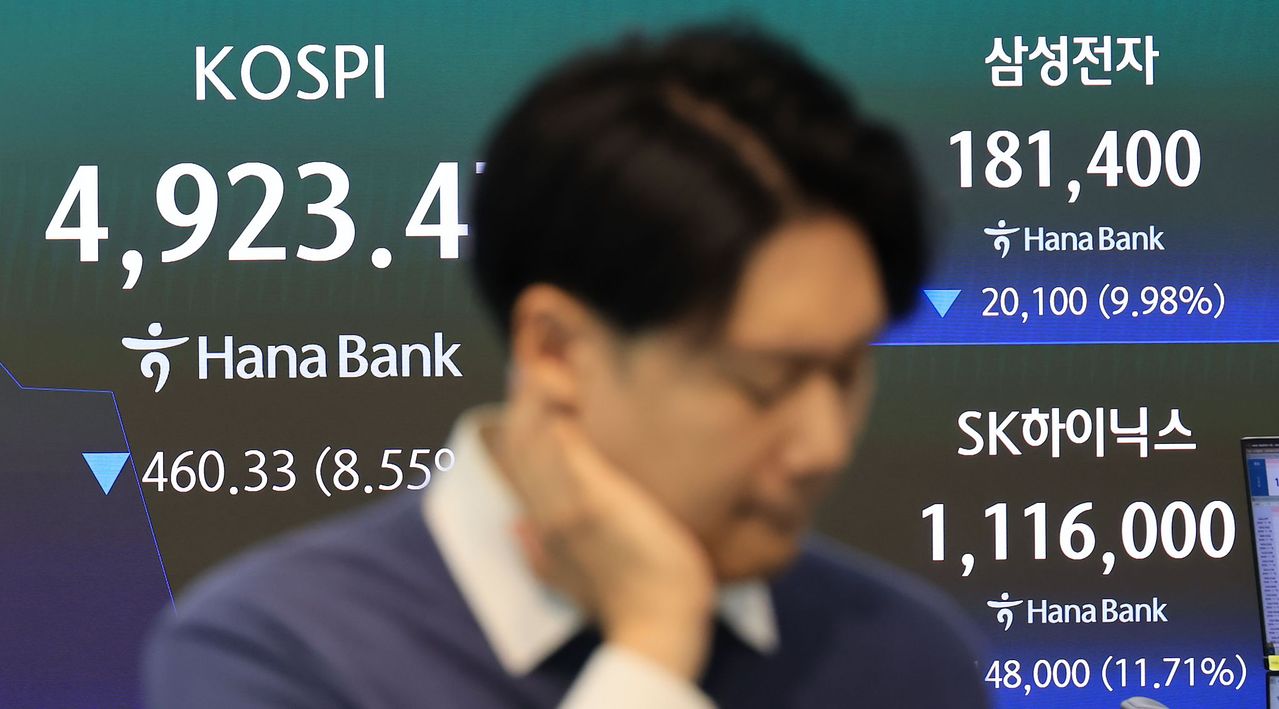
Mental health holding up? Not quite. Overnight, Wall Street stock market crash conditions wiped out $2.3 trillion, and today even the Kospi 5000 line collapsed. Everyone is in a state of panic. Some recalled the 2008 financial crisis, while others declared the ‘total capitulation’ of investors. Just how severe is this situation? We’ve gathered 10 statements poured out by Wall Street experts during this massive market slump.
The Nasdaq 100 index plummeted 6.4% in a single day, marking its biggest drop since the COVID-19 pandemic in 2020. The S&P 500 fell 4.4% and the Dow Jones dropped 3.4%. Semiconductor stocks, which had led the AI craze, were particularly devastated, with the Philadelphia Semiconductor Index crashing a massive 12%.
The catalyst was the US midterm elections. As the Democrats secured control of Congress, concerns grew that regulations on AI data centers could be tightened. This came on top of lingering worries that too much money was being poured into AI. When the negative news of regulation was added, investors rushed to dump their stocks. Selling pressure that initially started in AI-related stocks quickly spread across the entire market.
Here is an summarized compilation of remarks coming out of Wall Street since last night.
Why Did the Market Collapse Like This?
“Markets were overly concentrated in a single theme, and that theme’s trade is now being unwound. The concentration in AI was too high and its weight in the market became excessively large. I think this correction was necessary.” — Greg Taylor, Chief Investment Officer (CIO) at Purpose Investments
The 2008 global financial crisis and the 2001 dot-com bubble collapse were brought up as points of comparison. CIO Taylor took issue with the fact that too much money had rushed into AI, and that money has now started exiting all at once.
“Investors moved too hastily. Looking at next year’s earnings outlooks, the price-to-earnings (P/E) ratios of these stocks look low. However, if policies change, the entire environment surrounding data center construction changes structurally. In that case, existing earnings forecasts are no longer valid.” — Michael O’Rourke, Chief Market Strategist at JonesTrading
Until now, the justification that AI-related stocks were not expensive was their explosive future earnings. However, with Democrats taking control of Congress, the possibility of data center regulations increased. If data centers cannot be built as planned, earnings forecasts must be recalculated from scratch.
“Given the intensity and widespread nature of the sell-off, this decline goes beyond routine profit-taking. It is closer to a deeper reassessment of the very AI investment thesis that has sustained global stock market gains.” — Hebe Chen, Market Analyst at Vantage Global Prime
“Asian semiconductor-centric markets that rode the AI boom to new highs may now face the strongest headwind.”
Indeed, as Asian stock markets opened on the 6th, Korean and Taiwanese semiconductor stocks collapsed. Since any reduction in US AI investment would immediately impact the semiconductor supply chain, these regions are taking the hardest hit.
No Buyers Left, Only Sellers in Line
“We call this total capitulation by retail investors.” — Viraj Patel, Global Macro Strategist at Vanda Research
Previously, American retail investors bought stocks as if waiting for dips whenever prices fell. However, this time it was the opposite. They net-sold $265 million worth of individual stocks in a single day, the largest scale since the COVID-19 crash in March 2020.
“While large long-only funds are sitting out of buying, smaller hedge funds are liquidating all positions.” — Michael Monahan, Partner and Portfolio Manager at Founders ETF
Big players are staying on the sidelines, while hedge funds are instead offloading their holdings. With buyers disappearing from the market and a flood of sell orders, the depth of the drop was inevitable.
“Our phones are ringing off the hook.” — John Flood, Goldman Sachs Trading Desk
Big players on Wall Street are calling Goldman to ask how far down the market is going to fall. Yet, Goldman Sachs reportedly noted that buying interest verified in the market was virtually nonexistent.
“True panic is felt in the selling. One-sided positioning, deleveraging, and the possibility of forced liquidation are making the situation much worse.” — Dillin Wu, Strategist at Pepperstone Group
“It is not a story that corporate fundamentals suddenly worsened overnight. Investors are in a situation where they must reduce risk regardless of what they hold.”
This is why even sound stocks are being sold off together. Those who invested with borrowed money may be forced to sell their holdings if losses mount. Sell orders are pouring out without even time to check whether a company is fundamentally good or not.
Should You Buy Stocks Right Now?
“The latest trading featured many characteristics of technical-driven movements.” — Scott Ladner, Chief Investment Officer (CIO) at Horizon Investments
With year-end right around the corner, institutional investors are in a period where they must protect annual returns, making it difficult to newly purchase risky stocks. This is why Barron’s reported, citing Ladner CIO’s analysis, that a rebound could become more difficult.
“As someone who normally loves market sell-offs, I am approaching this one much more cautiously.” — Marta Norton, Chief Investment Strategist at Empower
“We are only investing in companies with very sound financial conditions and that look cheap by traditional valuation metrics.”
Rather than blindly buying anything just because it is cheap, investors are selectively picking companies with robust financial health and genuine undervaluation.
“From my perspective, this is a correction phase as investors readjust their expectations.” — Shiyao Ang, Fund Manager at abrdn
“Catching the bottom is difficult. Catching a falling knife is hard.”