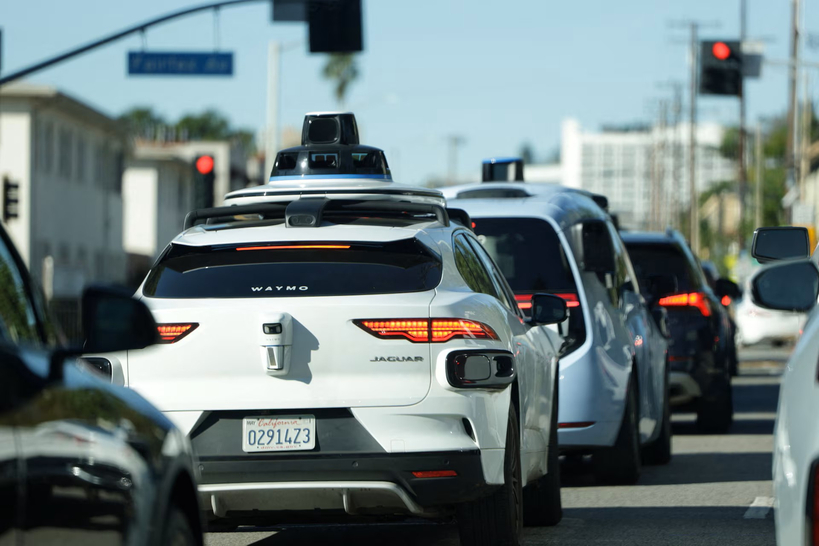
Waymo robotaxi traffic accidents in Los Angeles have increased significantly, raising growing concerns about their safety.
According to an analysis of data from the National Highway Traffic Safety Administration (NHTSA) and California autonomous vehicle accident records by the LA Times, Waymo reported 219 collisions in LA County last year. This is more than triple the 69 cases reported in 2024. Already, 186 accidents have been reported this year as well.
However, the vast majority of these accidents did not result in major injuries.
Of the Waymo accidents in LA County this year, more than 80% involved no noticeable injuries, while about 15% were classified as having potential for injury. Accidents categorized as severe injuries accounted for less than 1%.
Furthermore, a substantial portion of the accidents occurred while the Waymo vehicles were stationary. Among this year’s incidents, 82 occurred when the vehicles were stopped, and 65 happened while traveling straight.
There were also instances where Waymo did not directly cause fatal accidents.
In January, although a collision in San Francisco involving at least five vehicles resulted in one fatality and the death of a pet, the unmanned Waymo vehicle was found not to be responsible for the accident.
Waymo emphasizes that despite the increase in total accident counts, the accident rate per driving distance continues to decrease.
The number of accidents per 1 million miles dropped from about 57 in 2023 to 13.7 in 2024, and 6.7 last year, falling below 6 this year.
The company also stated in a recently released safety report that across 67 million miles driven in LA, there has not been a single accident resulting in serious injury or death. Waymo estimates that if human drivers had traveled the same distance, approximately 11 severe injury accidents would have occurred.
Nevertheless, experts point out that it is still premature to conclude definitively that robotaxis are safer than human drivers.
This is because current autonomous vehicles primarily operate in regions with relatively mild weather and restricted driving conditions. Matthew Raifman, a researcher at the UC Berkeley Safe, Smart Transportation Research Center, explained that while autonomous vehicles are likely safer than human drivers in environments currently permitted for operation, those results cannot be directly applied to all driving conditions.
The fact that different autonomous driving companies use varying technologies is another variable. While Waymo and Amazon’s Zoox use LiDAR sensors, Tesla does not. Experts note that current data is insufficient to determine which technology is safer.