Chinese Chamber Focuses on “Community Empowerment”
Long-Term Leadership and Political Engagement Strengthen Influence
Second Generation Leaders Take Center Stage
Critics Ask Why Korean Organizations Cannot Do the Same
The difference was visible starting with the mission statement itself.
For the Chinese Chamber of Commerce of Los Angeles, an organization with a 128-year history, one phrase stands out prominently: “Community Empowerment.” Another key goal emphasizes preserving and promoting cultural traditions.
The organization’s structure and long-term strategy also differ sharply from many Korean American business groups.
With roughly 25 board members, the Chinese Chamber consistently organizes seven to eight major programs and events each year across Southern California. Rather than relying heavily on membership dues, much of its funding comes from board members and outside corporate sponsors.
Its influence extends well beyond traditional Chinese American population centers such as Monterey Park, Alhambra, and Diamond Bar. The organization includes bankers, developers, investors, and political figures throughout Los Angeles. Nearly half of its board members are younger second-generation Chinese Americans in their 30s and 40s, many of whom maintain extensive networks within mainstream American business and political circles.
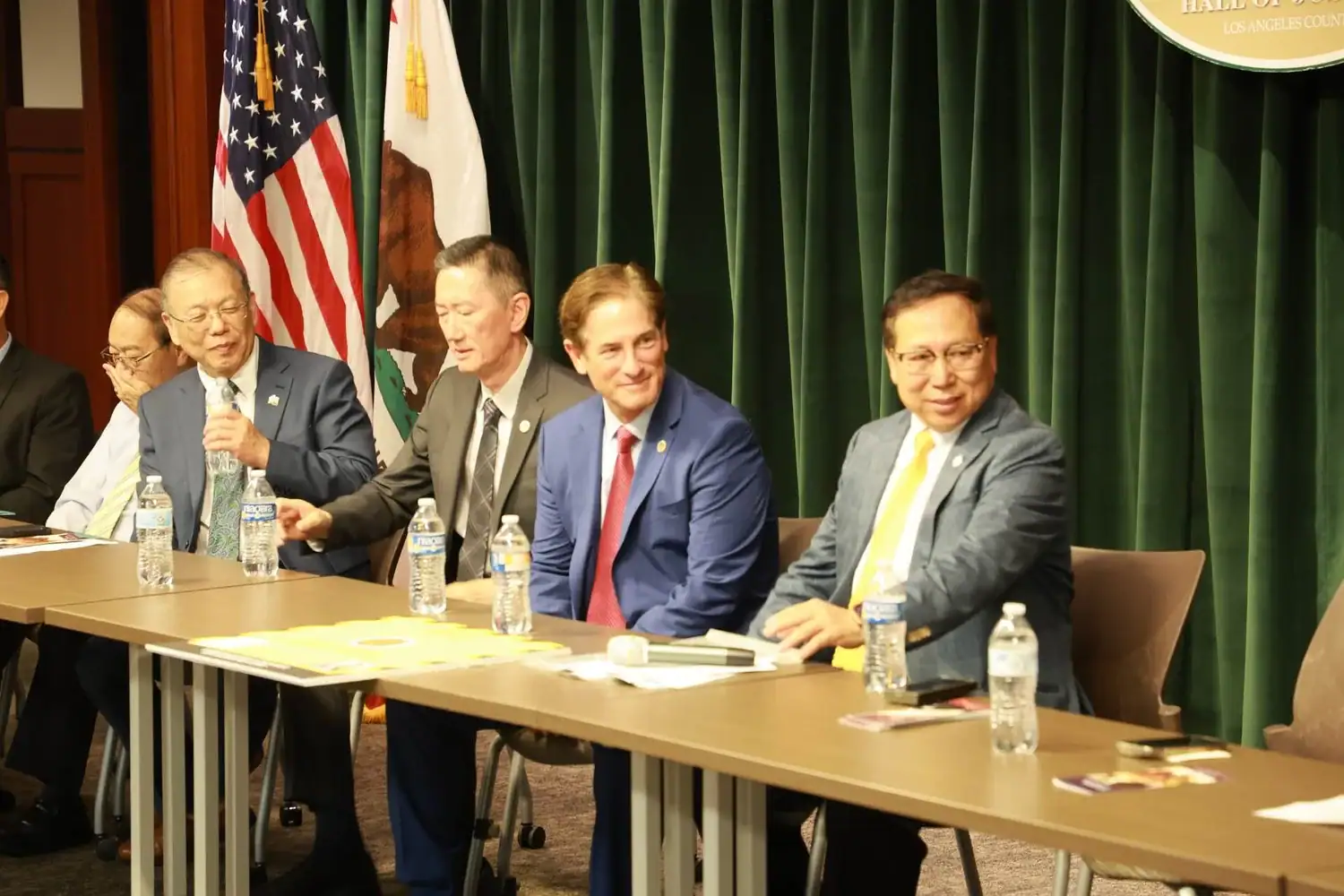
That generational transition has become one of the organization’s biggest strengths.
The chamber has already entrusted certain large-scale cultural events — including the annual Moon Festival — to younger second-generation leadership groups. Community leaders say mainstream corporate sponsors respond differently when younger, bilingual professionals take the lead, recognizing that they understand both Asian American communities and broader American culture.
Long-term institutional continuity has also played a major role in expanding the organization’s political influence.
Chester Chong, one of the chamber’s longtime leaders, first joined the organization’s board in 1988 and has spent nearly four decades serving in various leadership roles, including chairman and president.
Unlike many ethnic business organizations that avoid direct political involvement, Chong has publicly endorsed candidates and actively campaigned alongside them during local elections. He has personally escorted candidates through Chinatown during races for Los Angeles mayor, sheriff, and district attorney.
According to people familiar with the organization, Chong strongly believes that even unsuccessful political alliances strengthen Chinatown’s long-term political influence.
“If you sincerely support candidates and engage in the political process, the community gains influence regardless of who wins,” he has often argued.
Critics say that approach contrasts sharply with the more cautious culture within the Los Angeles Korean American Chamber of Commerce.
While the Korean chamber occasionally invites candidates to events or offers modest donations, critics argue it has rarely built the kind of long-term political relationships seen in Chinatown.
The Korean chamber’s bylaws emphasize promoting friendship, cooperation, and information-sharing among members while protecting the interests of Korean American business owners. But critics say the organization has become too internally focused, functioning more as a private networking structure than a broader community institution.
Non-members often find it difficult to access the chamber’s professional network or industry resources. Some board members have argued that the organization needs to become significantly more open and inclusive.
Another major concern is the lack of second-generation participation. Only a handful of board members are close to second-generation Korean American professionals, and programs specifically designed for younger leaders remain limited. Attendance at monthly board meetings has reportedly declined partly because younger Korean Americans feel disconnected from the organization.
Recently, Sang Bong Chung has attempted to address that issue by creating networking opportunities specifically for younger generations. He reportedly emphasized that the goal was simply to create space for younger professionals to connect freely without excessive oversight from senior leadership.
Community observers say the effort is an encouraging first step, though many believe much broader structural changes are needed.
Of course, the Chinese American and Korean American communities have different histories, cultures, and immigration experiences. But many observers argue that both communities ultimately share the same challenge: building long-term political and economic influence as minority communities in the United States.
For some Korean American leaders, that may require a willingness to look beyond traditional event-driven operations and begin thinking in terms of broader community empowerment, generational transition, and long-term institutional influence.