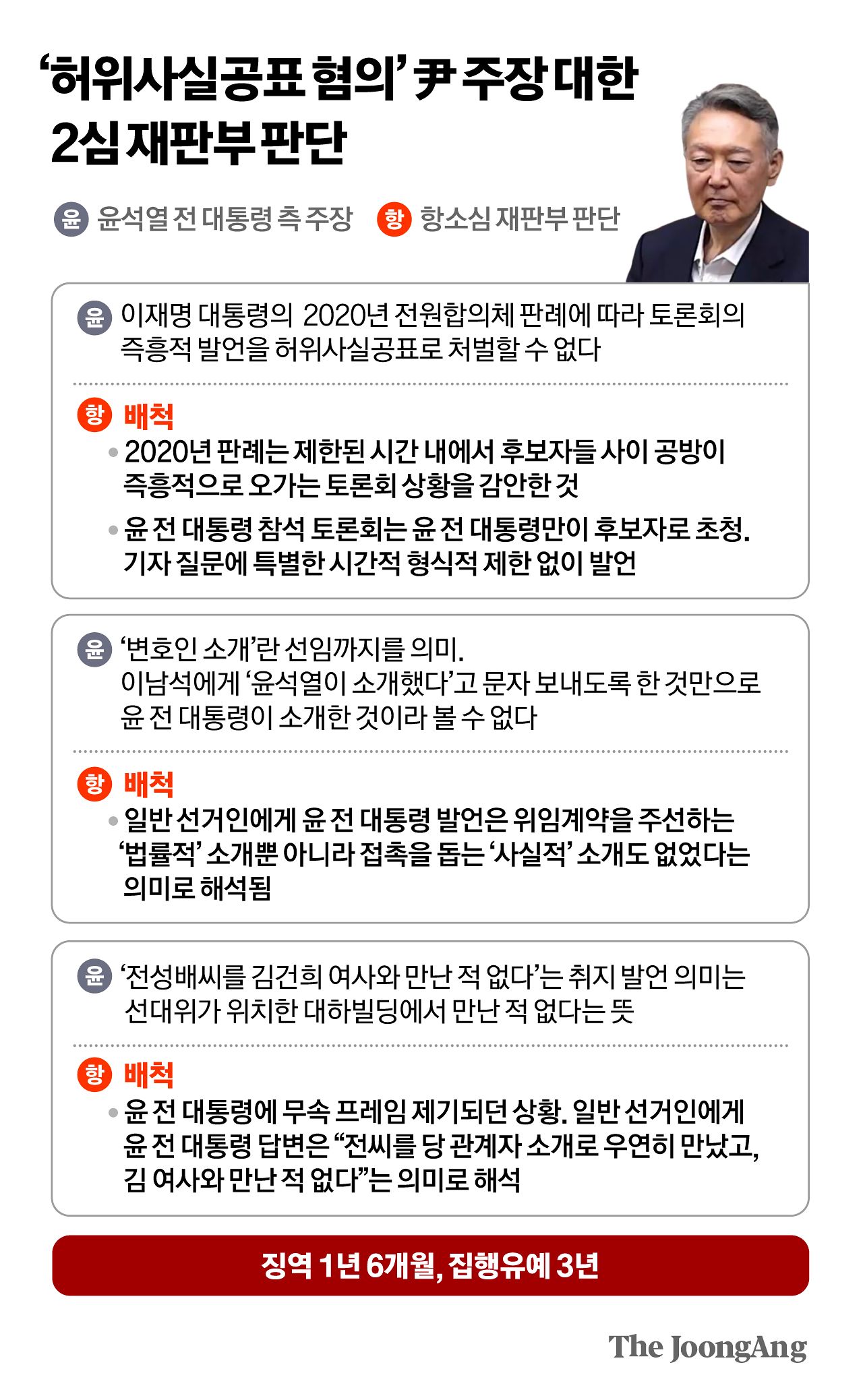
An appellate court has upheld a 당선무효형 (sentence invalidating an election victory) against former President Yoon Suk Yeol on charges of publicizing false information ahead of the 20th presidential election. The court heavily relied on the legal principles established by the Supreme Court in May of last year regarding the remand of Lee Jae-myung. The legal logic previously targeting Lee is now pressing down on the People Power Party. If this ruling is finalized, the party will be required to return 39.7 billion won in election expenses reimbursed from the 20th presidential election.
The 2nd Criminal Division of the Seoul High Court (Presiding Judge Baek Seung-yeop) dismissed the appeal filed by the former president, maintaining the original ruling of one year and six months in prison, suspended for three years. The appellate court noted that despite having a duty as a presidential candidate—the highest state responsibility—to provide proper grounds for judgment, he infringed on voters’ right to make informed choices by publicizing false information during the election process, and has consistently offered excuses since the investigation.
The former president was put on trial for two major instances of spreading false information during his 20th presidential campaign. He faced charges of falsely claiming during a Kwanhun Club roundtable in December 2021 that he had never introduced attorney Lee Nam-seok to former Yongsan Tax Office chief Yoon Woo-jin. He was also charged with falsely explaining during an interview at the Buddhist Leaders Forum in late 2022 that he had been introduced to Jeon Seong-bae by a party official and had never met him alongside Kim Keon-hee.
The core issue of the case was the permissible limits of freedom of political expression. Citing the Supreme Court ruling from May 1 of last year, the appellate court maintained that the expression’s meaning must be interpreted from the perspective of the voters rather than the individual candidate or the court, thus narrowing the scope of protected political expression.
The appellate court evaluated that ordinary voters would understand the remarks as implying that the defendant had not introduced attorney Lee Nam-seok to Yoon Woo-jin in either a factual or a legal sense. Pointing to past remarks, the court noted that the defendant was well aware of the distinction between factual and legal introductions.
Furthermore, the court stated it was recognized that Kim Keon-hee had maintained a close relationship with Jeon Seong-bae since 2013 and that the couple had met Jeon multiple times. Consequently, giving voters the impression that he had only encountered Jeon by chance during the campaign constituted the publication of false information.
The defense had argued for acquittal based on a 2020 Supreme Court en banc precedent concerning Lee Jae-myung’s “forced admission of an older brother to a mental hospital” remarks, arguing that impromptu debate comments warrant limited clarity. However, the appellate court ruled that the 2025 precedent applies since the statements in question were made during interviews and Q&A sessions with reporters rather than a restricted candidate debate.
Following the ruling, political parties expressed contrasting reactions over the application of the legal principles. While the Democratic Party welcomed the judiciary’s decision regarding election crimes, the People Power Party raised concerns over fairness regarding the handling of campaign fund returns.