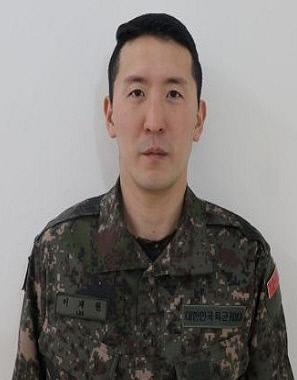
A Choice That Redefines Real Duty
In South Korea, few topics are as widely avoided as military service.
Even those who have completed it often hesitate to revisit their experiences. For many, conscription is not a matter of choice but an obligation—something to endure and move past.
That is precisely why the story of a 37-year-old man named Jae-won Lee stands out.
After serving as a captain in the United States Army—including a posting in South Korea—Lee made an uncommon decision: he returned to Korea, regained his citizenship, and enlisted again—this time as a rank-and-file serviceman.
Why would someone take such a path?
Lee’s answer lies not in circumstance, but in identity.
He comes from four generations of military service. His grandfather retired as a colonel, his father served as a lieutenant, and his great-grandfather was a Korean independence activist during the Japanese colonial era. For Lee, service is not simply a duty imposed by the state—it is a legacy inherited from family and history.
Even while wearing the U.S. uniform, Lee says he never forgot Korea.
His turning point came while stationed at Camp Humphreys in Pyeongtaek. There, he met his British wife, who developed a deep appreciation for Korean culture and strongly supported his decision to reconnect with his roots. Her support ultimately helped lead him to reclaim his Korean nationality after more than two decades and fulfill his military obligation.
The decision was not easy.
Lee left behind a stable career as a U.S. federal employee. He even pursued legal action in an attempt to serve on active duty in Korea, but ultimately was assigned to public service duty due to institutional limitations. Still, he did not waver.
“Loyalty is not defined by rank or form of service,” he said.
Today, Lee is undergoing training alongside recruits much younger than himself, preparing to serve as a public service worker. Gone is the polished uniform of a commissioned officer—replaced instead by dust and sweat—but his sense of purpose appears stronger than ever.
His story forces us to confront an uncomfortable question: What does military service really mean?
In a time when some young men seek to avoid conscription—sometimes even by leaving the country—Lee’s decision runs in the opposite direction. It reflects not obligation, but conviction.
For many Korean Americans, particularly second-generation immigrants, identity is often defined by distance. But Lee’s journey suggests something different—that identity can also be defined by return.
What lies ahead for him remains uncertain. Will he continue a career in military service, or transition into public office or civilian life? Whatever path he chooses, one thing seems clear: fear is unlikely to be a factor.
Supported by his wife and guided by a deeply rooted sense of purpose, Lee has already made a choice that few would consider—and even fewer would follow.
In doing so, he has redefined what it means to serve.
What else can we say? just 이재원 파이팅!!
EunYoung Lee contributed to this story. |