Artificial intelligence is rapidly expanding its role in personal finance, with more Americans turning to AI chatbots for guidance on investing, saving, budgeting, and debt management than ever before.
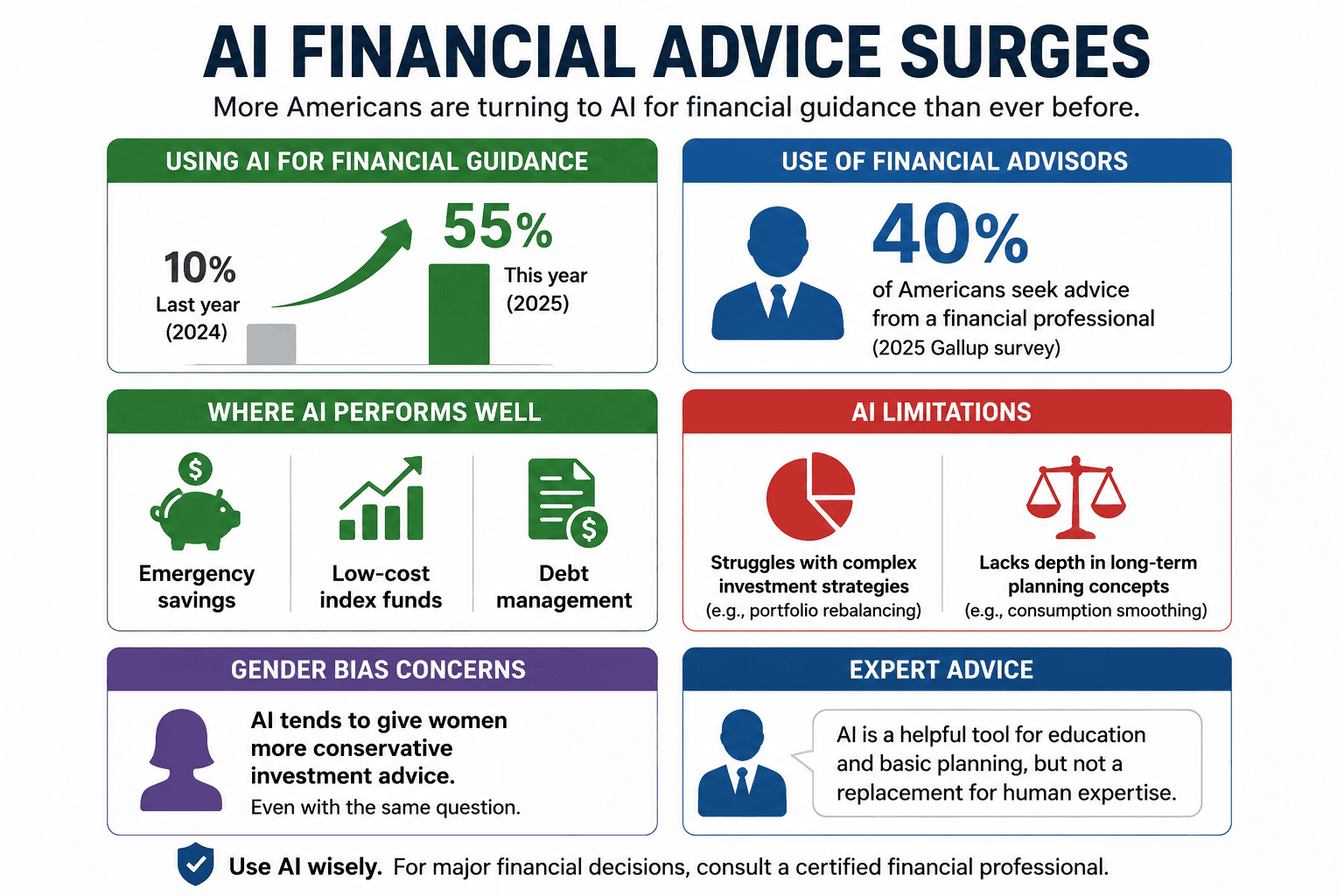
According to a recent survey by TD Bank, the percentage of Americans using AI tools to help manage their finances jumped from just 10% last year to 55% this year. The figure now exceeds the share of consumers who seek advice from financial professionals. A 2025 Gallup survey found that only about 40% of Americans consult a financial advisor for financial guidance.
Experts say AI’s growing popularity stems largely from its accessibility and convenience. Users can receive instant answers to questions about investing, retirement planning, budgeting, and debt reduction without scheduling appointments or paying consultation fees. Younger consumers, in particular, are increasingly relying on AI-powered tools to help make financial decisions.
However, researchers caution that AI-generated financial advice has important limitations.
A study conducted by researchers at the Massachusetts Institute of Technology (MIT) and Stanford University examined the types of financial questions asked by 1,000 participants and evaluated the quality of responses generated by popular AI chatbots.
The researchers found that AI generally performs well when providing basic financial guidance, such as building emergency savings, investing in low-cost index funds, and reducing exposure to high-risk investments. In these areas, chatbot responses were often consistent with widely accepted personal finance principles.
The technology struggled, however, when addressing more sophisticated financial concepts. AI frequently failed to adequately explain portfolio rebalancing strategies designed to maintain a target level of investment risk, as well as “consumption smoothing,” a concept that focuses on balancing spending and saving over a person’s lifetime.
The study also found that the quality of AI-generated advice depends heavily on the user’s level of financial literacy. Participants with stronger financial knowledge tended to ask more precise and detailed questions, which resulted in more accurate and useful responses. Researchers estimated that investment decisions based on higher-quality prompts could potentially generate long-term returns roughly 5% greater than those based on less informed questions.
Another concern identified by researchers was gender bias.
The study found that AI systems often provided more conservative investment recommendations to women than to men. Female users were more likely to receive suggestions emphasizing lower-risk portfolios and reduced stock allocations.
Some of the differences reflected the types of questions being asked. Men were more likely to inquire about stocks and aggressive investment strategies, while women tended to focus on debt management and lower-risk financial planning. However, researchers also found instances in which AI generated more conservative recommendations for women even when the same question was asked.
Experts warn that artificial intelligence may be replicating some of the same biases historically observed among human financial advisors. AI specialist Sam Taube noted that gender bias present in traditional financial planning could carry over into AI-driven systems if not carefully addressed.
While AI can serve as a valuable tool for financial education and basic planning, experts recommend using chatbot-generated advice as a starting point rather than a final decision-making authority. For major financial decisions involving investments, retirement planning, or wealth management, consulting a certified financial professional remains the safest approach.