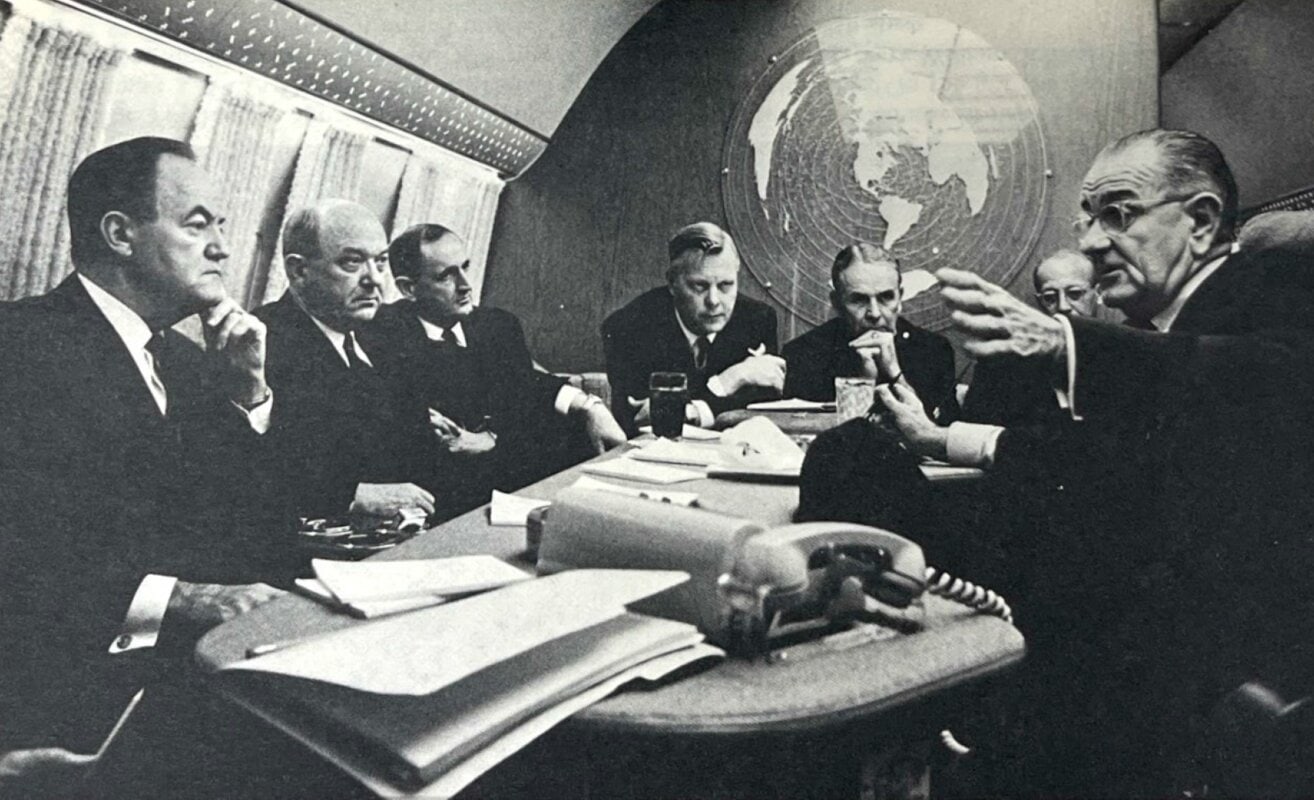
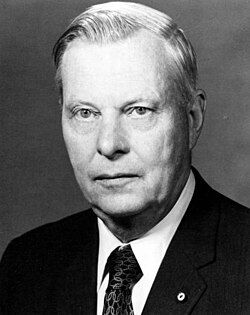
There was once a young American diplomat who, in the 1930s, considered the idea of Korean independence almost unthinkable. Yet after Japan’s defeat in August 1945, he became an outspoken advocate for quickly removing the remnants of Japanese colonial rule from the Korean Peninsula — and ultimately helped influence U.S. policy.
His name was Ural Alexis Johnson (1908–1997), who would later serve as U.S. ambassador to Japan. When Johnson was appointed to the post, The New York Times, in its July 26, 1966, edition, described him as a “Far East expert.”
Johnson entered the U.S. Foreign Service in 1935. Two years later, after serving in Japan, he was assigned as vice consul at the U.S. Consulate in Seoul.
Seoul was also where Johnson first found real satisfaction in his career as a diplomat.
In his 1984 memoir, The Right Hand of Power, Johnson recalled that his fluency in Japanese made him particularly well suited to mediating between Americans in Korea and the Japanese authorities. The memoir, written with Jef Olivarius McAllister, recounts Johnson’s decades in American diplomacy.
His initial assessment of Korea’s prospects, however, was deeply pessimistic.
Johnson described colonial Korea as “the pathetically corrupt and weak Korean government offered no resistance.” From what he saw at the time, he wrote, the possibility of Korean independence barely seemed imaginable.
“I never did cross my mind during the trip or any other time that South Korea would ever gain independence from Japan,” Johnson recalled in substance. “Simply too preposterous.”
At the same time, Johnson was sharply critical of the brutality of Japanese colonial rule. His memoir described policies aimed at suppressing Korean identity, including forced assimilation, Japanese-language education and the inculcation of Japanese nationalism.
By seeing this, Johnson mentioned “I never did understand why the Japanese, whose sense of tradition and formality is so highly developed, could not see how offensive they were to Koreans and how much just a little tact might have learned.”
He also recalled having the impression that Japanese Army and police stationed in Korea treated Koreans far more harshly than Japanese naval officers in Taiwan.
Determined to better understand Korea, Johnson traveled extensively around the peninsula. In 1938, he journeyed from Seoul through Pyongyang, Manpojin and Unsan and into the northern regions.
He later recalled that the knowledge he gained of Korea’s geography and climate proved valuable when he became involved in U.S. policy and support operations before and during the Korean War.
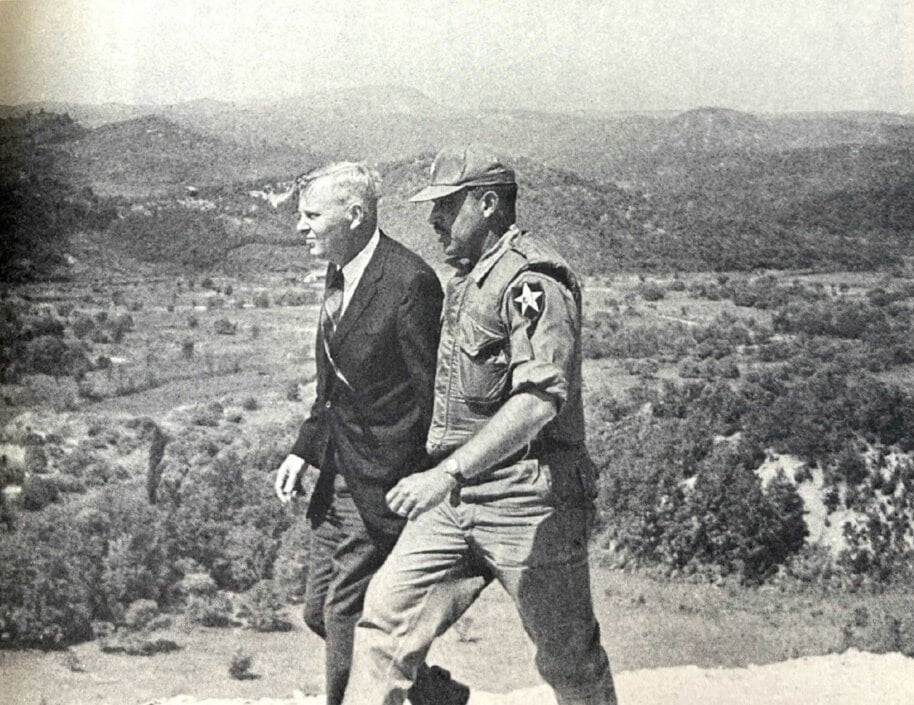
On August 16, 1945, Johnson was serving as a U.S. consul in Manila when Lt. Gen. Richard Sutherland, chief of staff to Gen. Douglas MacArthur, asked him to meet Lt. Gen. John R. Hodge, commander of the U.S. Army’s XXIV Corps, which was preparing to enter Korea.
Johnson was one of the few American officials in the region with firsthand experience in Korea. His later oral history confirms that he was working closely with Sutherland and MacArthur’s headquarters during the early occupation period.
After meeting Hodge, Johnson was struck by how little the general and his staff knew about Korea.
What alarmed him most was their initial occupation plan.
The proposal called for retaining much of the Japanese colonial administrative structure, including the Japanese governor-general and his officials, to administer Korea under the authority of the U.S. military government. The approach largely mirrored the occupation model being prepared for Japan.
Johnson strongly objected. He believed that preserving the Japanese apparatus in Korea would amount to extending the very police-state system Koreans had endured under colonial rule.
In later accounts, he described the officials available to run the country as essentially “despised Japanese occupiers and their puppets.”
Johnson and Hodge raised the issue with Sutherland and MacArthur, arguing that Korea required a separate military-government policy.
MacArthur, however, showed little interest in revising the plan.
Johnson later mentioned that MacArthur “unwilling to go back to Washington at that point.”
Johnson therefore took another route.
He raised the matter with his superior, U.S. Consul General in Manila Paul Steintorf, who reported it to the State Department. The archival record confirms that Steintorf’s August 26 telegram informed Washington directly of Johnson’s objections to retaining the Japanese colonial administration.
The matter ultimately reached senior officials in Washington and helped force a reconsideration of the occupation policy.
Amid fierce Korean opposition to the continued presence of Japanese officials, the Truman administration moved away from their retention. Historical records show that the decision to temporarily retain Japanese officials generated intense criticism and was subsequently reversed.
Johnson returned to Korea on September 22, 1945, six years after his earlier assignment, this time to assist Hodge as the U.S. military government was being established.
He maintained close contact with Hodge’s staff, at one point even allowing one of the general’s aides to stay at his quarters as he worked to understand developments on the ground.
Despite his criticism of the original occupation plan, Johnson later offered a more sympathetic assessment of Hodge himself.
He described Hodge as an earnest and capable soldier and a better administrator than his later reputation suggested. The greater problem, in Johnson’s view, was that Hodge had begun his mission under fundamentally flawed instructions.
For Johnson, witnessing the end of Japanese colonial rule and Korea’s liberation was deeply emotional.
He wrote that seeing Korea freed was an intensely moving experience. It also forced him to acknowledge how badly he had misjudged the country years earlier when he thought independence was virtually impossible.
For the veteran diplomat, it became an enduring lesson about the limits of predicting history.
In fact, Johnson’s connection to Korea had begun even before his posting to Seoul.
At Foundry Methodist Church in Washington, D.C. — the church where Johnson was married — a Korean man regularly attended services and persistently spoke about his country’s struggle for independence.
The young Johnson paid little attention.
At the time, he regarded the Korean as something of a “hopeless idealist,” a man pursuing a cause that seemed to have little chance of success.
That man was Syngman Rhee, who would later become the first president of the Republic of Korea.