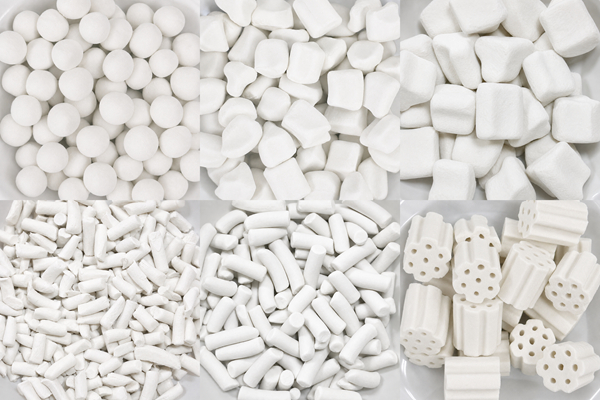
PureSphere Co., Ltd. (CEO Jihn-Koo Lee) announced that it has developed a catalyst capable of simultaneously decomposing perfluorocompounds (PFCs) and nitrous oxide (N2O), both emitted during semiconductor, display, and solar cell manufacturing processes, and is moving to supply the product to the market in earnest.
Etching and chemical vapor deposition (CVD) processes used in semiconductor, display, and solar cell manufacturing can emit fluorinated greenhouse gases such as carbon tetrafluoride (CF4), nitrogen trifluoride (NF3), and sulfur hexafluoride (SF6), along with nitrous oxide (N2O). These gases are classified as greenhouse gases with a significant impact on global warming, and as demands for global carbon neutrality and greenhouse gas reduction intensify, the importance of post-treatment technology that can effectively decompose and process them is also growing.
Conventional PFCs treatment has mainly relied on scrubbers that thermally decompose the gases at high temperatures. However, because this method requires continuously maintaining high operating temperatures, it consumes large amounts of energy in the form of electricity and fuel, and creates thermal and maintenance burdens on equipment from high-temperature operation.
Catalytic decomposition offers an advantage in that the catalyst lowers the activation energy required for the reaction, enabling gas decomposition at lower temperatures than conventional high-temperature incineration.
Building on this catalytic technology, PureSphere has developed a catalyst that can treat PFCs and N2O simultaneously in a single process. Rather than simply lowering the operating temperature, the company focused on securing catalyst activity and durability by accounting for the acid gases, moisture, and oxygen that can be present in actual exhaust gas from semiconductor and display manufacturing processes.
Cu- and Fe-zeolite-based catalysts, commonly used for N2O decomposition, typically show high activity at relatively low temperatures but can suffer reduced durability in real process environments where acid gases and moisture are present. Conversely, conventional commercialized PFCs decomposition catalysts can be used to treat PFCs but have relatively low N2O decomposition efficiency, making it difficult to effectively treat both greenhouse gases at once.
The catalyst developed by PureSphere is designed to address these limitations of existing technology. Its key feature is that it maintains catalyst durability under conditions involving acid gases and moisture, as well as in an oxygen atmosphere, while simultaneously decomposing PFCs and N2O.
The catalyst is also expected to offer economic advantages. Its use can lower the operating temperature to around 750°C, reducing the electricity and gas consumption needed for scrubber operation compared to conventional high-temperature incineration. The company expects this could cut energy costs by roughly 30 to 50 percent or more, depending on the process and operating conditions.
Another strength is that, rather than requiring separate processes or equipment to treat PFCs and N2O as in the past, a single scrubber can treat both types of greenhouse gases at once. This is expected to simplify equipment configuration, reduce installation footprint, and contribute to lowering overall process costs, including initial equipment investment and operating expenses.
“We have developed a catalyst that treats PFCs and N2O simultaneously while maintaining durability under actual process conditions where acid gases, moisture, and oxygen are present,” a PureSphere official said. “We expect it to help reduce the high energy consumption and equipment burden of conventional high-temperature incineration methods, while contributing to greenhouse gas reduction and process efficiency in the semiconductor and display industries.”
PureSphere is an environmental materials company specializing in catalysts for removing air pollutants such as ozone (O3), carbon monoxide (CO), and volatile organic compounds (VOCs), with the technical capability and production infrastructure to design and manufacture catalysts optimized to each client’s process environment and equipment conditions.
The company has been expanding its business scope by developing and commercializing air-environment catalysts using transition and precious metals, as well as adsorbents and environmental equipment, and has recently broadened the application of its technology into carbon neutrality and greenhouse gas reduction.
In particular, PureSphere is pursuing the development and commercialization of core materials and technologies in the carbon-neutrality field, including catalysts to reduce methane slip emitted from LNG-fueled vessels and carbon dioxide (CO2) adsorbents. Through this, the company is expanding the catalyst technology it has accumulated in air pollutant reduction into the greenhouse gas reduction field, strengthening its technological competitiveness to respond to the eco-friendly, carbon-neutral market.