
As high inflation and living costs persist, Korean Americans are cutting expenses while seeking to protect their homes, investments and retirement savings. The Korea Daily and Bank of Hope conducted the “2026 Korean American Economic Life Survey” to examine the community’s financial life and changes since 2020. This five-part series looks at key trends in employment, income, housing, investment, living costs and banking.
〈SERIES〉
- Employment, Income & Business Trends
- Housing & Home Equity
- Investment & Retirement Planning
- Inflation & Living Costs
- Korean American Bank Usage
Survey Highlights Structural Shift from Self-Employment to Salaried Roles Among Korean Americans
Long-term economic pressures and high living costs are reshaping the demographic and financial landscape of the Korean American community, according to a recent comprehensive survey.
The “2026 Korean American Economic Life Survey,” conducted in partnership with Bank of Hope, tracks financial activities, employment trends, and income shifts across the community since 2020. Findings from the five-part series show a clear departure from traditional entrepreneurship, alongside a growing retiree demographic and widespread income stagnation.
When asked about their current primary occupation:
-
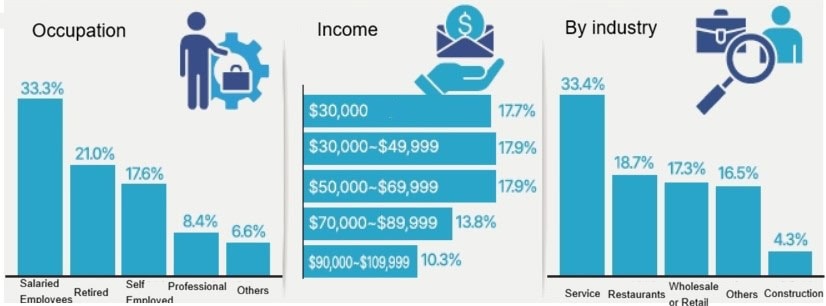
Salaried Employees: Formed the largest segment at 33.3%.
-
Retirees: Accounted for 21.0%.
-
Self-Employed Business Owners: Represented 17.6%.
-
Professionals: Totaled 8.4%.
-
Freelancers and Independent Contractors: Stood at 6.6%.
-
Other Occupations: Recorded 5.8%.
Multi-Year Data Confirms Decline in Small Business Ownership
A multi-year comparison tracking data from 2020 to 2026 illustrates a structural decline in small business ownership among Korean Americans.
Self-employed individuals made up 24.4% of respondents in 2020, dropping to 19.6% in 2023, and falling further to 17.6% in 2026. Conversely, salaried corporate workers expanded from 22.9% in 2020 to 35.3% in 2023, settling at 33.3% in 2026. While self-employed business owners outnumbered corporate employees in 2020, salaried workers now outnumber business owners nearly two-to-one.
Simultaneously, the proportion of retirees expanded from 11.9% in 2020 to 17.6% in 2023 and 21.0% in 2026, reflecting rapid population aging within the community.
Household Incomes Stagnate for More Than Half of Respondents
Income levels across Korean American households showed widespread stagnation year-over-year.
A majority of survey participants—51.2%—reported that their household income remained unchanged compared to the previous year. Meanwhile, 23.0% noted an increase in income, and 22.8% experienced an income reduction. While conditions represent a substantial recovery from 2020—when 69.3% reported falling incomes during the peak of pandemic disruptions—more than half of households continue to navigate flat wage growth amidst persistent inflation.
Annual income distribution remains heavily concentrated in low-to-middle brackets:
-
Under $30,000: Reported by 17.7% of respondents.
-
$30,000 to $49,999: Logged by 17.9%.
-
$50,000 to $69,999: Recorded by 17.9%.
Combined, 53.5% of all respondents reported earning less than $70,000 annually.
Income distribution varied significantly by profession. Salaried workers clustered primarily in middle-income tiers, with 20.6% earning between $50,000 and $69,999 and 19.1% earning between $70,000 and $89,999. Licensed professionals recorded higher earning tiers, with 22.6% making $150,000 or more. Government employees also reported steady middle-to-upper compensation, with 47.2% earning between $70,000 and $109,999.
The self-employed segment exhibited significant income disparity. While 17.9% earned between $50,000 and $69,999, 14.8% earned between $30,000 and $49,999, and 12.6% earned under $30,000. Conversely, high earners generating $200,000 or more accounted for 11.2% of business owners.
Rising Operating Expenses and Weak Demand Squeeze Small Business Owners
Despite broad income variations, small business owners report facing severe operational headwinds due to declining revenue and surging overhead expenses.
Over half of self-employed respondents—57.1%—reported a year-over-year decrease in sales, while 28.8% reported flat revenue, and only 10.5% saw revenue growth. Revenue declines hit mature business owners hardest, impacting 61.9% of entrepreneurs in their 50s and 58.3% of those in their 60s.
When asked to identify their single greatest operational challenge, 47.0% cited declining sales and customer foot traffic, while 35.8% highlighted rising operating expenses and commercial rent burdens. Concerns over operational costs have risen dramatically over time, climbing from 15.3% in 2020 to 31.4% in 2023 and 35.8% in 2026.
Small Business Landscape Shows Divergence and Reduced Startup Activity
The structural composition of Korean American businesses remains overwhelmingly concentrated among small-scale enterprises.
Businesses generating under $500,000 in annual revenue comprised 49.2% of total commercial entities. Those generating between $500,000 and $1 million represented 24.0%, while companies earning between $1 million and $5 million made up 16.8%. Enterprises generating $5 million or more accounted for 10.1%. While businesses earning under $500,000 decreased from 68.4% in 2020 to 49.2% in 2026, growth in higher-revenue brackets points to growing scale divergence among established firms.
By industry sector:
-
Service Sector: Led business distribution at 33.4%.
-
Food & Dining Services: Followed at 18.7%.
-
Wholesale and Retail: Accounted for 17.3%.
-
Construction: Fell from 6.4% in 2020 to 4.3% in 2026, driven by tariff uncertainties and material cost fluctuations.
The vast majority of Korean American businesses operate with small teams. Firms employing 10 or fewer workers accounted for 90.9% of all surveyed businesses, while 11 to 30 workers made up 6.9%, and firms with over 30 employees represented under 2%.
In terms of operational history, 29.2% of businesses have been operating for 10 to 20 years, 22.0% for over 20 years, and 23.6% for 5 to 10 years. Conversely, new startups operating for less than two years plummeted from 39.4% in 2020 to 10.2% in 2023 and 8.0% in 2026, signaling a sharp slowdown in new commercial ventures across the community.