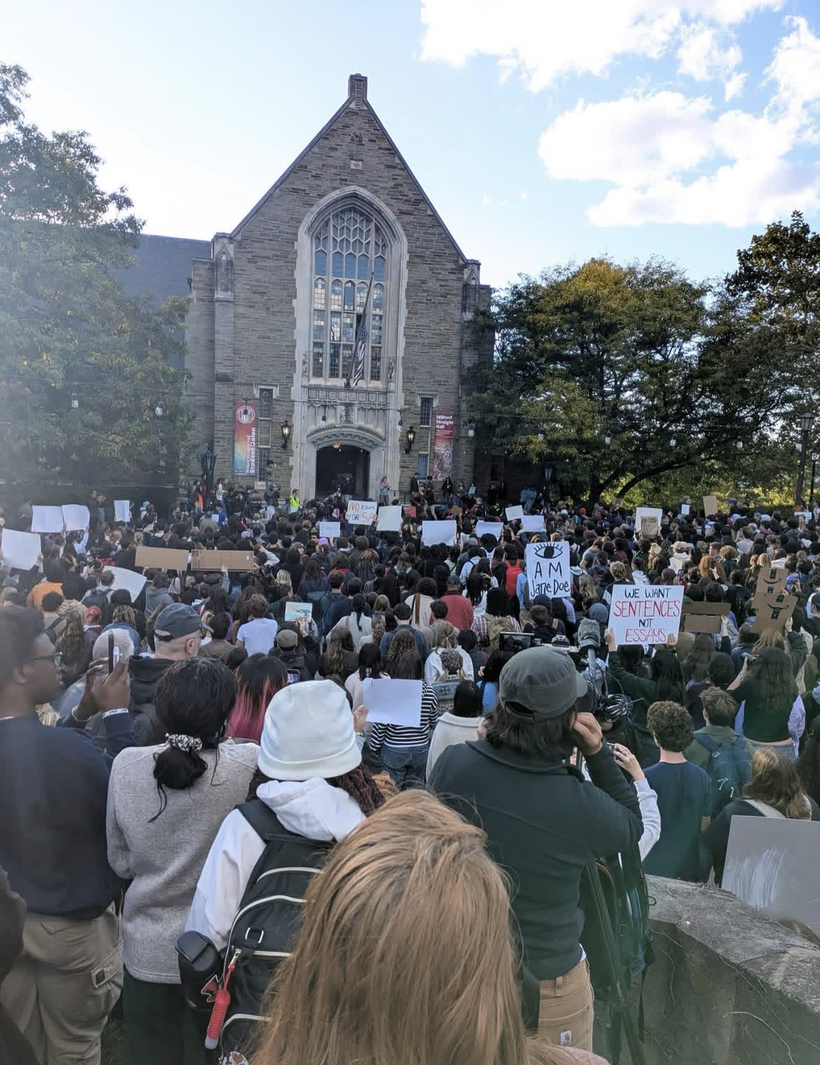
The disciplinary and investigative procedures surrounding a Cornell sexual assault case have sparked massive backlash across the university and the surrounding community. Thousands of students, faculty members, and local residents gathered on campus to protest the university’s handling of the incident.
According to disciplinary records obtained by The New York Times, two of the seven accused students were expelled. Two others received suspensions and disciplinary probation, while one was barred from campus for three years. The remaining two students faced restrictions including no-contact orders with the victim, mandatory educational classes, and written apologies.
Korean student Winston Lee received a two-year suspension and disciplinary probation. According to the complaint, the female victim alleged that Lee inhaled ketamine on top of her and forced her to perform oral and vaginal sex.
A recorded phone call between Lee and the victim immediately following the incident was also newly released. In the November 7, 2024, call obtained by ABC News, Lee expressed remorse for the “backlash” the victim experienced as a result of the incident. He also stated that there was no way for him to have known what was happening inside the room when he entered.
The victim’s legal representation issued a statement on the 3rd criticizing the disciplinary actions for failing to reflect the severity of the allegations, noting that all but two of the students would ultimately still be able to receive Cornell degrees.
New details have also emerged regarding the response of the prosecutor’s office that handled the case at the time.
Tompkins County District Attorney Matthew Van Houten had previously stated that he received only a six-page summary of the incident from Cornell police. However, records reviewed by The New York Times indicate that police offered to review additional evidence, but Van Houten declined.
As concrete details of the university discipline and initial investigation continue to surface, anger among Cornell community members continues to mount.
A large-scale campus protest was held on the 5th. According to The Cornell Daily Sun, participants marched to Day Hall, the university’s administration building, wearing name tags reading ‘Jane Doe’ and purple pins symbolizing the sexual assault survivors’ network.
Protesters chanted slogans such as “No justice, no peace” and “Ban fraternities.” When President Michael Kotlikoff’s name was mentioned, cries for his resignation rang out.
Protest organizers demanded the establishment of minimum disciplinary standards for sexual assault cases, standard investigation periods, and enhanced training for campus police in responding to sexual violence. Some participants also called for the expulsion and degree revocation of the students involved, as well as the transition of the university’s internal disciplinary system into an independent body.
The Cornell University Faculty Senate is pursuing a vote of no-confidence against the central administration. The draft resolution states that the faculty “does not have confidence in the central administration’s ability to effectively address the ongoing sexual violence crisis at Cornell.”
Even if the no-confidence motion passes, it does not grant the authority to directly dismiss the president or administrative officials. However, Ariana Kim, a professor and member of the Faculty Senate, explained to The New York Times on the 6th that the move essentially sends a clear message to university leadership: “We do not believe you are fit to run this institution.” Following students’ demands for the president’s resignation, the faculty has also moved to formalize its lack of trust in the leadership.
Anger and solidarity movements surrounding the incident have extended online as well.
When political commentator Michael Tracey recently announced plans to obtain and reveal Jane Doe’s actual identity, thousands of social media users began posting phrases such as “I am Jane Doe.” This effort aims to hinder attempts to uncover the victim’s real identity, allowing users to identify with the anonymous victim and demonstrate solidarity in protecting her identity.
To date, none of the seven accused males have been criminally charged. New York Governor Kathy Hochul appointed New York Attorney General Letitia James as a special prosecutor on the 1st to handle the reinvestigation of the case and determine whether to pursue criminal charges.