Bipartisan support for the South Korea-U.S. alliance remains strong nationwide, but a clear ideological temperature gap exists when it comes to viewing South Korea depending on political party alignment, according to a recent report.
While perceptions in the security sector matched evenly between Democratic and Republican supporters, wide gaps emerged in favorability, trade, and culture. Notably, favorability toward South Korea among supporters of the ruling Republican Party has cooled significantly compared to the past.
According to the “U.S. Perceptions of the Korean Peninsula” survey released on the 8th by the Washington D.C.-based Korea Economic Institute (KEI), 64% of total respondents answered that the South Korea-U.S. alliance serves U.S. national security interests. By political party, 71% of Democrats and 73% of Republicans agreed, showing virtually no difference. Similarly, 71% of respondents favored deploying U.S. troops to defend South Korea in the event of a North Korean invasion.
This demonstrates that the importance of the alliance forms a solid consensus across party lines. The fact that 75% of total respondents evaluated the alliance as beneficial to the U.S. or both countries further reinforces this bipartisan support.
Conversely, clear differences in perspective between the two party bases appeared in trade, culture, and national favorability.
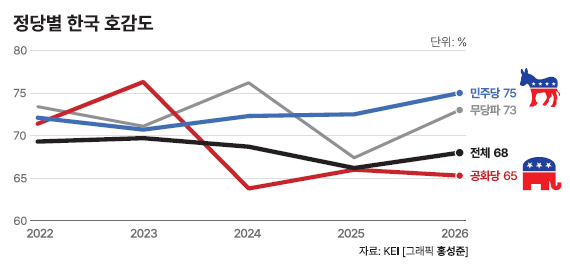
Favorability toward South Korea stood at 75% for Democrats and 65% for Republicans, showing a 10 percentage point gap. In particular, Republican favorability had risen steadily since KEI surveys began in 2020, peaking at 76% in 2023, but plunged to 64% the following year and has failed to recover. In contrast, Democratic favorability has risen steadily from 69% in 2020.
Overall favorability toward South Korea this year reached 68%, a 3 percentage point increase compared to the 2020 survey, but it has largely remained capped in the upper 60% range over the past seven years. This suggests there are limits to how directly the popularity of Korean cultural waves like K-pop and K-food translates into national favorability.
The most extreme temperature gap appeared in trade policy. The proportion of respondents hoping to expand trade with South Korea was 27% among Democrats, compared to only 14% among Republicans.
Support for tariff reductions on South Korean products also stood at 55% for Democrats and 44% for independents, while only 16% of Republicans supported it. These figures reflect America First and protectionist sentiments deeply rooted among the Republican base since the launch of the second Trump administration.
Cultural consumption and interest tendencies also mirrored party lines directly. Interest levels among Democrats significantly outpaced Republicans across all surveyed items, including food, beauty, K-pop, and movies. In particular, the interest gap in food and beauty categories was the widest at 16 percentage points.
Meanwhile, the response that “there is not a single Korean culture of interest” accounted for a majority of 52% among Republicans, well ahead of Democrats (33%). Despite this, 59% of all respondents evaluated that Korean culture plays a positive role in enhancing South Korea’s image domestically.
This survey shows that while the solid backbone of the alliance remains intact, protectionism and cultural conservatism centered around the conservative base are acting as variables hindering economic and cultural ties between the two countries.
The survey was conducted by KEI together with polling agency YouGov from August 21 to September 1, targeting 1,207 adults.