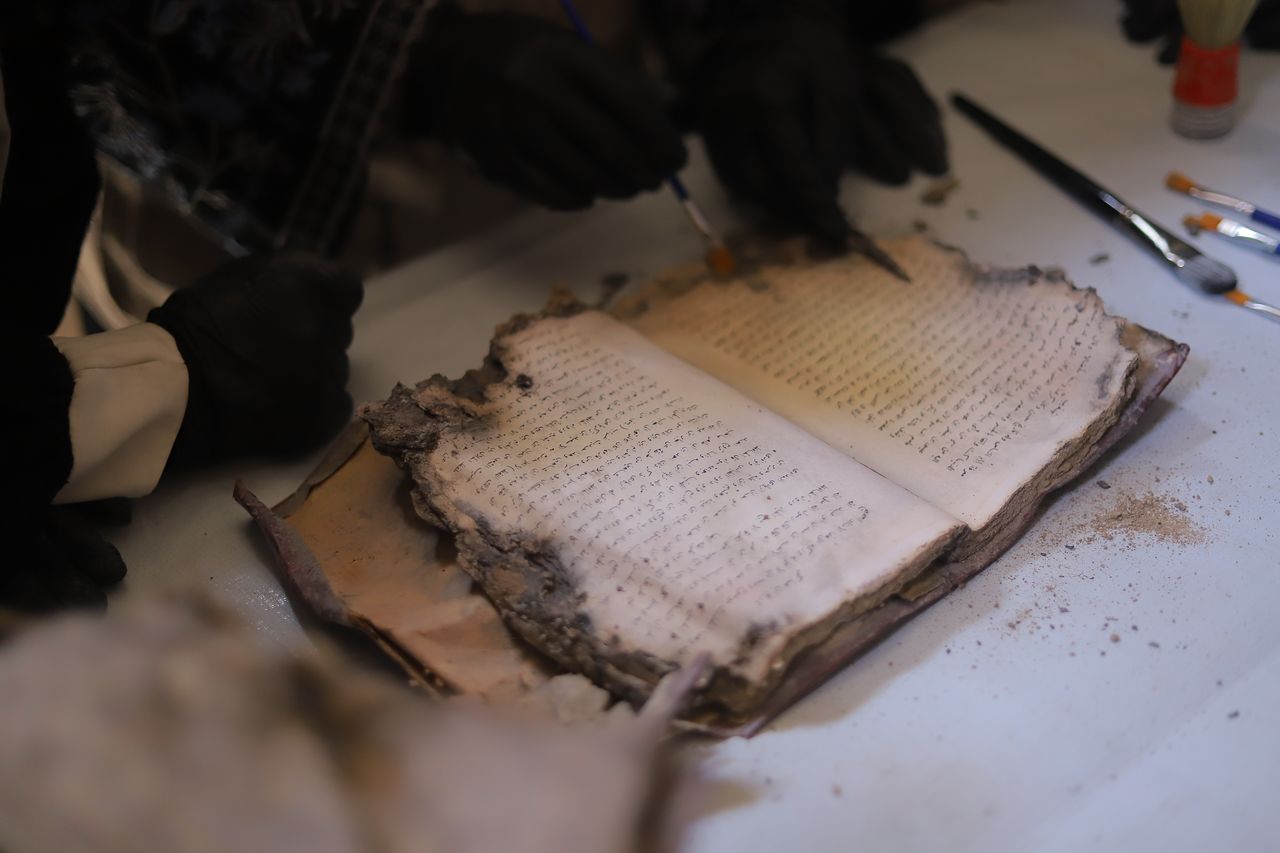
In December 2023, an Israeli airstrike targeted and destroyed the library of the Great Omari Mosque in the Gaza Strip. The facility had housed rare manuscripts and archival materials relating to Islamic jurisprudence and theology dating back to the 13th century. Individuals rushed into the ruins of the destroyed library to rescue the ancient texts.
Lacking heavy machinery, they cleared the rubble with their bare hands, working from 6 a.m. to 6 p.m. daily. The excavated materials needed to be converted into digital formats, but frequent power outages posed severe challenges. The restorers recalled that despite the grim reality, every single sheet of paper they managed to save felt like reclaiming their own souls.
Those individuals are Palestinian manuscript researcher Abdul Latif Abu Hashem and preservationist Haneen Al-Amassi, both active in the Gaza Strip. Last month, UNESCO selected them as the recipients of the UNESCO Jikji Prize. Established in 2004 to commemorate the inscription of Jikji—the world’s oldest extant metal movable print book—on the UNESCO Memory of the Register, the prize honors contributions to the preservation and research of documentary heritage. This marks the first time individuals, rather than an organization, have won the award.
According to UNESCO, more than 258 rare ancient manuscripts and approximately 25,000 pages of historical records have been preserved and digitized through the efforts of Abu Hashem and Al-Amassi. Due to ongoing conflict, the two could not attend the award ceremony held last month in Cheongju, South Korea, where Jikji was originally printed. In an email interview, they expressed that they accepted the honor not as personal recognition, but as a tribute to the memory and heritage of Gaza.
Abu Hashem, who has long worked with ancient texts at the library, founded the ‘Eyes on Heritage’ foundation in 2007 to restore documentary heritage such as rare manuscripts. Al-Amassi, a conservation specialist, joined the foundation in its early stages. The foundation has focused on collecting, cataloging, and creating copies of historical records, photographs, and ancient texts scattered or buried across the region.
Continuing restoration work in war-torn Gaza was far from easy. In 2014, the foundation’s building was destroyed by a massive Israeli airstrike. Abu Hashem explained that over 1,000 rare books, dozens of manuscripts, and various archives were lost. That harrowing experience accelerated plans to not just preserve historical texts physically, but to digitize them comprehensively to protect them from complete destruction by bombings.
The pair described the Israeli attacks as ‘cultural genocide.’ They criticized the actions as an attempt to erase the Palestinian narrative and obliterate their identity, noting that once documentary heritage vanishes, it becomes much easier to compress thousands of years of Gaza’s history into just a few decades.
Last year, another Israeli airstrike leveled the foundation building once more. Abu Hashem reflected that it felt as though Gaza’s layered memories had been buried beneath the debris. However, Abu Hashem and Al-Amassi immediately set out to recover the artifacts trapped beneath the wreckage. Abu Hashem emphasized that even though the physical places housing memories were destroyed, they sought to rescue memory itself, pointing out that some of the saved documents do not exist anywhere else in the world’s major libraries.
Abu Hashem and Al-Amassi described their mission as a profound sense of responsibility toward past generations who passed down these materials for centuries, as well as toward the future generations of Palestine who hold the full right to inherit that memory intact.