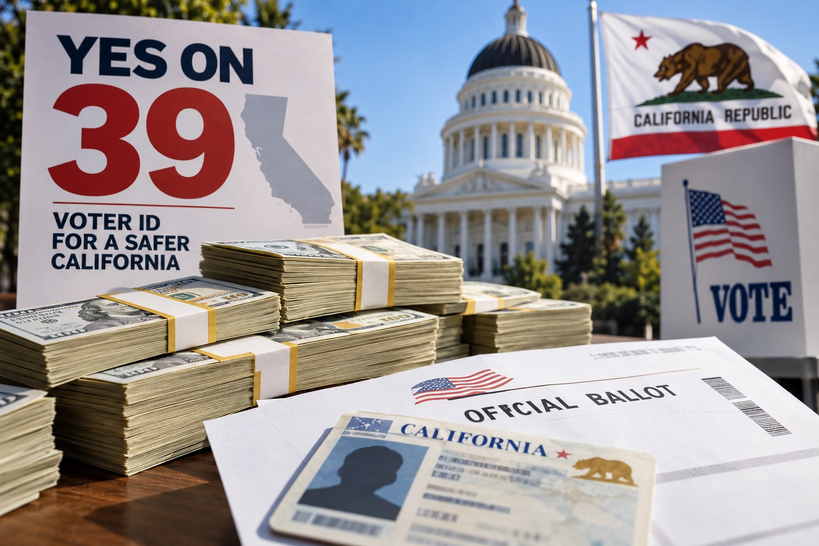
A high-stakes political battle is unfolding in California as a proposed ballot measure to mandate government-issued identification for voting attracts massive funding from billionaire donors. Following heavy financial contributions from out-of-state Republican donors, prominent tech figures are also pouring substantial sums into the campaign.
According to political media reports, Airbnb co-founder Joe Gebbia has contributed $8 million in support of Proposition 39, which will appear on the upcoming November ballot. This marks the largest political campaign donation Gebbia has ever made in California.
Proposition 39 seeks to require voters to present a government-issued photo ID, such as a driver’s license, at polling places. For mail-in voting, voters would be required to provide the last four digits of their Social Security number or a government-issued ID number. Currently, California requires voter registration identity verification, but does not mandate ID presentation at the physical ballot box.
The initiative has drawn significant financial backing from billionaires outside the state. Illinois billionaire Richard Uihlein, founder of packaging supplier Uline and a major Republican donor, has reportedly contributed $17 million to the “Yes on 39” campaign.
Additional financial supporters include Southern California businessman Stephen Bray, who provided more than $3 million in loans alongside a $50,000 direct contribution. Cryptocurrency entrepreneurs the Winklevoss brothers each donated $250,000, while Nicole Shanahan, former running mate to Robert F. Kennedy Jr., contributed $370,000.
Political analysts suggest that the heavy spending by billionaires is part of a broader national strategy. Proponents may be using heavily Democratic California as a testing ground for voter ID mandates before attempting to expand similar legislation to other states.
Supporters argue that verifying voter identification is a crucial step to prevent voter fraud and enhance public confidence in elections. They also emphasize that 36 states across the country already require or request photo ID at the polls.
Conversely, the opposition, led by the California Democratic Party and various civil rights organizations, argues that such measures could disenfranchise vulnerable populations, including low-income residents. Critics are particularly concerned that since approximately 90% of California voters utilize mail-in ballots, mandatory ID numbering could lead to a surge in invalidated votes.
Despite the influx of funding for the measure, recent polling indicates that the initiative faces an uphill battle among voters, with approval lagging in recent public policy institute surveys.