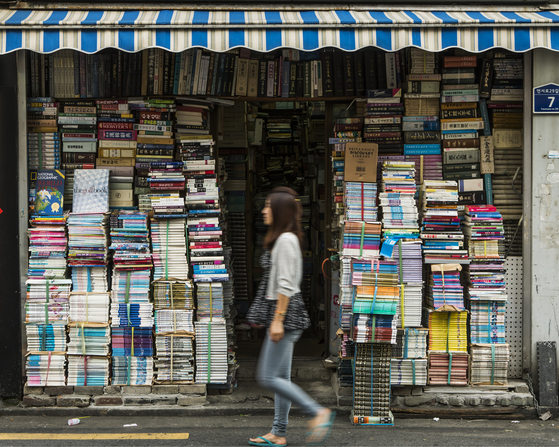
Attempts by suspected artificial intelligence (AI) companies to purchase used books in bulk were confirmed in South Korea as well on the 11th. Similar cases have been reported in the United States, Germany, Ireland, and Japan, fueling growing controversy. Experts believe that AI companies are buying up large quantities of second-hand books to use for AI model training before eventually destroying them.
Seoul Book Repository, a bookstore and cultural space located in Sincheon-dong, Seoul, received a strange email in mid-August. An individual identified as ‘C’, introducing themselves as the purchasing head for company ‘B’—a book distribution firm in Arizona, USA—described their company as one that purchases books in bulk for resale in the United States. C stated that they wanted to purchase Korean-language used books in large quantities.
Specifically, the email stated, “We are looking for suppliers to regularly purchase Korean general books (such as adult liberal arts, literature, and practical guides) on a pallet or container basis.” A single container typically holds 50,000 to 80,000 books. C specified that they do not purchase manga or children’s books, expressing a strong willingness to buy by offering advance payments in dollars or Korean won.
C also asked several questions: “Are there bookstores among used bookstores capable of large-scale sales (hundreds to thousands of copies) that you can introduce us to, or is there a way to negotiate a bulk purchase through the management?” and “Do you have any inventory or donated books that are unsold, long-stored, and available for bulk external sale?”
Seoul Book Repository opened in 2019 as a large-scale used bookstore, bringing together 25 second-hand shops to sell about 120,000 used books. While used book sales ended in 2024 and it currently operates as a new bookstore and complex cultural space, a Google search for ‘second-hand bookstores in Korea’ still places Seoul Book Repository near the top of search results. It appears C reached out based on this information.
“We replied that we are no longer a used bookstore,” said Kim Soo-hyun, head of Seoul Book Repository. “At the time, we just thought it was strange, but looking back, it seems likely that an AI company was buying Korean second-hand books for training purposes.”
C and other representatives from company B even visited South Korea in person from August 18 to 21. During their visit, they met with operating officials from Yes24’s used bookstore division. Yes24 had also received a similar email to the one sent to Seoul Book Repository and scheduled a meeting.
According to Yes24, B’s representatives requested that Yes24 not ship the books directly to them, stating that they would arrange transportation companies themselves. Similar bulk purchases of used books confirmed overseas were handled through this type of transport method, making it difficult to clearly verify whether the used books ultimately flowed into AI companies. Representatives from company B also stated that they hoped to purchase specialized books, while again excluding children’s and juvenile books.
A Yes24 official noted, “It is the first time we have ever received a request to purchase used books in such massive quantities from overseas.” Since the meeting in late August, no further contact has been made by company B, leaving the transaction uncompleted. Meanwhile, Aladin, which operates used bookstores nationwide, reported receiving no such inquiries.
Company B told Seoul Book Repository and Yes24 that the reason for purchase was that “demand for Korean-language books within the U.S. is steadily increasing.” However, combining the email received by Seoul Book Repository and the Yes24 meeting contents, suspicions naturally arose that the books were being acquired for AI training.
When a reporter contacted C via email on the 8th, company B was still proceeding with the bulk purchase of Korean used books. C stated, “We purchase books one copy at a time,” adding, “The number of unique titles is more important than the total number of copies.” AI systems have no reason to train on duplicate copies of the same book.
C stated that the book categories of interest for purchase are non-fiction for adults, specifically academic books, specialized books, business and economics, science, history, humanities, and arts and design. Manga, religious books, children’s books, study guides, magazines, and English-language books are excluded from purchases. Fiction is considered a lower priority, C added. Regarding the condition of book covers, C said it does not matter at all, as long as the books are intact, complete, and readable.
This marks the first time that an attempted bulk purchase of used books suspected to be for AI training has been confirmed domestically. Previously, a trial concluded in the U.S. in July revealed that Anthropic had purchased at least 500,000 books, used them for training, and then destroyed them. In Berlin, Germany, even second-hand books like a ‘1970 Driver’s License Test Guide’ were sold off in bulk. Last month, reports emerged in Japan of unexplained orders flooding used bookstores everywhere. The used books purchased in this manner have been heading to large U.S. logistics warehouses.