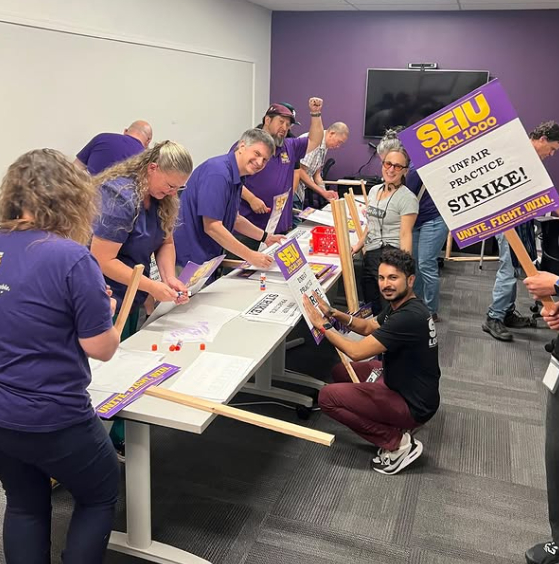
Tens of thousands of California state workers strike for a full day on October 21, causing inevitable disruptions to major public services, including the Department of Motor Vehicles (DMV).
According to Service Employees International Union (SEIU) Local 1000, which represents 100,000 California state employees, the strike is scheduled to begin at 7 AM and conclude on the same day. Previously, the union passed a strike authorization measure with a 96.2% approval rate among members in an October 8 vote. If carried out as planned, this will mark the first statewide strike in the 44-year history of the union.
Nonprofit news outlet CalMatters reported on October 20 that while the DMV plans to keep its windows open on the day of the strike, depending on the scale of employee participation, wait times could increase or some offices may close early.
Additionally, administrative services related to the Employment Development Department (EDD) unemployment benefit payments and the CalFresh low-income food assistance program are also expected to face delays.
SEIU Local 1000 represents approximately 100,000 state government employees, including accountants, government analysts, nurses, IT professionals, and custodians. Of these, about 95,000 are eligible to participate in this strike. The remaining 5,000 are classified as ‘essential personnel’ whose work stoppage could pose a significant threat to public health and safety, restricting their participation. The eight agencies employing these essential workers include Caltrans, the California Department of Corrections and Rehabilitation (CDCR), the California Department of Education (CDE), and the Department of State Hospitals (DSH).
This crisis stems from a labor dispute over wages and working conditions. The union is protesting the state government’s wage cut proposals and mandatory office attendance policies, demanding wage increases, reduced health insurance cost burdens, and expanded remote work options.
Both sides have been negotiating new terms since their previous collective bargaining agreement expired at the end of June, but have failed to reach an agreement. In response, the union filed a complaint with the California Public Employment Relations Board (PERB) in July, alleging that the California Department of Human Resources (CalHR) engaged in unfair labor practices by intentionally delaying negotiations.
Union President Anica Walls emphasized, ‘This strike is not just an issue for state employees, but for the entire working class. We are speaking out for the 100,000 state workers who are not receiving a fair living wage.’
On the day of the strike, large-scale rallies are scheduled to be held simultaneously in about 10 major cities, including Los Angeles, San Francisco, Oakland, San Diego, and Sacramento.
However, the possibility remains that the union could call off the strike at the last minute. The labor and management are scheduled for mediation talks on the 30th, and if there is no progress in these negotiations, the possibility of further strikes cannot be ruled out.