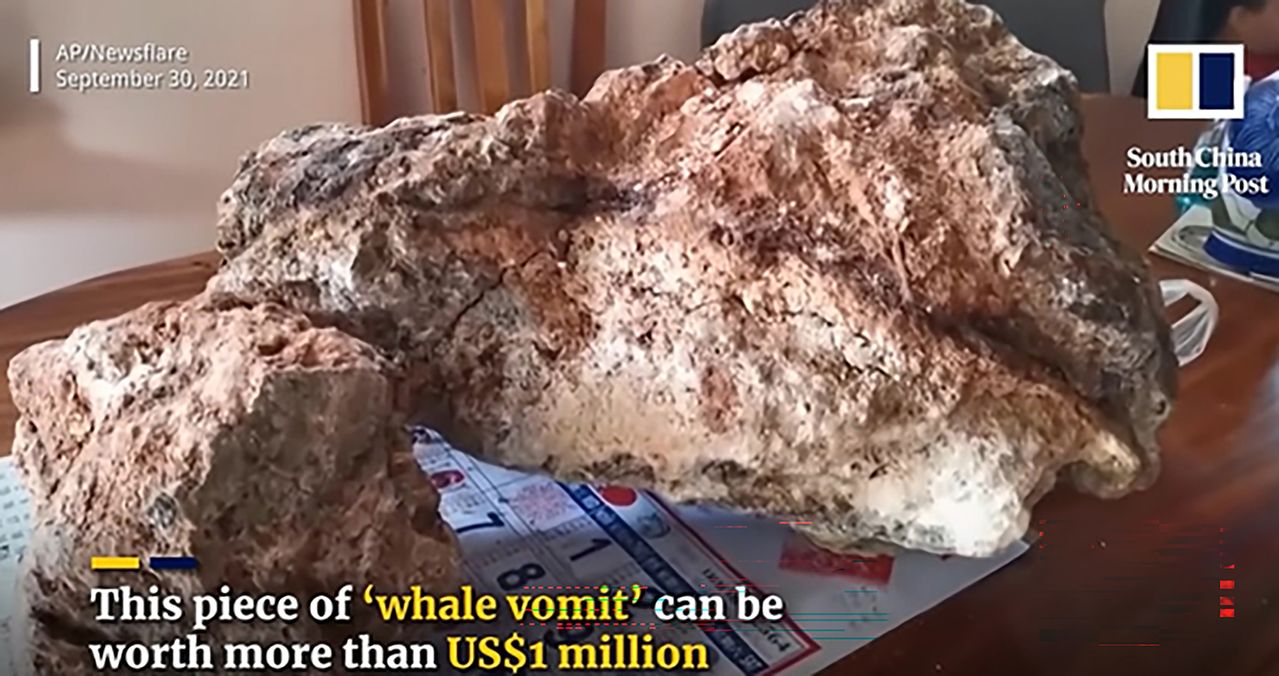
A white lump mistakenly picked up as melted plastic on a Florida beach turned out to be ambergris, a rare and highly valued ingredient used in perfume making. Often called ‘floating gold,’ ambergris is regurgitated matter from sperm whales and is used as an expensive component in luxury fragrances. Depending on its quality and aging state, this precious raw material can fetch over $10,000 per ounce (approx. 28g).
According to a report by the UK’s Daily Mail on the 24th (local time), Christine Marvin discovered the white and golden-mixed lump buried in the sand while taking a walk on Melbourne Beach, Florida.
At first, she thought it was just melted plastic commonly washed up on beaches. However, touching it revealed an unexpected texture. She noted that the object was very lightweight and smooth like beeswax, prompting her to suspect it might be the coveted ambergris prized by perfumers, leading her to report it to authorities.
Ambergris is formed in the digestive system of sperm whales and can be expelled from the body through excretion or vomiting.
Sperm whales are the real-life model for ‘Moby Dick.’ Adult males average 16 meters in length and weigh 45 tons, making them the largest of all toothed animals to have ever existed on Earth. The name ‘sperm whale’ historically linked to the oily substance (spermaceti) in their massive heads, along with ambergris found in their intestines, made them prime targets for historical whaling ships.
Ambergris is known to develop its signature fragrance as it floats in the ocean and ages over a long period. Foreign media outlets reported that the value of this substance can reach up to $10,000 per ounce (approx. 13.24 million KRW), making it more than twice as expensive as gold, which typically trades around $4,000 (approx. 5.3 million KRW) per the same weight.
Ambergris once gained widespread attention as a natural fixative used in luxury perfumes, famously associated with fragrances like Chanel No. 5. However, today, synthetic alternatives are frequently used due to scarcity and high costs.
The National Oceanic and Atmospheric Administration (NOAA) classifies ambergris as a byproduct of protected marine mammals, legally prohibiting individuals from collecting, possessing, or selling it.
After first discovering ambergris in 2024, Marvin found another piece later that same year, marking this latest find as her third overall discovery.