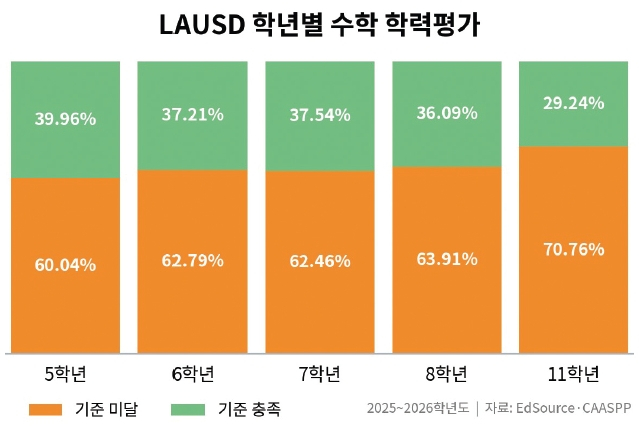
According to the 2025–2026 California Smarter Balanced Assessment Consortium (CAASPP) results released by the California Department of Education, LAUSD math scores showed that 60.26% of students fell short of state academic standards. In English language arts, more than half, or 51.67%, also missed the benchmark.
This evaluation measures how well students understand the curriculum required for their respective grades. Scores are divided into four tiers, with students in the top two tiers classified as meeting academic standards.
The standard-meeting rate for 3rd-grade English stood at only 44.12%. More than half of the students failed to reach basic academic standards such as reading and writing skills required for their grade level.
Academic Achievement Gaps Based on Economic Background
Academic achievement gaps based on family economic status were also clear. The math standard-meeting rate for low-income and other economically disadvantaged students was 34.29%, about half the rate of their more affluent peers (66.28%). For English, low-income students recorded a 43.08% proficiency rate, showing a gap of more than 30 percentage points compared to non-disadvantaged students (74.04%).
The state government is investing millions of dollars in educational budgets, particularly to enhance student literacy. It has also introduced screening systems to identify kindergarten through 2nd-grade students struggling with reading early on. However, analysts note that it will take more time for these policy effects to translate into actual academic improvements.
Calls for Systemic Reform and Declining Immigrant Enrollment
Troy Flint, chief information officer for the California School Boards Association (CSBA), pointed out that the pace of academic improvement is excessively slow. He emphasized that fundamental reforms to the state’s educational administration and evaluation systems are urgently needed to boost student academic achievement. Meanwhile, the number of newly arriving immigrant students in LAUSD has plummeted by nearly half, dropping from 20,755 last school year to 11,103 this year, a 46.5% decrease.
Northern California’s Oakland Unified School District has also reduced the number of schools operating educational programs for newly arrived immigrant students from 17 to 6. While this district had maintained a minimum of 1,300 new immigrant students annually since 2017, the count dropped to 498 last school year and fell further to 212 as of the 7th of this month.