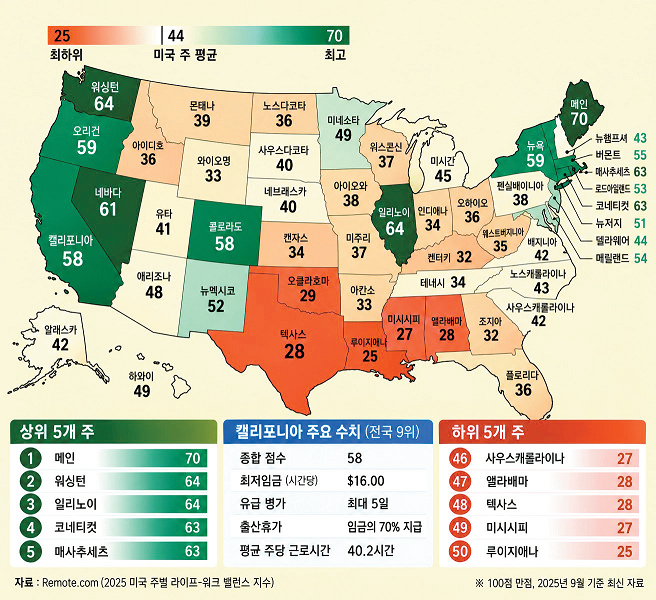
California’s work-life balance has experienced a noticeable decline, dropping five spots over the past three years, according to recent findings.
Despite maintaining a position in the national top 10, the state continues to face challenges regarding average working hours, despite its high minimum wage and robust worker protection policies.
How California Ranks Nationally
According to a comprehensive evaluation by global employment platform ‘Remote’—which assessed metrics such as average working hours, paid sick leave, annual leave, minimum wage, and healthcare environments—California work-life balance scored 58.37 points, placing it 9th nationwide.
Having ranked 4th in the 2022 survey, the state slipped five positions by 2025. This drop is largely attributed to California’s overall average weekly working hours standing at 40.20 hours—the highest among the top 10 states—alongside lower scores in paid maternity leave and compensation indexes.
Top States and Regional Disparities
Maine claimed the top spot nationwide with 69.62 points, followed by Washington, Illinois, Connecticut, Massachusetts, Nevada, New York, and Oregon. Many of the top 10 states are concentrated in the Northeast and West.
Conversely, Southern states lagged significantly behind. Louisiana recorded the lowest score at 25.01, followed closely by Mississippi, Alabama, and Texas in the bottom tier. These low-ranking states generally lack mandatory paid annual or sick leave laws and maintain a minimum wage stuck at the federal level of $7.25 per hour.
Broader Workplace Fatigue and Systemic Impact
Employee fatigue remains at alarming levels across the board. Data from the Society for Human Resource Management (SHRM) indicates that 51% of domestic workers feel completely drained by the end of their workday, while 44% report experiencing burnout on the job.
This comprehensive study demonstrates that work-life balance is not merely a product of individual professions or corporate culture, but is significantly influenced by regional labor environments, including local wages, working hours, and mandatory leave policies.