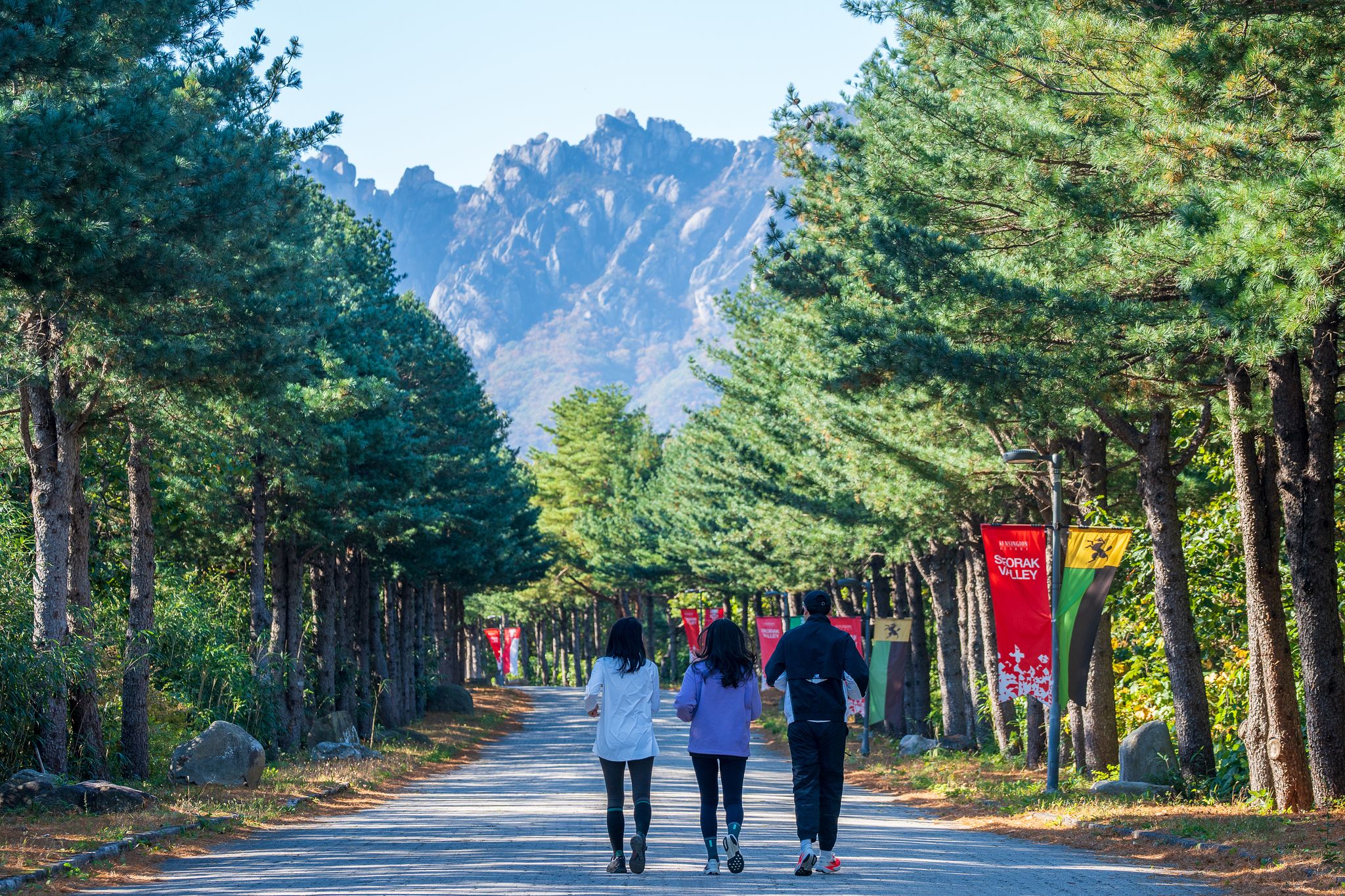
When the cold wind blows, reasons to visit Goseong multiply. Climbing Sinseondae (645m, also known as Seongindae) reveals an overwhelming panoramic view of Ulsanbawi Rock adorned with autumn foliage, while descending to the port makes the heart reassuringly full with freshly arrived dorumuk fish. From sun-dried buckwheat makguksu to piping-hot octopus gukbap, choosing what to eat after a mountain hike is a joyful dilemma. Late autumn Goseong travel was enjoyed by pairing fall foliage hiking with seasonal delicacies.
In Goseong, eyes naturally drift eastward toward the ports and the sea. In autumn, however, it is nice to briefly turn away from the sea. True to its name meaning ‘a walled town nestled against high mountains,’ heading inland deepens the scenery.
On the 22nd, I climbed Sinseondae in Goseong. It is a rocky peak situated on the waist of Sinseonbong (1204m) north of Seoraksan Mountain. Because it allows hikers to encounter the magnificent figure of Ulsanbawi Rock through a relatively short hike, it is quite famous among MZ-generation ‘sanlini (hiking beginners).’
There are two main ways to ascend: starting from the Hwaamsa Temple parking lot halfway up the mountain or following the walking trail from Kensington Resort Seorak Valley into the temple.
During peak foliage season, the entrance to Hwaamsa Temple gets congested with cars, making the resort route a great alternative. Walking for about an hour longer replaces being trapped in a car with enjoying autumn scenery. Surprisingly, this walking trail features more runners than walkers. Because it captures views of running against the backdrop of Ulsanbawi Rock, running crews from all over the country steadily visit.
A representative from Kensington Resort also introduced that ‘as the number of runners increases, the resort, which used to focus mainly on families, has become much younger.’ An era where people take certification photos running beneath Ulsanbawi Rock. Trends change diligently even in front of ancient, renowned mountains.
I paused briefly in front of the Hwaamsa Temple Iljumun gate. The signboard reading ‘Geumgangsan Hwaamsa Temple’ was clear. Did you know? Sinseonbong is counted as the southernmost first peak among the 12,000 peaks of Mount Geumgang. Chief Monk Daehyeon of Hwaamsa Temple offered blessings, saying, ‘Looking today, the autumn leaves have descended quite prettily, and since it is located along the Geumgangsan mountain range, it possesses extraordinary spiritual energy. Please take home good energy.’
Starting from the entrance of Hwaamsa Temple and passing Subawi Rock and Sirutteokbawi Rock, I reached Sinseondae in about an hour. The view, previously blocked by the forest, opened up in an instant. Stepping onto the spacious, playground-like rocky area, the six peaks of Ulsanbawi Rock blocked the front straight on.
While it felt like a giant wall from down below, every peak showed a different face from here. Wrinkles carved into the rock face and deeply grooved valleys were clear. Turning my head, the Goseong sea beyond Hwaamsa Temple unfolded in one breath.
Due to lingering summer heat, people say the autumn foliage of Seoraksan Mountain falls short of previous years. That disappointment was left behind at Sinseondae as I descended. After taking in both Ulsanbawi Rock and the East Sea at a glance, my mind stopped questioning the hues of the foliage.
Hunger at the end of a hike is welcome. Having arrived in a makguksu (buckwheat noodles) region, we started with a bowl of buckwheat noodles. The season that noodle enthusiasts wait for is late autumn and winter because freshly harvested buckwheat noodles can be tasted.
We visited ‘Sanbuk Sonamu Makguksu,’ a restaurant spanning three generations in Goseong. It serves 100% pure buckwheat makguksu (11,000 KRW) for its noodles. Pure buckwheat lacks gluten and breaks easily, making the dough process demanding. After kneading it firmly with hot water and letting it rest for over three hours, the dough is kneaded several times more upon ordering to press out the noodles.
President Jeon Cheol-ja explained, ‘Buckwheat is ground with its husk intact, giving the noodles a grayish-brown hue, which is called ‘tomyun (earth noodles)’ in Goseong.’ Pouring cold dongchimi broth over freshly pressed buckwheat noodles and adding a little perilla oil and sugar, I put a bite in my mouth. A single chopstick full revealed the difference in the noodles. Following the easily breaking texture came a light, savory flavor.
At 8 AM the next morning, I visited Ayajin Port. Fishing boats that had ventured out to sea since the crack of dawn returned to the pier, unloading gomchi (slimy sculpin) and cod. Welcoming sights caught my eye throughout the pier: piles and piles of dorumuk stacked high.
Dorumuk, which prefers cold water, flocks to shallow coastal waters between late October and December, the spawning season. Fishermen set gillnets (long rectangular nets) timed to this period. Fisherman Park Young-chul said, ‘When catches are heavy, a single boat can pull up 200 du reum (4,000 fish).’ On this day, one du reum of dorumuk traded around the 42,000 KRW mark.
The ‘Eobu Babjib’ restaurant in front of the port sets tables with fish caught by its captain. We ordered dorumuk stew and grilled dorumuk (40,000 KRW each). At this time of year, dorumuk features more roe than flesh.
Every time the roe was chewed, it popped in the mouth. The savory taste kept drawing chopsticks back. President Yoo Young-mi explained, ‘Dorumuk is known as a winter fish, but its roe becomes firmer as the season nears its end, making late-autumn dorumuk even more tender and delicious.’
For young travelers visiting Goseong these days, ‘octopus gukbap’ is said to be popular. It is literally gukbap topped with octopus. While octopus is caught year-round from spring onward, the chilly winds of this season make it ideal to enjoy as a hot gukbap. Thinly sliced boiled giant octopus is placed on top; the procedure is to first pick out the octopus and bean sprouts like shabu-shabu, and then eat the gukbap afterwards. After emptying a bowl of gukbap, Goseong’s cold ocean breeze felt much easier to endure.