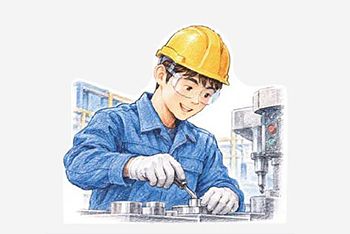
In an era where artificial intelligence (AI) threatens traditional employment, the ultimate dream job for job seekers has shifted to production jobs, combining ‘king’ and ‘production worker’ into a new slang term. The employment preference of Generation Z, once represented by Pangyo and major tech giants, is moving toward semiconductors and large-scale corporate manufacturing sites. Analysts suggest that this strategic shift is driven by expectations of massive performance bonuses and the pursuit of career paths that are difficult for AI to automate.
According to Binulabs, the operator of the university student platform Everytime, a survey of 500 college seniors and job seekers nationwide in September revealed that the most desired job function was ‘production, site, and quality control’ at 20.2%. This surpassed traditional favorite roles such as marketing, advertising, and public relations (13.4%), planning and strategy (12.4%), and was nearly double that of development, IT, and data (11.0%). In short, young job seekers preferred factory workshop jobs requiring work uniforms over IT companies where dress codes and attendance rules are relatively relaxed, such as hoodies and jeans.
In the rankings of preferred companies for employment, Samsung maintained its number-one spot for the fourth consecutive year at 27.6%. SK saw its preference surge from 7.8% last year to 16.8% this year, rising to second place. Conversely, Naver, which had held the second spot for three consecutive years, fell to fourth place (8.6%) this year, while Kakao, ranked third in 2023, slipped out of the top five entirely (2.4%).
The prestige of professional jobs has also declined. When given a choice between accountants and lawyers versus semiconductor research positions at Samsung and SK, 59% chose semiconductor research roles. The top conditions for a good job (multiple responses) were high financial compensation (57.4%), work-life balance (53.2%), and job stability (41.4%). A representative from Binulabs analyzed that as anxiety over office jobs being replaced grows due to the expansion of AI, Generation Z is paying more attention to roles like production and site work that are relatively difficult to replace.