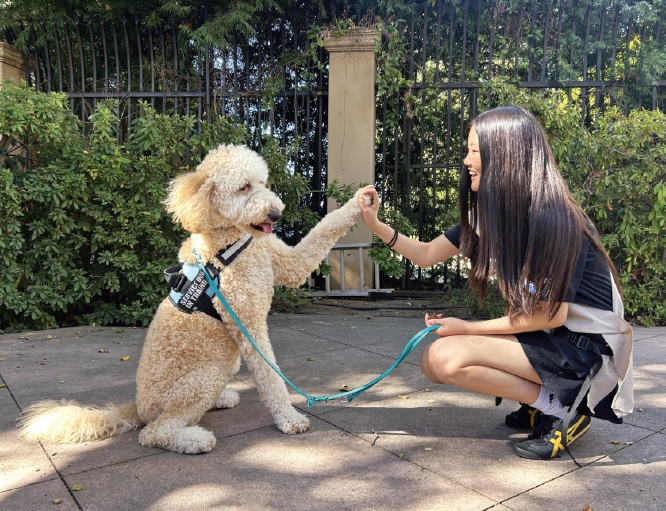
On November 19, at the office of MobilityDog, a non-profit service dog training organization in Pasadena, a 13-month-old puppy named Honey stayed close to Claire Hong, a 12th grader at Village Christian High School.
“Touch.” When Hong extended her hand, Honey pressed her nose against it. This seemingly simple action is foundational training for eventually helping individuals with disabilities push elevator buttons or close refrigerator doors.
Hong is a “Puppy Raiser,” a volunteer who cares for Honey at home and handles socialization training. She has been together with Honey for a year.
Training dog Honey wakes up around 7 a.m. every day, finishes her meal, and gets into the car with Hong, who is heading to school. This is to get her used to long car rides. She also follows Hong to grocery stores and cafes, practicing adaptation to various people, noises, and unfamiliar environments.
There are also many rules to follow at home. Honey cannot get on sofas or chairs without a command. This is to build the habit of staying quietly under a dining table in public places like restaurants later on.
The most important thing in training is the ability to focus on the user without being shaken by surrounding stimuli.
Hong emphasized, “Honey is still in training, so she completely loses focus when people touch her or try to get her attention. While I understand the interest in Honey, consideration for training dogs is necessary.”
Honey stays at home until she is about 18 to 20 months old before being handed over to professional trainers. Afterward, she intensively learns tasks suited to the needs of individuals with disabilities and meets her new family.
Hong said, “The upcoming farewell won’t be easy, but I am excited about the fact that Honey will grow up to be a service dog and walk alongside someone who needs help. The reward is beyond description.”
The roles of service dogs are expanding into various fields, ranging from mobility impairments and hearing loss to mental disabilities and chronic illnesses.
Depending on their training, service dogs can pick up objects for people with disabilities and detect blood sugar changes in diabetic patients. They also respond to epileptic seizures or assist individuals suffering from post-traumatic stress disorder (PTSD) in their daily lives.
It takes an average of three years to be assigned a service dog.
According to a “Service Dog Appreciation Month” resolution adopted by the California legislature in September, less than 1% of the state’s approximately 61 million individuals with disabilities receive help from service dogs. Nationwide, the number of active service dogs is estimated at about 500,000.
There are broadly two ways to be assigned a service dog: through a professional training organization or by commissioning a private trainer. Non-profit training organizations train and assign service dogs based on donations and volunteer labor, reducing the financial burden on users.
According to Assistance Dogs International (ADI), there were a total of 134 registered organizations in the North American region as of last year.
ADI stated, “While more people are waiting for service dog assignments, new matches are decreasing.”
The main reason training organizations cannot increase the supply of service dogs is a shortage of puppy raisers like Hong.
Janie Heinrich, founder and executive director of MobilityDog, said, “The problem is a lack of puppy raisers rather than funds. We want to expand our training scale, but we need to secure households willing to take in the puppies first.”
Since its establishment in 2018, MobilityDog has received a total of 796 requests for service dogs. Only 48 service dogs have completed training and been assigned to users so far. This year, six puppy raisers, including Hong, are active in the organization.
MobilityDog is currently recruiting puppy raisers to care for four new puppies arriving at the end of March next year.
Heinrich said, “It’s true that puppy-raising requires significant time and dedication, but it is something that completely changes someone’s life. Service dogs are opening up new life possibilities for countless individuals.”
Anyone can apply for the puppy-raiser program. Individuals with disabilities who need the help of a service dog apply for placement with a training organization and undergo screening. Eligibility requirements, procedures, and costs vary by organization.
To become a puppy raiser, prior experience raising a dog is not required. However, you need a living environment where you can care for a puppy long-term and the time to participate in training.
Training organizations require applicants to submit an application, participate in a phone interview, and meet with local volunteers. Primary caregivers must be 18 or older, but minors can participate alongside adults.
Working professionals can also apply, provided they have the conditions to keep or care for the puppy while at work. Expenses such as food, vaccinations, and medical bills are generally covered by volunteers, though some financial support may be available.
To receive a service dog, individuals with disabilities must submit an application to a training organization and undergo evaluation. The organization assesses the applicant’s disability type, the assistance tasks required of the service dog, the living environment, and the ability to care for the dog.
MobilityDog accepts applications from individuals aged 16 and older with mobility impairments. Applicants must attend an orientation session and submit medical documents and recommendation letters. The organization then decides whether to assign a service dog based on evaluations and interviews.
The waiting period for a service dog varies depending on the organization, disability type, and required training. Applicants must check the recruitment status and eligibility requirements of each organization beforehand.