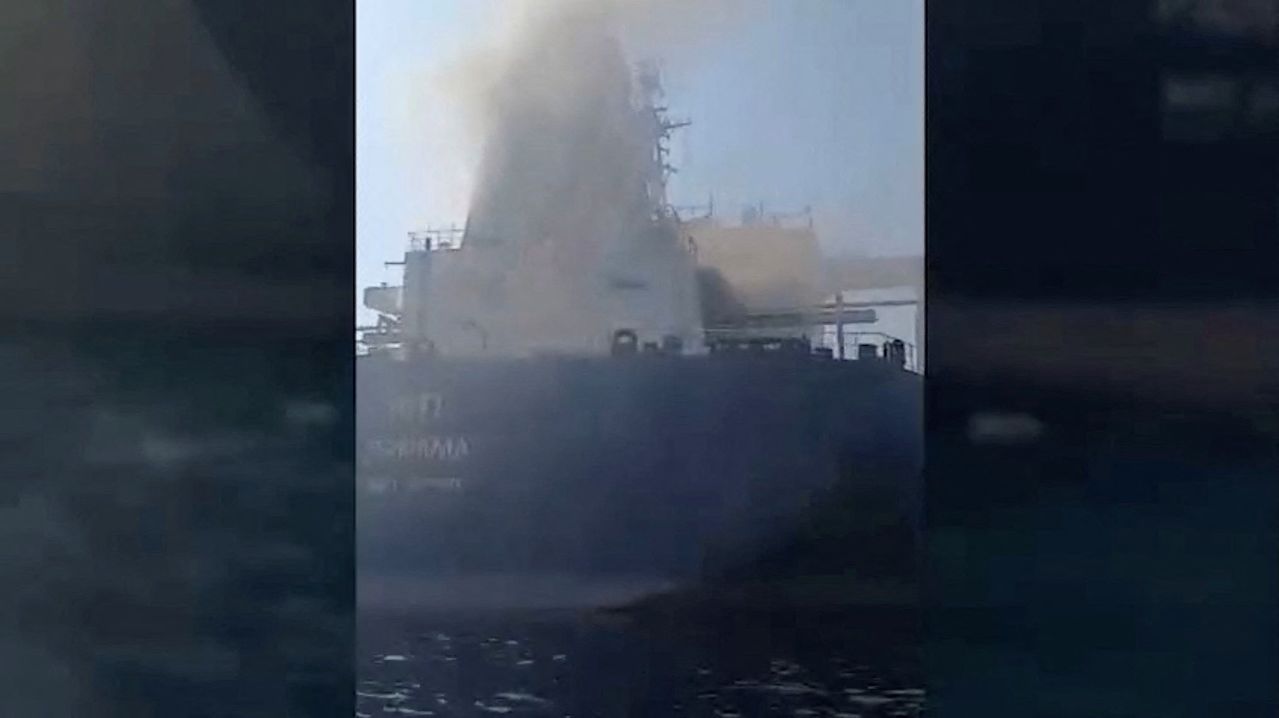
Amid falling international oil prices, tanker attacks are intensifying in the Hormuz Strait, a vital global crude oil transport route. Cases have also been detected where attempts were made to repeatedly target the same vessel to hinder rescue operations, or to attach limpet mines to the hulls.
Bloomberg News reported on the 19th (local time), based on its own compilation and UK Maritime Trade Operations (UKMTO) data, that Iran’s vessel attacks have continued at an average of about one per day this month, following a surge last month. About 14 attacks were reported in the Hormuz Strait this month, with at least two crew members missing from attacks this week.
The Abu Dhabi National Oil Company (ADNOC) recently stated that one of its vessels passing through the strait was attacked, leaving one crew member missing and 11 injured.
Kuwait also sent a protest letter to the International Maritime Organization (IMO) this week, stating that eight of its tankers had been attacked in recent weeks. Kuwait defined this as a “clear violation of international law that undermines regional security and stability” and urged Iran to halt the attacks.
Multiple maritime security officials reported that Iran attempted to repeatedly strike the same vessel to thwart rescue operations. Cases of limpet mines attached to ship hulls were also confirmed, and videos of vessels engulfed in flames spread among crude oil trading circles and shipowners.
The surge in attacks coincides with a drop in oil prices as Middle Eastern crude exports approached pre-war levels. Brent crude futures prices fell by about 20% this month. The International Energy Agency (IEA) also stated last week that crude oil supply exceeded demand for the first time since the outbreak of the war.
Crude oil transport volume through the Hormuz Strait has shown signs of recent decline. According to energy data firms Kpler and Vortexa, the 7-day moving average combining strait crude transit volume and ship-to-ship transfers in the Gulf of Oman dropped from about 13.4 million barrels per day at the beginning of this month to about 10 million barrels as of the 10th.
However, the recent figures are provisional numbers as additional transit details are being verified. Bloomberg explained that due to weekly and monthly shipment volatility, it is premature to attribute the volume decrease solely to the fallout from attacks.
The level of military tit-for-tat between the U.S. and Iran is also rising. U.S. fighter jets targeted a missile launching site on Kish Island in the Persian Gulf this week in response to Iranian attacks targeting U.S. personnel and assets. The U.S. also issued new warnings to vessels violating its blockade of Iranian ports.
Western officials view the possibility of a large-scale additional U.S. airstrike as having increased over the past few days. A senior Saudi Arabian shipping official stated that even if attacks continue, they have no choice but to continue crude oil transport through the Hormuz Strait.
There are also limits to grasping the exact scale of damage. This is because Gulf oil-producing countries do not disclose information on attacks due to security concerns, and shipping companies are also reluctant to report them. UKMTO likewise stated that it is facing difficulties in compiling attack counts due to unreported cases.
Georgios Sakellariou, an analyst at shipping analytics platform Signal Ocean, said, “It seems that a situation where vessel attacks occur virtually every day has become the ‘new normal.’ Due to the attacks and information non-disclosure, grasping accurate transport volumes has become complicated, and as vessel losses occur, more ships will be needed.”