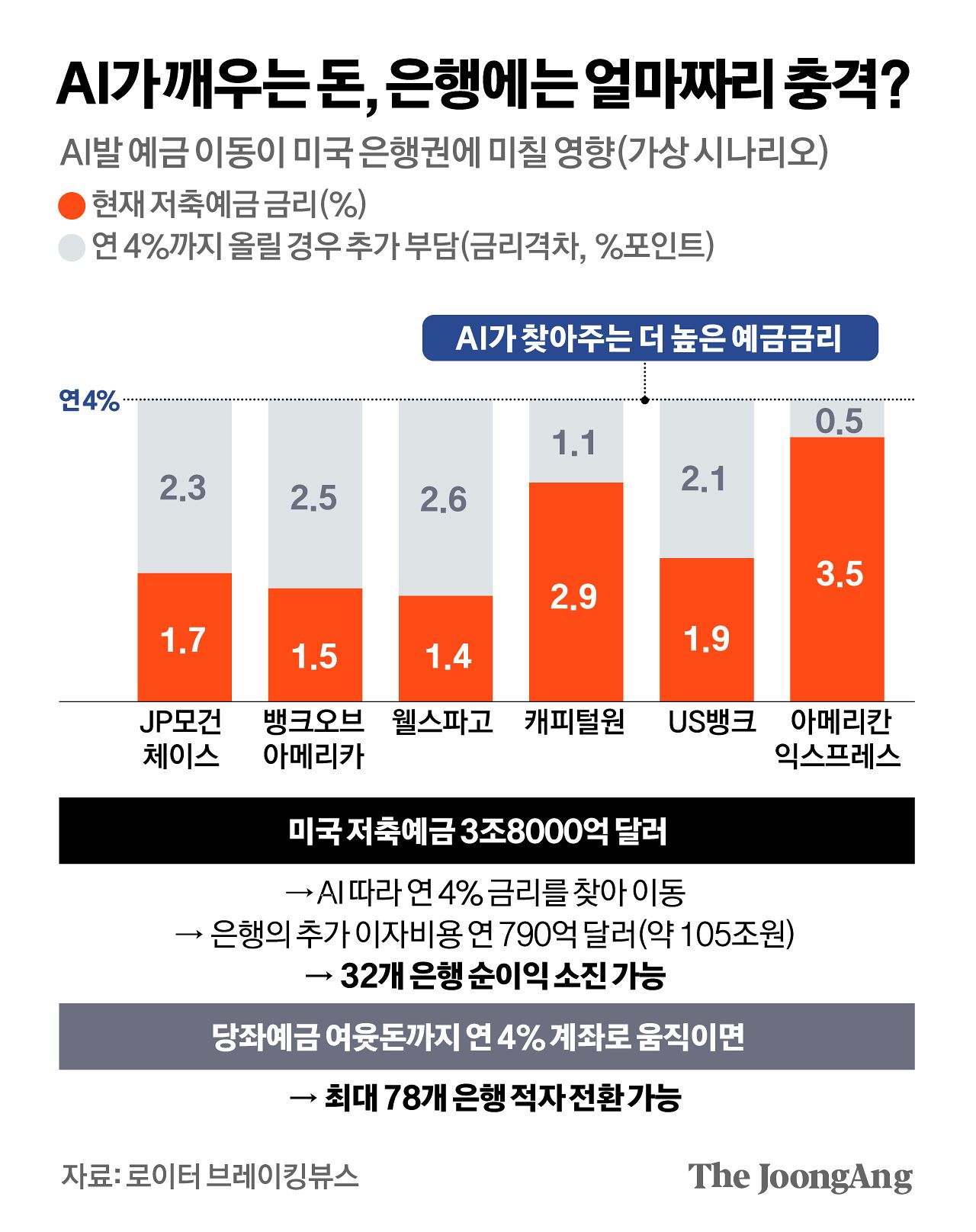
If an artificial intelligence could automatically transfer your neglected money earning low interest into high-yield accounts, how much would you save? Analyzing around 500 US banks revealed it exceeds 100 trillion won annually. This is the price of the ‘laziness’ wasted so far, and money that will return to customers as AI evolves from a ‘tool that answers’ into an ‘agent that moves money.’
Reuters reported on the 6th, estimating the additional AI-driven burden on about 500 US banks, stating that ‘banks are facing an end.’ When 3.8 trillion dollars in savings deposits follow AI advice to find a 4% annual interest rate, the additional interest cost for banks reaches 70.9 billion dollars (approx. 105 trillion won). This scale could wipe out the net income of 32 banks. Reuters also projected that if AI moves all remaining funds except the minimum balance in checking accounts into 4-percent products, up to 78 banks could fall into deficit. The Financial Times (FT) similarly estimated on the 7th that up to 500 billion dollars (approx. 670 trillion won) in the US banking sector could be threatened by AI-driven deposit shifts.
A new variable called AI has emerged in the financial sector, which has long relied on consumers’ AI banking agent and the ‘laziness tax.’ Meta’s ‘Muse,’ launched last month, connects to bank accounts to find unnecessary consumer spending and cancel or switch products with user approval. OpenAI’s ‘Dots’ continuously processes assigned tasks using its own cloud computer even after users step away.
‘Sleeping deposits’ are also abundant in South Korea. As of late July, savings and demand deposits in domestic deposit-withholding banks reached approximately 681 trillion won. A significant portion remains in demand deposit accounts despite low interest rates.
Experiments to wake up these ‘lazy funds’ have begun in South Korea, albeit at an early stage. Under the Financial Services Commission’s ‘MyData’ service launched last February, designated service providers review users’ income and credit scores with consent, automatically requesting interest rate cuts from banks. By July of this year, 162,000 people benefited, saving a total of 100.3 billion won, an average of 610,000 won per person. The scope of roles is set to expand into debt adjustment, loan refinancing, policy fund applications, voice phishing damage relief, and claiming hidden insurance money.
South Koreans also exhibit a uniquely high usage rate of AI in finance and investment, laying a broad foundation for the growth of ‘financial AI agents.’ Analyzing economic index raw materials released by Anthropic, developer of the generative AI ‘Claude,’ the JoongAng Ilbo found that in May, the proportion of ‘investment research’ among Claude usage observed in South Korea was 3.50%, ranking first among 79 countries with public statistics. The higher category of ‘buying and investing’ was also the highest among 106 countries at 4.42%. While it is currently a stage of asking AI ‘where should I invest,’ an era where AI handles everything from comparison and recommendations to applications and transactions at once could open in South Korea once execution rights are supported.
However, consumers worldwide remain equally hesitant to readily hand over the keys to their wallets. According to a survey of 14,300 consumers across 13 countries conducted by global security firm Thales between January and February, 34% responded they would ‘cancel unused subscriptions via AI,’ and 32% answered they would ‘automatically switch to cheaper products.’ In contrast, ‘changing travel reservations’ stopped at 11%, and ‘fund transfers between bank accounts’ was limited to 7%. Park Chan-am, CEO of Stealien and advisor to the National AI Strategy Committee, pointed out, ‘The greater the authority an AI agent holds, the greater the risk of being abused during hacking. We must carefully manage not only convenience but also the extent of authority granted for tasks.’
Laws and systems also fail to sufficiently support ‘acting AI.’ Current financial laws strictly regulate personal verification and payment method management, creating constraints for AI to transfer money or make payments on behalf of users. Services where AI applies for interest rate reductions on behalf of consumers were also exceptionally permitted through regulatory exceptions granted by financial authorities. Baek Yeon-joo, a research fellow at the Korea Institute of Finance, pointed out, ‘Applying AI to services that compare and recommend financial products like investment and insurance is highly likely to be interpreted as solicitation under the Financial Consumer Protection Act. It is difficult to secure the same level of trustworthiness, ethical standards, and expertise as humans due to the opaque operating logic of generative AI outputs.’
An analysis has emerged that preventing AI from eliminating consumer ‘laziness taxes’ from becoming a new threat to the financial sector has surfaced as a task. Moon Jong-hyun, head of the Genians Security Center who exposed and publicized the circumstances of AI agents being utilized in recent financial relay hacking incidents, stated, ‘Since we fall behind in productivity and response capability if we do not use AI, we cannot simply rebuild walls claiming it is dangerous. In an era where AI opposes AI, designing how much authority to grant and how humans control it is more important than technology introduction.’