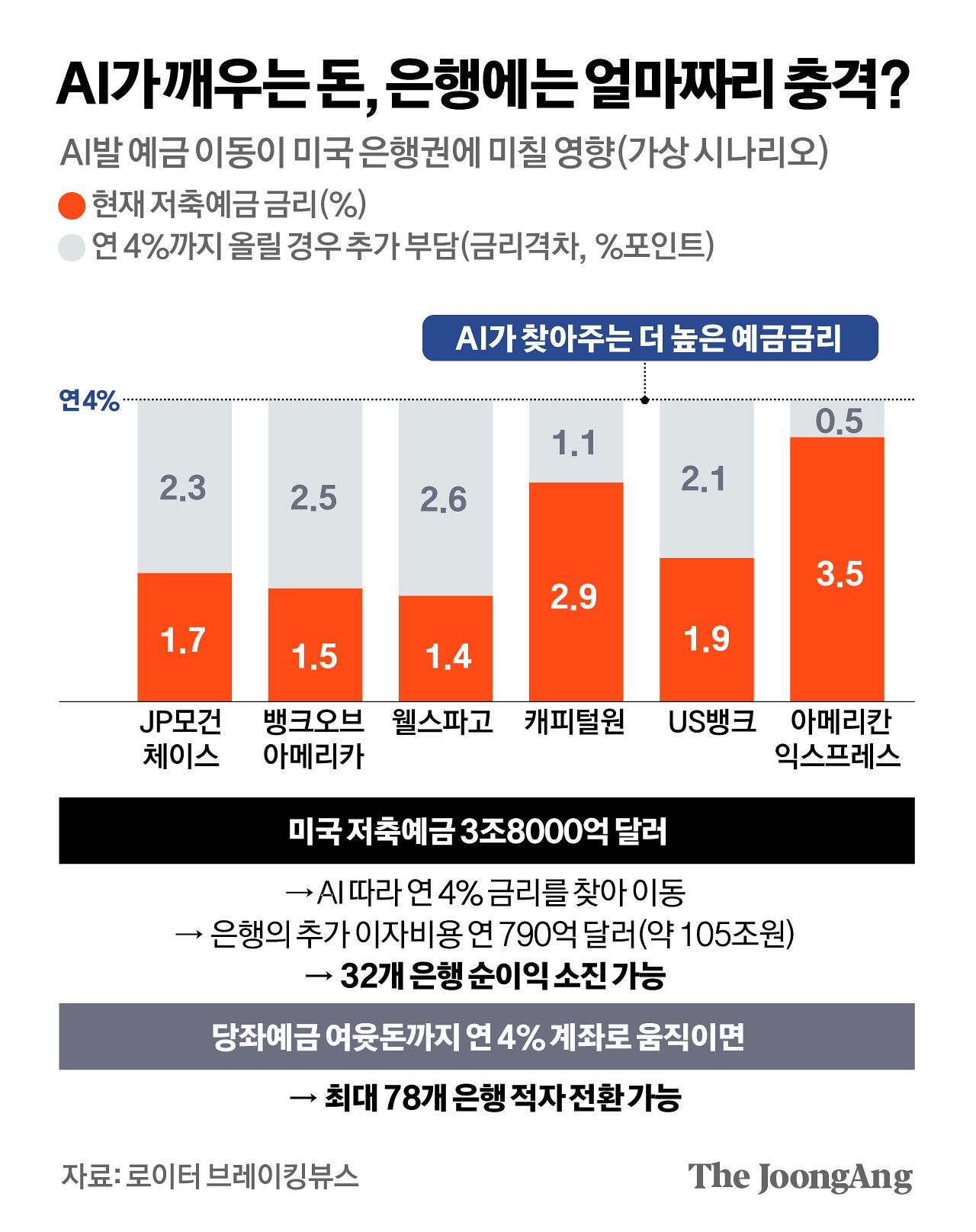
Imagine how much money you could save if an artificial intelligence automatically transferred the cash you left sitting in a low-interest bank account into a high-yield account just because you were too busy or didn’t know better. Looking at about 500 US banks, that amount exceeded 100 trillion won annually. If AI evolves from a ‘answering tool’ into a ‘money-moving agent,’ this is the money that will return to consumers.
Reuters reported on the 6th, warning that “banks are facing the end,” and estimated the additional burdens on about 500 US banks due to AI in this manner. If $3.8 trillion in savings deposits follow AI’s advice to find a 4% annual interest rate, the additional interest expense paid by banks would reach $79 billion (approx. 105 trillion won) per year. For 32 out of the 500+ banks, this scale could wipe out their entire net income. Furthermore, if AI leaves only the minimum required amount in checking accounts and moves the rest into 4% products, Reuters projected that up to 78 banks could fall into deficit. The Financial Times (FT) also estimated on the 7th that AI-driven deposit movements could threaten up to $500 billion (approx. 670 trillion won) in the US banking sector.
A new variable called AI banking has emerged in the financial sector, which has long relied on consumer ‘laziness tax.’ Meta’s ‘Muse,’ launched last month, connects to bank accounts to find unnecessary expenditures and cancels or switches them with user approval. OpenAI’s ‘Dots’ continues to handle tasks entrusted by users even after they step away, utilizing its own cloud computer.
Experiments to wake up ‘lazy money’ have also begun in South Korea. Under the Financial Services Commission’s MyData service launched last February, designated providers review users’ income and credit scores with their consent and automatically request interest rate cuts from banks. By July of this year, 162,000 people benefited, saving a total of 100.3 billion won, averaging 610,000 won per person. Their roles are expected to expand further into debt adjustment, refinancing loans, applying for policy funds, and claiming hidden insurance payouts.
South Korea also has plenty of ‘sleeping deposits.’ As of late July, the balance of savings and demand deposits in domestic banks reached approximately 681 trillion won. South Koreans also have an exceptionally high usage rate of AI for finance and investment, providing a strong growth foundation for financial AI agents. Analyzing raw data on the economic index released on the 11th by Anthropic, the developer of the generative AI ‘Claude,’ the JoongAng Ilbo found that the proportion of ‘investment research’ among Claude usages observed in South Korea last May was 3.50%, ranking 1st among 79 countries with public statistics. The higher category, ‘buying and investing,’ was also the highest among 106 countries at 4.42%. Although it is currently the stage where people ask AI “where should I invest?,” an era where AI handles everything from financial product comparison to application and trading in one go could open in South Korea once execution rights are supported.
However, laws and regulations do not yet support ‘acting AI.’ Current laws strictly regulate identity verification and payment method management during financial transactions. Baek Yeon-joo, a research fellow at the Korea Institute of Finance, pointed out that “because the operating logic of generative AI outputs is opaque, it is still difficult to guarantee the same level of reliability, ethical standards, and professionalism as humans.” Safety issues, as revealed in recent financial sector hacking incidents, are also stumbling blocks. Moon Jong-hyun, head of the Genians Security Center, stated, “As we live in an era where AI faces AI, it is crucial to design how much authority to give to AI and how humans will control it.”