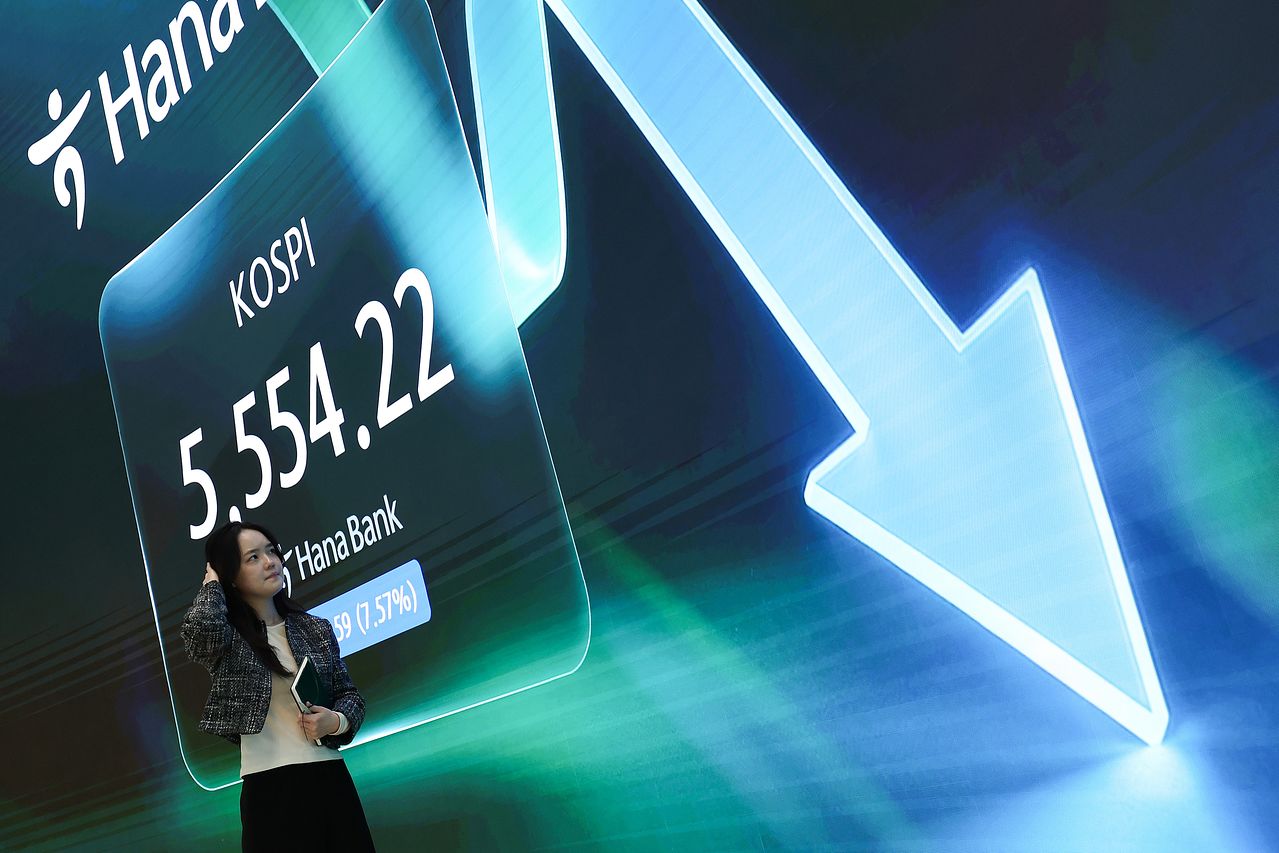
Semiconductor stocks that once fueled the artificial intelligence investment frenzy plunged last week, slamming both U.S. and Asian markets. The downturn was driven by mounting financing burdens for massive AI infrastructure investments and growing fears that China is rapidly catching up in memory semiconductor technology. Some experts are even calling it a “dress rehearsal for an AI bubble collapse.”
According to Bloomberg on the 18th, the Philadelphia Semiconductor Index fell for eight consecutive trading sessions through the 16th, dropping about 16% over the period. This marks the longest losing streak in 18 years, since October 1–10, 2008. The Nasdaq Composite also fell 4.5% last week, marking its worst weekly performance since June.
Asian stock markets took a direct hit as well. Goldman Sachs’ index of Asian AI hardware stocks dropped 11% last week, hitting its steepest decline since mid-July. According to the Korea Exchange, the Kospi dropped for seven straight sessions before rebounding 2.05% on the 16th. However, it still suffered a 14.5% loss for the week of October 12–16, with Samsung Electronics (-17.7%) and SK Hynix (-24.3%) seeing sharp concurrent declines. Japan’s Nikkei 225 and Taiwan’s Taiex indices fell 5.4% and 4.5% respectively.
Fears Over AI Infrastructure Financing Sustainability
Market anxiety has been fueled by doubts regarding the financial sustainability of massive AI infrastructure projects. Bloomberg reports that capital expenditures by major hyperscalers are projected to exceed $3 trillion over the next three years, but rising oil prices and high interest rates are amplifying borrowing burdens. Corporate bond prices for AI cloud firm CoreWeave have fallen to levels signaling distress, and its stock plunged 25% last week. Broadcom CEO Hock Tan warned that the market resembles a casino where investors barely know what they are buying. Additionally, reports that China’s ChangXin Memory Technologies (CXMT) is advancing its high-end DRAM technology have heightened anxieties over intensifying memory competition.
Baison Ling, managing director at UBP Private Bank, told Bloomberg that if hyperscalers and emerging cloud firms fail to secure funding for data center investments, it will inevitably lead to reduced orders for Asian memory suppliers like TSMC, Samsung Electronics, and SK Hynix. Jian Shi Cortesi, fund manager at GAM Investment Management, noted that financing costs act like gravity on the AI boom, warning that mere investment delays could trigger a revaluation of Asian suppliers’ earnings outlooks and valuations.
Spillover Effects Into Bond and Foreign Exchange Markets
The anxiety has spread to bond and foreign exchange markets as well. According to the Wall Street Journal, the yield on the 10-year U.S. Treasury note fell 0.146 percentage points last week to close at 5.097%, marking its biggest weekly decline since mid-February. The dollar index against six major currencies dropped 0.69% in the latter half of the week. The Financial Times analyzed that capital inflows into safe-haven U.S. Treasuries reflect growing doubts about the growth outlook of a U.S. economy heavily reliant on AI investments. George Saravelos, a strategist at Deutsche Bank, warned the FT that concentration risk in a handful of large-cap AI stocks is immense and that the market is severely underestimating the likelihood of unexpected problems.
However, Kunjal Gala, head of global emerging markets at Federated Hermes, told Bloomberg that he is unconcerned by the recent semiconductor sell-off because underlying AI demand remains strong. Jae-won Lee, an analyst at Yuanta Securities, noted that actual fundamental damage has not yet been confirmed, emphasizing the need to monitor whether AI credit risks stabilize and if earnings forecasts for 2027–2028 hold steady.