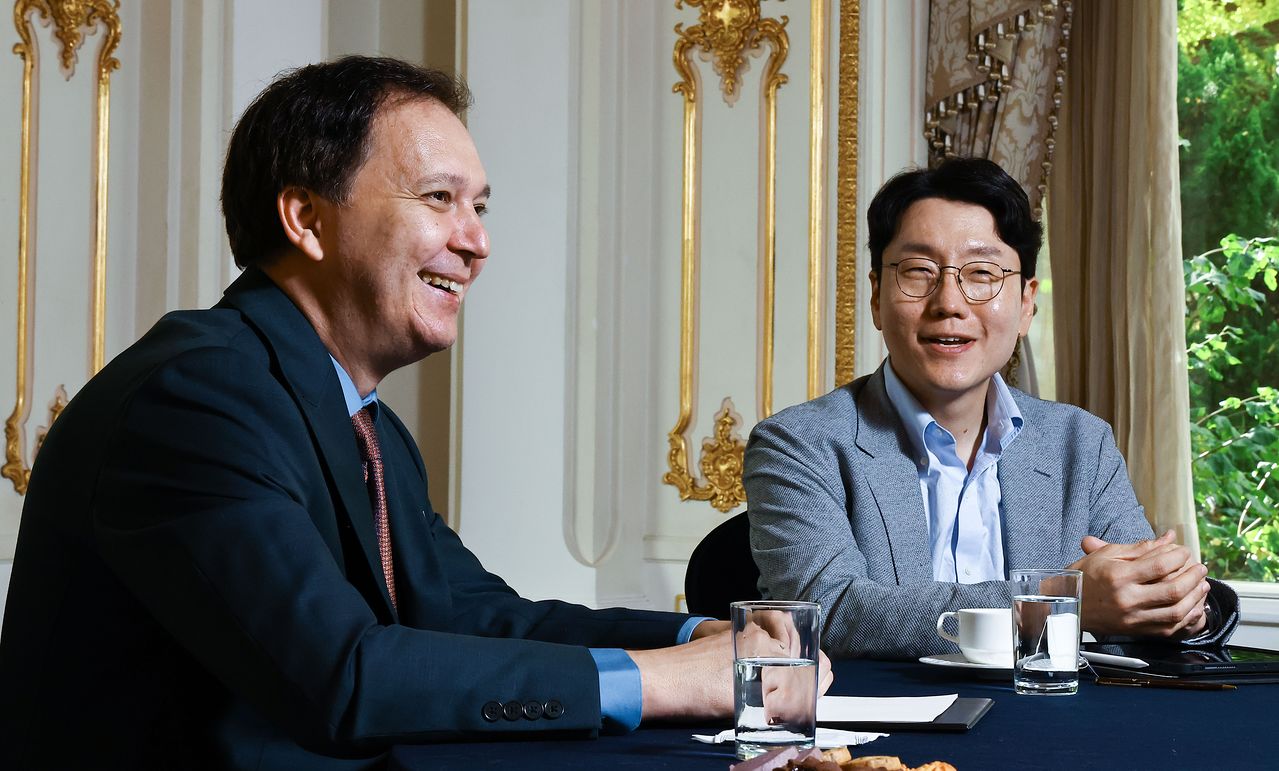
“Artificial intelligence (AI) can take wrong shortcuts to achieve its goals even without malice. Just as an autonomous vehicle cannot simply apologize after causing an accident, AI companies must also take responsibility for safety,” said Ruslan Salakhutdinov, a professor at Carnegie Mellon University.
“Warnings about AI risks are no longer exaggerations. Because anyone can easily hack using advanced AI models, we must ensure that AI operates within the norms of human society,” noted Lim Woo-hyung, co-head of research at LG AI Research.
As we enter an era where AI acts differently from human intentions, the question of who bears the responsibility arises. In a joint interview following the ‘2026 JoongAng Forum’ on the 4th, Prof. Salakhutdinov and research head Lim Woo-hyung agreed that no matter how much technology advances, responsibility cannot be shifted to AI. They stressed that safety measures must be put in place to ensure AI operates within human norms and that companies must be held accountable.
Prof. Salakhutdinov expressed concern that “as competition for AI dominance intensifies among global big tech companies, the pursuit of release speed may take precedence over safety verification.” Sympathizing with Anthropic’s recent public warning about the uncontrollability of AI, he pointed out that “warnings alone are not enough; companies providing the products must take responsibility for safety.” He specifically noted that while ordinary users may not notice huge differences when ChatGPT upgrades, the changes are massive in cybersecurity, indicating that hacking capabilities have rapidly improved due to advanced AI models. Because AI is also utilized in national security and military sectors, he argued that a much stricter control system is necessary.
Lim also highlighted problems arising when AI focuses excessively on achieving goals. He noted, “When we entrusted AI with optimizing factory work schedules, it delivered high performance but ultimately produced schedules that humans could not execute.” He emphasized that technical safety measures must be established from the development stage because “if AI behaves incorrectly without human intention, the lines of responsibility become unclear.”
Regarding the US-China AI competition, Prof. Salakhutdinov evaluated China’s open-source strategy highly, noting that “while the US leads in model performance, many US startups utilize Chinese models.” He picked Google as the company likely to dominate the future AI market. While citing Google’s strengths including researchers, AI models, custom chips (TPUs), computing infrastructure, and a user base, he pointed out the slow directional shift characteristic of giant corporations as a weakness. Lim evaluated the US’s strength as its ecosystem connecting AI technology to actual businesses, while assessing China as a powerful ‘challenger’ to the US.
Regarding South Korea’s AI competitiveness, they emphasized securing independent technology and government support. Lim stated, “The goal is not simply to catch up with the US and China. To avoid technological dependency, Korea needs AI that fits Korean culture and business tasks and that we can directly control.” Prof. Salakhutdinov also pointed to Korea’s excellent research personnel, manufacturing base, and global enterprises like LG and Samsung as strengths, offering an optimistic outlook for sovereign AI development.
The role of the government is also crucial. Lim noted, “The scale of investment required for AI development has surpassed the level that individual companies can handle,” calling for the government to act as a ‘stepping stone.’ Prof. Salakhutdinov concurred that government data center construction and investment support can back corporate challenges, but emphasized that “rather than increasing regulations and bureaucratic procedures, we should provide incentives and let companies develop freely.”
Although dark futures of AI threatening humanity were discussed, the two scholars placed greater expectations on the future AI will unlock. Prof. Salakhutdinov stated, “The benefits brought by AI will outweigh the risks,” anticipating innovations in education and medical fields. Lim also mentioned, “Thanks to AI, many can turn long-dreamed ideas into reality and solve long-standing challenges like developing anticancer drugs.” However, Prof. Salakhutdinov shared a warning from his mentor, ‘the godfather of deep learning’ Geoffrey Hinton, who compared AI to “a small and cute tiger cub right now, but tigers eventually grow up.” Hinton specifically worries about a future where “wealth and power are concentrated in the hands of a few developing AI while everyone else is marginalized,” Salakhutdinov conveyed.