
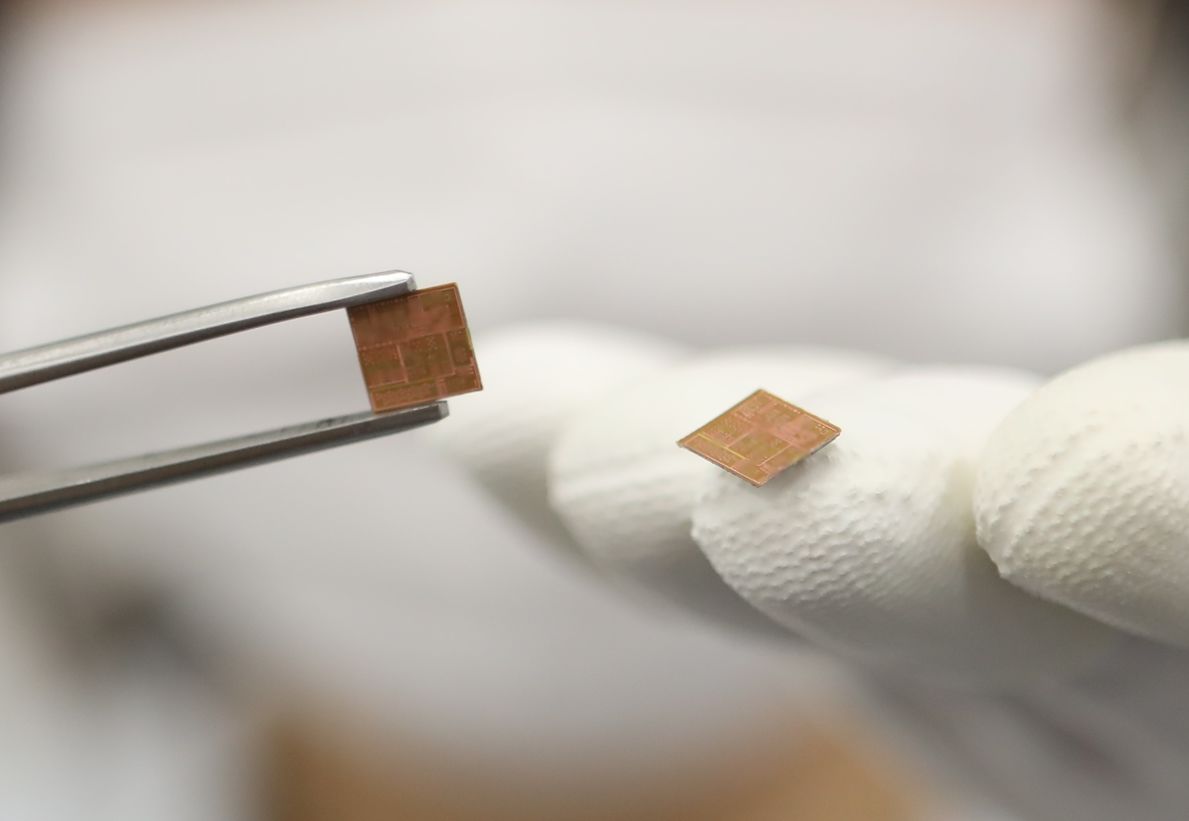
The AI semiconductor substrate market has emerged as a new supply chain bottleneck, prompting global chipmakers to engage in fierce competition to secure advanced packaging components with multi-billion-dollar contracts, such as Intel’s recent deal valued at up to 8 trillion won.
According to industry sources on the 4th, Intel disclosed in its third-quarter report filed with the U.S. Securities and Exchange Commission (SEC) that it is struggling to meet sufficient demand for data center central processing units (CPUs) due to a shortage of packaging substrates. Intel expects the supply crunch for core components like substrates and memory to persist through next year.
Following the close of the third quarter, Intel finalized two contracts to secure substrate supplies, with expected financial outlays ranging between $5.3 billion and $6.1 billion (approximately 7.1 trillion to 8.2 trillion won). Of this amount, about $3.3 billion is scheduled to be disbursed by the end of 2027, illustrating how semiconductor manufacturers are pouring massive capital into securing components they will use years down the line.
The underlying cause of the substrate supply shortage lies in the enhanced performance of AI semiconductors. As the performance of CPUs and graphics processing units (GPU) deployed in AI servers increases, the substrates connecting them must also become larger and more complex. Because multiple layers of circuits must be precisely stacked, production difficulty is high and expanding factory capacity requires a significant amount of time.
A prime example is the flip-chip ball grid array (FC-BGA). This high-value-added substrate transmits electrical signals between semiconductor chips and mainboards, and is widely utilized in AI servers and data centers. As the supply crunch intensifies, some customer companies are even stepping up to subsidize substrate makers’ facility investment costs and guarantee long-term purchase volumes.
Domestic companies are also moving to expand production capacity to cope with surging demand. In September, Samsung Electro-Mechanics announced a total investment of 6.78 trillion won in its Sejong campus and Vietnam subsidiary to scale up FC-BGA production facilities, allocating 4.27 trillion won to Sejong and 2.51 trillion won to Vietnam. The new Sejong facility is slated to begin mass production in September 2028, while the Vietnam plant is planned to go operational in June 2030.
This round of investments is being propelled by financial backing and mid-to-long-term purchase commitments from global clients. For Samsung Electro-Mechanics, this structure alleviates massive investment burdens while pre-securing future sales volumes.
Additional orders from customers have continued to flood in even after the announcement of the expansion plans. During its recent third-quarter earnings conference call, Samsung Electro-Mechanics stated that the currently planned expansions alone would be insufficient to meet all customer demand, and that it is reviewing the timing and scale of additional investments.
Financial performance is also on an upward trajectory. Samsung Electro-Mechanics’ package solution business revenue for the third quarter hit 9390 billion won, marking a 58% increase compared to the same period last year, driven by rising sales of high-value FC-BGA utilized in server CPUs, AI accelerators, and network equipment.
LG Innotek is similarly targeting the AI substrate market. Last September, the company unveiled an AI accelerator-focused FC-BGA with a side length exceeding 100mm and is currently discussing supply plans with customers. It aims to begin mass-producing products for AI training and inference by 2027 and expand its business territory into server-grade high-value substrates by 2028, while negotiating long-term supply agreements (LTAs) and additional investment schemes with two major clients.
Industry watchers believe that competition in the AI semiconductor market has escalated beyond chip manufacturing to securing stable supplies of core components. Kwon Min-gyu, a researcher at Kiwoom Securities, analyzed that as AI semiconductor demand rapidly grows, substrate supply is failing to keep pace, adding that ongoing supply shortages will positively impact the earnings of substrate manufacturers for the time being.