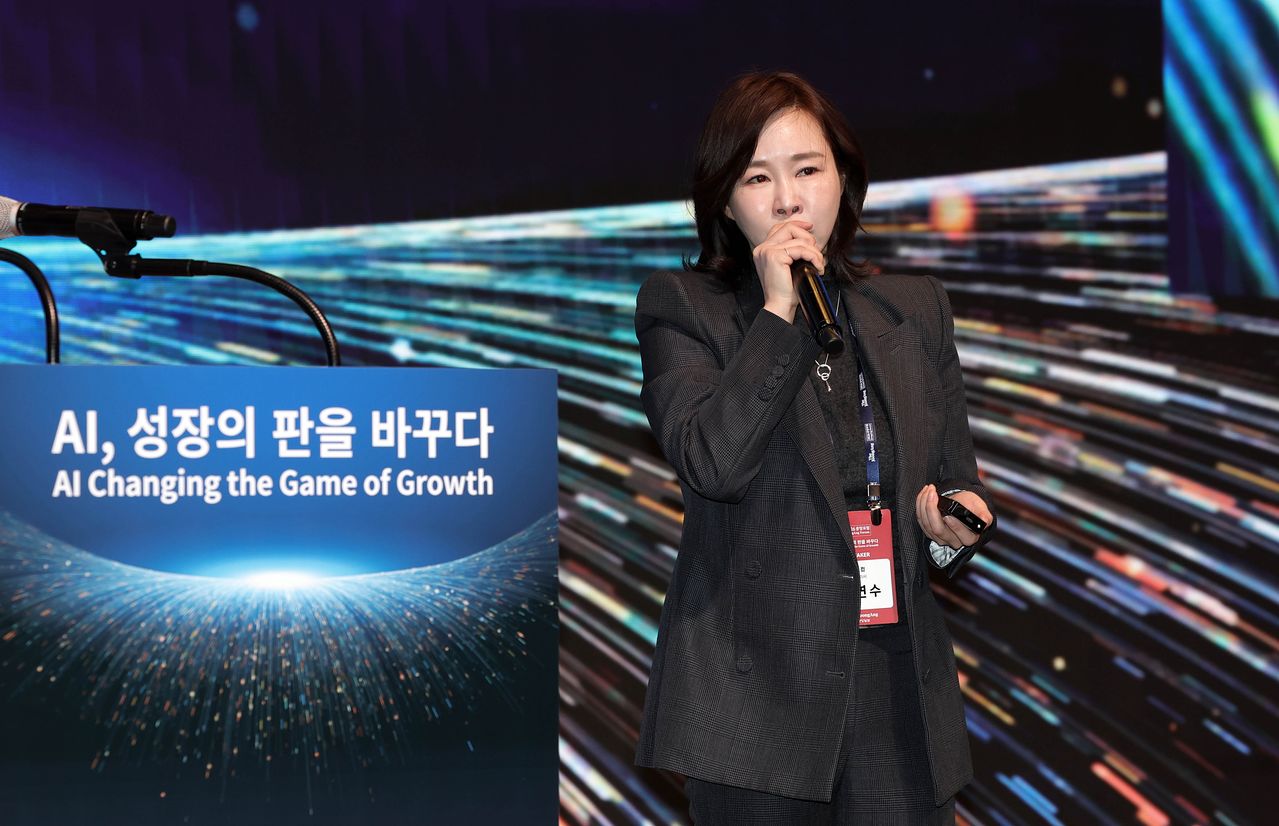
Diagnoses indicate that corporate growth strategies must evolve in the era of artificial intelligence (AI). Kim Yeon-soo, CEO of Hancom, spoke at the ‘2026 JoongAng Forum – AI, Changing the Rules of Growth’ held at the Grand Lotte Hotel in Sogong-dong, Seoul, on the 4th, stating, ‘Previously, the number of employees defined the size of a company, but now the scale of AI adoption determines it.’
CEO Kim noted, ‘AI has increased, but corporate growth has not followed.’ According to global consulting firms like McKinsey, 88% of companies used AI for at least one task last year. Conversely, only 20% of companies saw AI utilization translate into actual revenue this year.
‘It is not a problem with AI performance. It is because the way AI works and the way humans work are different,’ Kim pointed out. While corporations operate on a team basis, current AI remains limited to the role of a personal assistant that speeds up an individual’s tasks, she explained. Global big tech companies also appear to approach AI as a ‘team’ rather than a tool, but current enterprise AI agents are focused on specific tasks or domains, Kim pointed out.
She also shared that Hancom recently began grappling with similar concerns. ‘We did not hire any new recruits this year,’ Kim said, adding, ‘An era has arrived where we can no longer evaluate and compensate based on past role divisions (R&R).’ She explained, ‘Company growth no longer depends on ‘the number of people multiplied by per capita labor,’ but rather on the impact a single individual delivers,’ noting that the importance, completeness, and continuity of tasks all play a role.
Meanwhile, Hancom is set to introduce ‘Nomadian,’ an AI workforce platform focused on organizational management, to the North American market this coming December. Built upon the Hancom Agentic Operating System (OS), Nomadian features an AI team leader that distributes and coordinates the tasks of various agents.