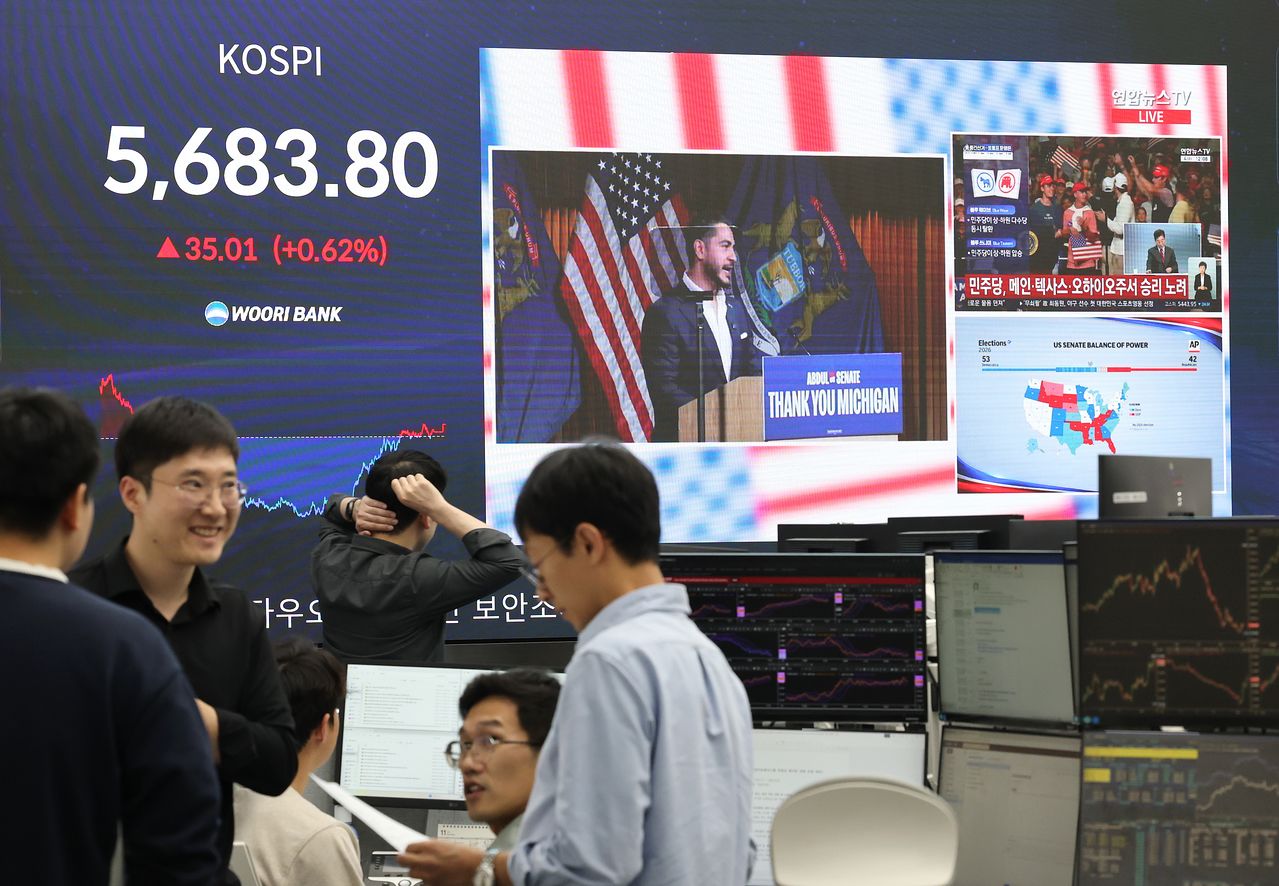
The U.S. midterm elections resulted in a sweeping victory for the opposition Democratic Party, sending a AI data center regulations shockwave known as a ‘blue wave’ through global stock markets. Growing concerns over tightened regulations on artificial intelligence (AI) data centers caused sharp volatility across Asian major indices, including the KOSPI and Japan’s Nikkei. Market attention is now focused on whether these U.S. regulatory moves will actually translate into reduced AI investments.
According to the Korea Exchange, the KOSPI closed up 0.62% at 5,683.80. Although it climbed as high as the 5,828 range in early trading, it reversed into a downward trend as early returns from the U.S. midterms signaled the Democrats securing both the Senate and the House. During the session, it plummeted over 4% to dip into the 5,421 range before recouping losses in the afternoon. The Kosdaq index also finished 1.50% higher at 714.95.
Despite massive selling by foreign investors, individuals and institutional investors propped up the market. On the main bourse, foreign investors net sold 2.502 trillion won, whereas retail and institutional investors net purchased 1.1442 trillion won and 1.0136 trillion won, respectively. Samsung Electronics and SK Hynix also plunged over 4% and 6% intraday before narrowing their losses to close down 0.68% and 0.14%.
Asian markets fluctuated in tandem. Japan’s Nikkei 225 index tumbled nearly 5% during the session before rebounding in the afternoon to finish down 1.42%. Japanese semiconductor-related stocks Kioxia Holdings and Taiyo Yuden each plunged 10% to 15% at one point. Taiwan’s weighted index also closed 0.83% lower compared to the previous session.
The Wall Street Journal analyzed that because East Asia supplies a significant portion of the hardware going into U.S. data centers, the possibility of stricter Democratic AI regulations hit South Korean, Japanese, and Taiwanese stock markets hard. Prashant Newnaha, a senior strategist at TD Securities, told Reuters that the Democratic landslide has reinforced regulatory oversight on AI companies while also increasing the potential for political gridlock.
In particular, the election results in key U.S. states where data center investments are concentrated have emerged as a major variable. According to Reuters, Democratic candidates who actively support data center regulations were projected to win gubernatorial races in Texas, Georgia, and Ohio. Key issues in these regions include stricter construction permits and shifting the costs of power grid expansions onto development corporations. Beacon Policy Advisors analyzed that the outcome of these 10 gubernatorial races could impact a total of $2.5 trillion in planned data center investments.
If regulations become a reality, future demand for South Korea’s semiconductor industry could also take a hit. Tom Orlik, Chief Economist at Bloomberg Economics, stated during a Korea Financial Investment Association webinar that while existing orders already in progress will not be affected, future profitability could be impacted. However, he maintained the baseline outlook that the broader trend of expanding AI investment will persist. Seosang-young, managing director at Mirae Asset Securities, similarly predicted that regulations are more likely to influence the costs and timelines of new projects rather than stifle total AI investment.
Meanwhile, global investors are also scouting for opportunities to re-enter technology stocks. George Efstathopoulos, a portfolio manager at Fidelity International, told Reuters that the midterms could serve as a catalyst for investors to refocus on sectors where the gap between corporate fundamentals and stock prices has widened, adding that it is a good time to gradually shift investment direction back toward tech stocks.
Domestic securities firms are also emphasizing the resolution of uncertainty, focusing on the possibility that the election shock will be short-lived. Kim Dae-jun, a senior researcher at Korea Investment Research, noted that the unique political uncertainties and extreme volatility characteristic of election seasons will subside, and the market will likely digest the election fallout within one to two days. Seosang-young evaluated that President Donald Trump’s acceptance of the election results and expression of willingness to cooperate with Democrats has helped alleviate uncertainties stemming from potential election challenges. Lee Kyung-min, head of FICC Research at Daishin Securities, stated that if regulations focus on cost-sharing rather than outright bans on data center construction, the drop in semiconductor stocks is excessive and the KOSPI will secure support around the 5,200 level.