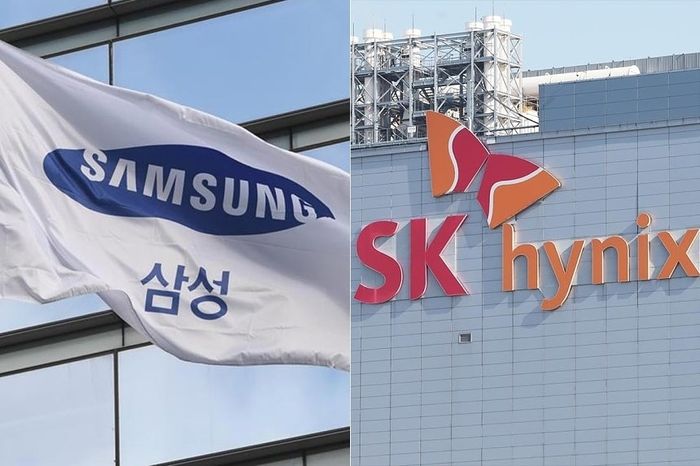
Record-breaking earnings were not enough to protect stock prices as the Alphabet market cap evaporated by 669 trillion won overnight, dragging down South Korea’s memory giants Samsung Electronics and SK Hynix. Investor sentiment toward big tech companies pouring massive amounts of money into artificial intelligence is shifting from “how fast are they growing” to “are they earning as much as they spend.”
Shaking Chip Giants Despite Record Profits
Samsung Electronics closed down 3.02% at 225,000 won, while SK Hynix dropped 7.08% to 1,418,000 won. As semiconductor leaders stumbled, the KOSPI index also fell 3.48% to close at 5,730.74. Looking solely at earnings, this decline is hard to rationalize. The two companies generated about 190 trillion won in operating profit from their semiconductor businesses alone in the third quarter. Orders are also backlogged, with Samsung securing long-term supply agreements and selling out its high-bandwidth memory supplies for next year, while SK Hynix projects its DRAM and HBM orders are effectively sold out through 2029.
The AI special demand also spread to components and equipment. Samsung Electro-Mechanics posted a third-quarter operating profit of 691 billion won, up 165% year-on-year to reach a record high. LG Electronics also announced that its order receipts for cooling systems used in AI data centers exceeded 3 trillion won this year.
The Epicenter: 669 Trillion Won Wiped Out Overnight
The downturn originated from AI investment concerns hitting US tech stocks. Alphabet shares plunged 12.6% on the Nasdaq, erasing about $500 billion (approx. 669 trillion won) in market capitalization in a single day, marking the second-largest single-day market cap drop in Wall Street history.
Profitability weighed heavily on Alphabet. While third-quarter cloud revenue surged 103%, capital expenditures doubled year-on-year to $51.4 billion, driving free cash flow into a negative $9.1 billion for the second consecutive quarter of deficits. Analysts point out that until Google proves it can monetize AI, its capital expenditure outlook will look less like an ambitious plan and more like a cost invoice.
Other big tech companies face similar conditions. Meta recorded a negative $2.12 billion in free cash flow, and Amazon saw its negative free cash flow balloon to $42.4 billion over the past year. To cover the shortfall in funding AI infrastructure, these firms are increasingly relying on debt. According to the Bank of Korea, five major cloud providers including Microsoft, Alphabet, Amazon, Meta, and Oracle issued about $230 billion in corporate bonds between January and September this year, more than double the total for the entirety of last year.
Samsung and SK Hynix are struggling despite record earnings for the same reason: if big tech’s investment capacity wavers, the memory boom cannot be guaranteed. Experts warn that big tech’s AI infrastructure investment growth rate may peak soon, and issues surrounding worsening free cash flow and capital raising will persist.
Will AI Investments Pay Off?
Ultimately, the key question is whether these massive investments will translate into actual profits. Moving forward, market watchers emphasize that investors must look beyond upwardly revised capital expenditure forecasts to evaluate whether monetization truly justifies the spending, whether free cash flow capacity exists, and whether credit spreads are worsening.