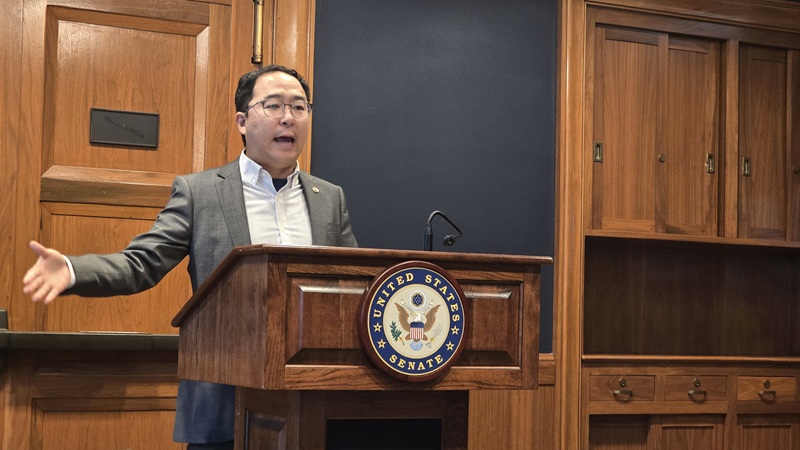
U.S. Senator Andy Kim said on May 28 that he opposes any USFK troop reduction that occurs without consultation with both Congress and the South Korean government. Speaking at a press briefing on Capitol Hill, Kim emphasized the strategic value of U.S. Forces Korea for both nations.
Kim, the first Korean American elected to the U.S. Senate, made the remarks during a roundtable with Korean media in Washington, D.C., held in recognition of Asian American, Native Hawaiian, and Pacific Islander (AANHPI) Heritage Month. His comments come amid reports suggesting a possible reduction or redeployment of 4,500 U.S. troops stationed in South Korea.
USFK Benefits Both Korea and the U.S.
“U.S. troops in South Korea serve not just Korean interests but American interests as well,” Kim said, adding that their presence is a key deterrent against North Korea’s threats. “The Trump administration must seriously consider how to maintain and strengthen our security partnership with South Korea’s next leader.”
Current National Defense Authorization Act (NDAA) guidelines call for maintaining the USFK presence at approximately 28,500 personnel. Kim noted that he has consistently opposed unilateral reductions in the past and played a lead role during the Trump administration’s first term to block efforts to draw down forces in Korea without congressional approval.
“There is bipartisan support in Congress for maintaining the U.S. troop presence and strengthening the U.S.-Korea alliance,” Kim said. “I am actively discussing these issues with my colleagues.”
Criticizes Trump’s ‘Transactional’ Approach
Kim also criticized President Donald Trump for linking national security to trade and industrial policy, calling it a “punitive approach” toward allies such as South Korea.
“We don’t need to put a gun to our partners’ heads to manage these issues,” he said. “This kind of approach is deeply damaging to the U.S.-Korea relationship.”
Kim pushed back on Trump’s proposals to reduce the number of international students and scrutinize visa applicants, including social media checks. He highlighted the economic and educational contributions of foreign students, citing personal examples from his own family.
“My father and wife both came to the U.S. on student visas,” he said. “International students help fuel America’s innovation and fund public universities. Reducing their numbers would ultimately harm U.S. students as well.”
Committed to Strengthening U.S.-Korea Alliance
Looking ahead to South Korea’s next administration following the June 3 presidential election, Kim pledged to serve as a bridge between Washington and Seoul.
“I hope the next Korean president will clearly articulate to President Trump the value of our strategic alliance,” Kim said. “For someone as transactional as Trump, it’s important to show how this partnership benefits the U.S. too.”
He added, “No matter who is elected, I’m ready to work with them to further strengthen the U.S.-Korea relationship.”
BY KANG TAE-HWA [thkang@joongang.co.kr]