SANGJIN KIM AND YEOL JANG
Reporting from the frontlines of the Buenos Aires protests
BUENOS AIRES — “Make Argentina Great Again.” Echoing U.S. President Donald Trump, President Javier Milei, 54, is pushing ahead with sweeping reforms aimed at reversing decades of economic decline. The slogan now defines a radical agenda drawing international focus—especially as mass protests erupt in Buenos Aires over Argentina pension reform.
At first glance, the unrest appears to center on retirement policy. But beneath the surface lies a deeper ideological clash. The reforms pit Milei’s libertarianism—a worldview opposing government intervention—against longstanding populist norms deeply embedded in Argentine society.
Milei believes the state itself is harmful. He rose to power as a counterforce to 40 years of populism, which many blame for Argentina’s collapse. Now, his bold reforms are stirring resistance. His approach resonates even in the United States, where the political right is watching closely.
Congress square, 1 p.m.: tension builds
Ahead of a major protest against reform, police block streets
On March 19, around 1 p.m. local time, the air outside Argentina’s National Congress grew tense. Security forces, including the Federal Police (PFA), installed metal barricades and restricted access. The sound of barricades clanging echoed through the streets.
Vehicles were blocked from key routes like Rivadavia Avenue and Callao Avenue, and pedestrian access was tightly controlled.
One week earlier, on March 12, violent demonstrations erupted at the same location. Over 100 people were arrested and 15 were hospitalized with serious injuries.
Protesters arrive by 4 p.m.
Drums, chants, and a harsh nickname for Milei
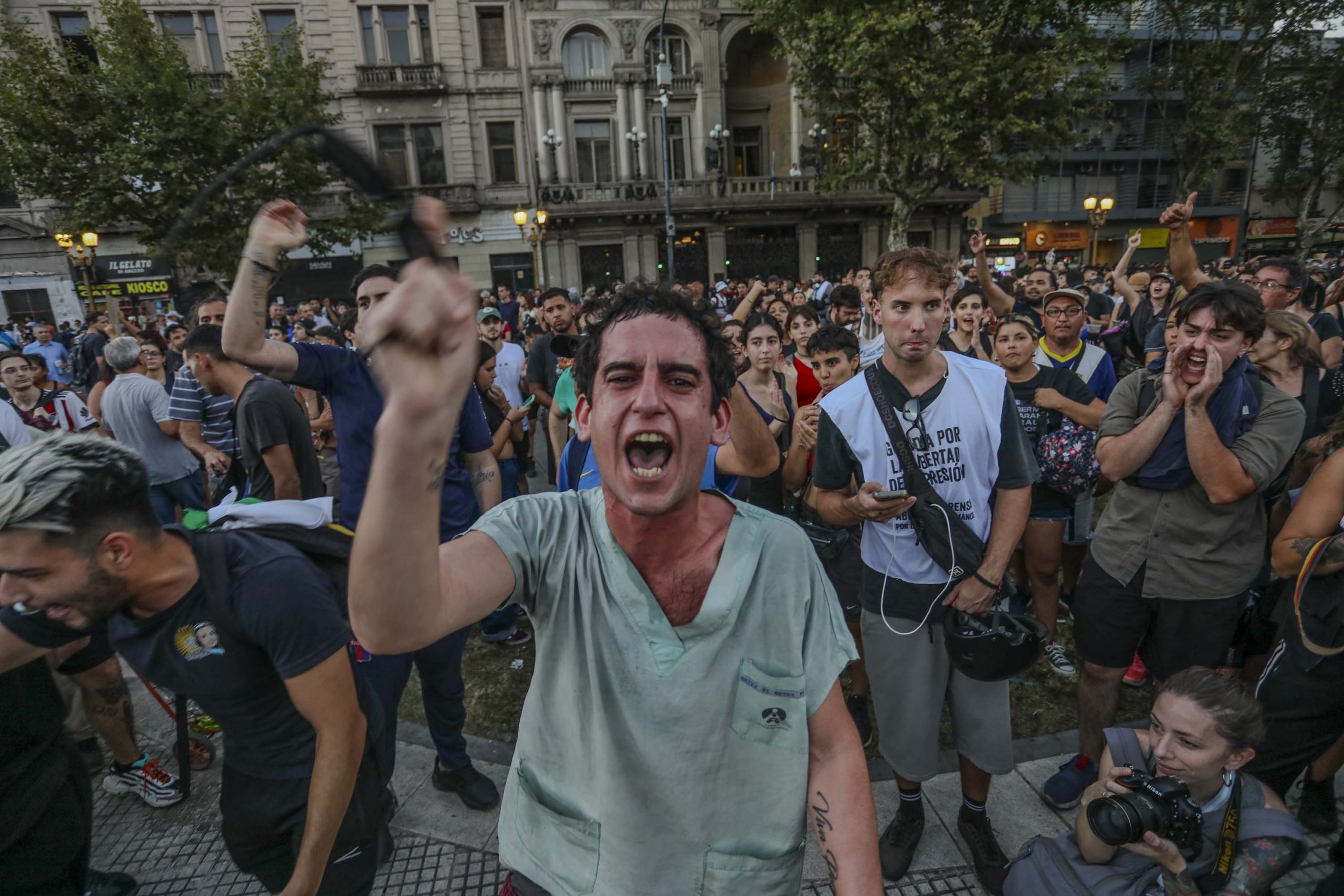
As 4 p.m. approached, large crowds gathered in front of Congress. Protesters beat drums and shouted slogans. Many yelled “Libertonto!”—a word blending “libertarian” and “fool,” mocking the president.
Florencia Mogado, a protester, said, “Many seniors can’t even make ends meet. Milei is out of his mind to try and cut pensions. This is a citizen revolution.”
Milei’s political philosophy, libertarianism, goes beyond neoliberalism. It leans toward anarcho-capitalism, rejecting state involvement in nearly all aspects of life. He identifies openly as an “anarcho-capitalist.”
Milei’s reforms: rapid and large-scale
Government size reduced, pensions frozen, deficit reversed
Since taking office, Milei has slashed 18 ministries down to 7. He halted most public spending and laid off 34,000 civil servants as of January. His pension freeze—now the center of protest—was a clear signal of intent: stop Argentina’s chronic deficit.
These reforms are already yielding results. The government budget, long a symbol of inefficiency, turned to surplus within a year.
Still, the reforms have triggered large-scale demonstrations because they represent values that many find difficult to accept—or let go of.
Opposition gathers under leftist banners
Socialist groups and football hooligans join the protest
As protest crowds grew, groups like the Socialist Workers Movement (MST), Politica Obrera, and the Socialist Left (Izquierda Socialista) arrived waving large flags. These groups directly oppose Milei’s ideology.
Hwang Jin-I, the first Korean Argentine to work as a national news anchor, said, “In the past, even those who didn’t qualify were receiving pensions. With Milei’s reforms, even football hooligans have joined the protests.”
Volunteers in vests marked “rescate” (rescue) roamed the area, formed as a response to injuries from the March 12 protest.
Carano Moreno, 71, held a sign reading, “Two tear gas canisters cost more than one pension.” He said, “Instead of listening to us, they fire tear gas and rubber bullets at powerless people.”
Violence revisited: elderly protester returns after collapse
Public outrage grows after police confrontation goes viral
Among the protesters was Beatriz Bianco, 87, who had collapsed after being hit by police during the earlier demonstration. Footage of her fall circulated widely, increasing tensions before the latest protest.
Meanwhile, Argentina’s economy shows signs of recovery. Inflation is declining. The Argentine peso, once near-worthless, is strengthening. In January, The Economist’s Big Mac Index ranked Argentina as the most expensive, with burger prices in Buenos Aires exceeding those in LA and New York by over 20%.
The reforms are proof that economic recovery is possible—if pursued decisively. This may be the greatest achievement of the Milei administration so far.
Public resistance remains strong
Protesters say reforms threaten livelihoods
Despite the progress, large parts of the population remain attached to past welfare models. Their continued resistance is visible in the streets.
Mariano Julico, a protester, shouted, “The police aren’t real Argentines. Their families will suffer too, but they only care about protecting those in power.”
When masked protesters began kicking barricades and provoking police, other citizens intervened. A group of around 100 encircled them, calling for restraint: “Don’t provoke the police!”
As tensions rose, police deployed water cannons and blocked all surrounding streets. Officers in riot gear lined up in front of barricades, with motorcycles revving to signal a clear warning.
Bottles flew toward the police, who responded with tear gas. Unlike the March 12 protest, officers avoided direct fire. Tear gas was launched low to the ground to disperse crowds.
Aftermath and outlook
Another protest planned; questions remain about Argentina’s future
At 9:30 p.m., police blocked every alley near Congress. As tear gas filled the air, most demonstrators retreated.
Santi García Díaz, photojournalist for Clarín, Argentina’s largest newspaper, said, “There will be another protest here next Wednesday. This is Argentina’s reality now.”
Whether this is the cry of collapsing populism being swept away by libertarian reform—or the slow return of populism itself—remains unclear.
This article is part of The Korea Daily’s on-the-ground coverage from Buenos Aires. Stay tuned for further updates.
- Javier Milei’s Reform Sparks Protests in Argentina
- Buenos Aires Tensions Escalate as Protests Loom
- Buenos Aires Protest Escalates as Thousands Gather
- Argentina Protest Standoff: Thousands Face Off with Police
- Buenos Aires Protest Clashes Escalate Near Congress
- Buenos Aires Riot Police Seal Off Streets Near Congress
BY SANGJIN KIM [sk1015@koreadaily.com]
AND YEOL JANG [jang.yeol@koreadaily.com]