
He was only nineteen.
Decades after joining the fierce battlefields of the Korean War, Roy Hibbert (91) reflected on the memories that shaped his youth and his view of a nation transformed.
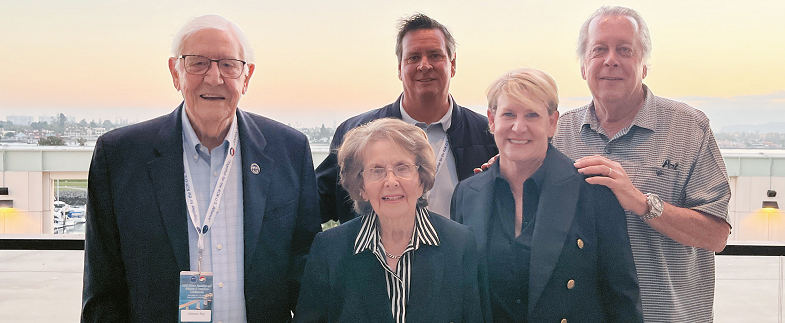
From September 1952 to September 1953, Hibbert served in the King’s Liverpool Regiment of the British Army, fighting Chinese forces at Hill 187, a 656-foot elevation in Pangbu-ri, Jangnam-myeon, Yeoncheon County, Gyeonggi Province. Speaking at the Korea Defense Veterans Association (KDVA) 4th annual conference in San Diego on October 25, he shared his experiences from the front and his thoughts on Korea’s astonishing rise since the war.
“When I received the deployment notice, I felt both excitement and fear,” Hibbert recalled. “Our regiment was in Berlin, working on postwar reconstruction. After the notice, we returned to the U.K., trained briefly, and sailed from Liverpool to Busan.”
He had followed the war closely before arriving. “President Harry Truman’s condemnation of North Korea’s invasion as an ‘unacceptable act’ and his call for United Nations (UN) intervention were major news then,” he said. “We knew British units like the Gloucestershire Regiment, Royal Northumberland Fusiliers, and Black Watch had already fought hard.”
Arriving at Busan Port in September 1952, Hibbert recalled being immediately sent north on an old train for nine to ten hours. “We got live ammunition on the train — that’s when it became real. After two or three more hours by U.S. Army truck, we reached Hill 187 and replaced the 3rd Battalion of the Royal Australian Regiment,” he said.
Life in the trenches was brutal. “It was all mud, full of rats. The Chinese outpost was only 0.75 miles away,” he said. “The day after we arrived, they used loudspeakers to say in English, ‘Welcome, King’s Regiment!’ They already knew our position.”
The soldiers called their dugouts “hooches.” Korean porters helped build them by digging and stacking sandbags. “We slept in sleeping bags on the floor and lit diesel lamps,” Hibbert said. “The U.S. rations were surprisingly good — they even included cigarettes and toilet paper. But when the British cooks came after four weeks, the food was terrible,” he added with a laugh.
While Hill 187 was relatively quiet, neighboring The Hook ridge saw fierce fighting. “It was a dangerous, hook-shaped position,” Hibbert said. “C Company was there. The Chinese briefly took it, but with U.S. Marine support, we retook it.”
Hibbert did not directly fight alongside Korean troops but remembered six Korean porters attached to his unit. “They were hardworking,” he said. “Once, when I shouted for ammunition, one panicked and ran away.”
Of his 100-man A Company, about 25% were killed or wounded. “Three of my close comrades died, and our company commander went missing,” Hibbert said. “When I visited Korea in 2017, I saw his name on the missing list at the UN Memorial Cemetery in Busan.”
That 2017 visit, sponsored by the Korean government as part of the Commonwealth veterans’ delegation from the U.K., Australia, and Canada, moved him deeply. “Seoul was in ruins in 1953,” Hibbert said. “Seeing it in 2017 as a global city was overwhelming. Its economy, culture, and music were world-class. Yunchan Lim, the pianist, is my favorite musician. Korea’s resilience is extraordinary.”
To Korea’s younger generation, Hibbert offered this message: “Never lose pride in your country. I saw the ruins of war — and how far you’ve come. Remember that, and keep striving.”
☞ About Roy Hibbert:
Born in 1933 in Manchester, Hibbert was drafted at 18. After serving in Germany and Korea, he moved to the United States in 1960, joining Jack Daniel’s and rising to import director. He now lives in Orange County with his wife, Barbara.
BY KYEONGJUN KIM [kim.kyeongjun1@koreadaily.com]